7th of Av - "Through Luz One Enters Beit El and Through Leah One Merits Rachel"
by the Esteemed Rabbi Eliezer Berland shlit"a
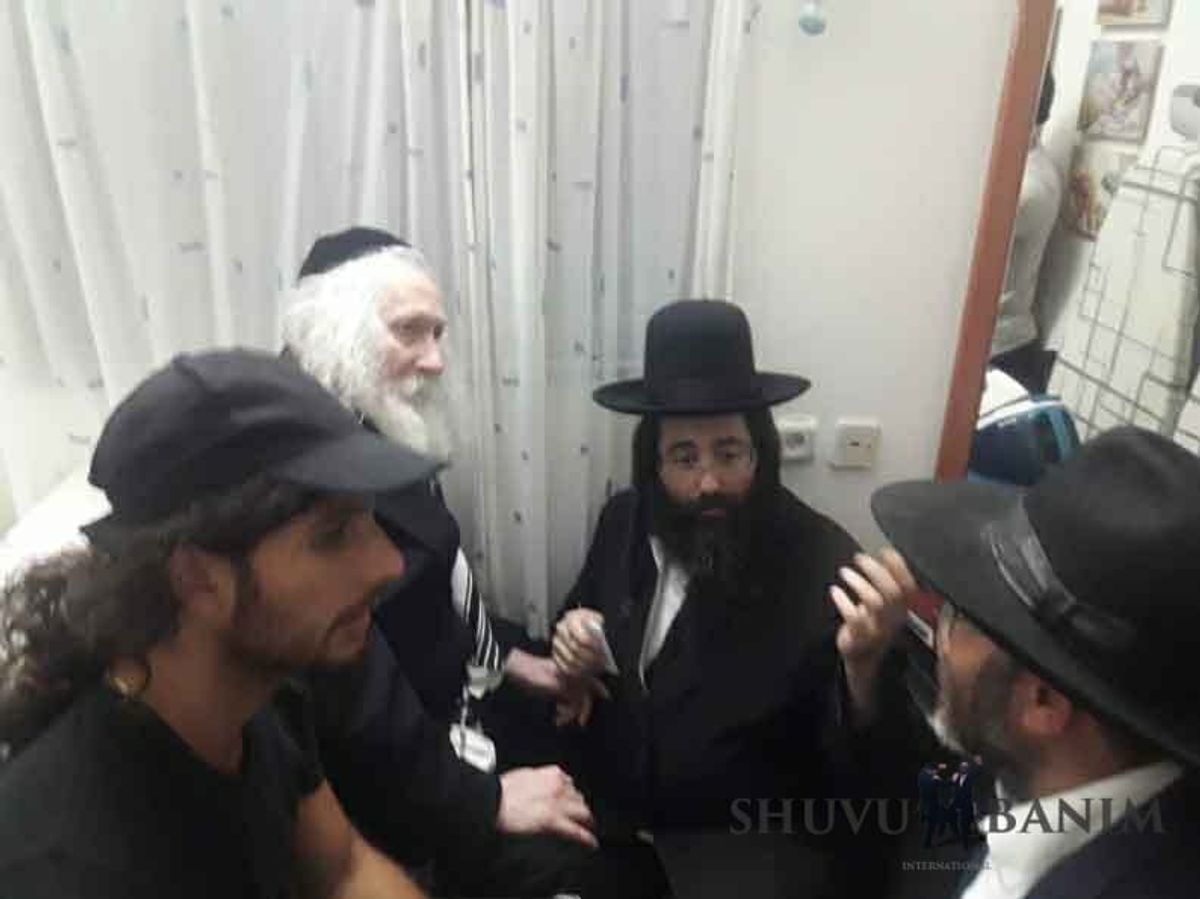
A lesson by the Gaon and Tzaddik, Rav Eliezer Berland shlit"a, at the Salma family home in Bnei Brak - Parshat Devarim, 7th of the month of Av, 5778.
Today is the day of the Ten Commandments; today is the 7th of Av. Today the Holy Temple of fire descends; today the nations entered the Holy Temple. Therefore, Rebbe Nachman says here in Torah 85 that on Tisha B'Av it is possible to resurrect all the dead. There are three weeks that are the essence of Luz, just as in Luz one does not die – the Angel of Death has no permission to enter. Also on Tisha B'Av, the Angel of Death has no permission to enter. Tisha B'Av is the day when it is possible to resurrect all the dead in the world; it is the time of the resurrection of the dead.
For on Tisha B'Av, Hashem renews the body. Everyone does teshuvah (repentance) and sits on the ground, and after this, they go out in dances on Tu B'Av, and on Yom Kippur they also go out in dances. They put a red garment on the window and it becomes white. A woman who has a red dress puts it on the window and it becomes a white dress. Whoever does not have a wedding dress puts one on the window.
"Lie down until the morning" (Ruth 3:13). What is "Lie down until the morning"? It is the time of resurrection. So now it is 'lie down until arise'. "Arise, cry out in the night at the beginning of the watches" (Lamentations 2:19). 'Lie down' is the festival of Shavuot; they call it 'lie down', which is – Boaz said to her – to Ruth, "Lie down until the morning." And 'arise' – that is "Arise, cry out in the night", that is from the 15th. In Ukraine, there is no Chatzot (midnight). In Ukraine, the sky is bright; the sunset is only at nine. Now, throughout Tammuz-Av, the sunset is at nine. After that, in Av, it begins to descend from nine to eight-thirty. On the 1st of Elul, the sunset is at eight-thirty – on the 1st of Elul. Until the 1st of Elul, the sky is bright; even in the middle of the night, the sky is clear – blue, not black. So there is no Chatzot, there is no Chatzot, until the sky takes on a black hue, then Chatzot begins. That is "Arise, cry out in the night." So from 'lie down' until 'arise' there is no Chatzot, and 'arise' means the resurrection of the dead. So, "Spring up, O well, sing to it" (Numbers 21:17).
For once, every woman could resurrect the dead; once, every woman had the power to resurrect the dead. There were 600,000 prophetesses – six hundred thousand prophetesses, and they were all flying in the air. From Tzippori, she flew in the air and she became the planet Venus (Kochav Nogah). Venus is Tzipporah; they were flying in the air. Why did they call her Tzipporah? Because she was flying like a bird. Cain wanted to take her as a wife, so she ran to Shemhazai, who knew the Explicit Name and so on... So now, Tisha B'Av is the time of the resurrection of the dead – it is the time when it is possible to resurrect the dead, and everyone can resurrect the dead. By sitting on the ground, it is possible to resurrect the dead. This is the consolation – "Comfort, comfort" (Isaiah 40:1).
For Manoach merited to resurrect the dead; Hazlelponi merited to resurrect the dead, like Yiskah, whom everyone looks (sochim) to in her shadow. Why did they call her Yiskah? Because everyone looks to her shadow. Hazlelponi – everyone takes shelter in her shadow; that is Hazlelponi. So, "Lie down until the morning" is the time of resurrection, because the Rebbe reveals to us that through Luz one enters Beit El. To Beit El, it is impossible to enter; it is a city that one cannot enter. So how does one enter? So there was Luz, because about Luz it is said, "Lie down until the morning."
So once, every woman knew how to resurrect the dead. Every woman in the time of the First Temple could resurrect the dead, every woman without exception. Six hundred thousand women could resurrect the dead. Every woman, if she walks in modesty, receives a spirit of prophecy and can resurrect the dead. This is "Lie down until the morning," which is the time of resurrection, that every woman can resurrect the dead. In the time of the Holy Temple, every woman could resurrect the dead.
And also in our generation, every woman who walks in modesty can resurrect the dead. It is written, "And they gave life to the children" (Exodus 1:17) – that they revived them, that they drew down a spirit of life. "And they gave life to the children," from the opening of the womb (nukva depardashka); from one is a spirit of life, and one is the spirit of Mashiach. From every spirit went out a spirit of life; from one went out a spirit of life and the spirit of Mashiach.
For now is the spirit of Mashiach, because the cow made two moos, moo-moo-moo. The first moo, he said: Now the Holy Temple is destroyed. An Arab – he had the Holy Spirit. Once, every woman had the Holy Spirit. The cow makes moo-moo-moo; he said, it seems that it was in sadness, so he said: Now we will burn the Holy Temple, now it is going up in flames.
After five minutes, she does it again, moo-moo-moo, but with joy. He said: Now Mashiach is born. This is the moment that on Tisha B'Av, Mashiach is born. Anyone who is born on Tisha B'Av is the soul of Mashiach. Every woman needs to go on the night after Tisha B'Av to the mikvah, every woman without exception, to go to immerse on the night after Tisha B'Av, and through this, she will merit Mashiach ben David. So it turns out that on Tisha B'Av, Mashiach is born, and everyone learns from the cow. There is a Red Heifer, there is an Eglah Arufah (decapitated calf); from the cow, one learns all the secrets.
Now Tisha B'Av arrives, it is possible to resurrect the dead. On Tisha B'Av, there is no dead person who is not resurrected. Just as Elisha resurrected the son of the Shunammite; there was a Zarephathite and there was a Shunammite, and after that, there was the wife of Ovadiah. There were three women who each received a jar, because this jar never ended. Each one received a jar; the Zarephathite received, "The jar of flour shall not be spent, neither shall the cruse of oil fail" (1 Kings 17:14). If today we find the jar, then it is possible to pour oil without end, until the resurrection of the dead. "The jar of flour shall not be spent, neither shall the cruse of oil fail" – until the resurrection of the dead, it is possible to pour oil and it will not be lacking for the world. He gave her the oil – this jar from which oil comes out without end, until the resurrection of the dead it flows with oil, until the time of resurrection.
"And it came to pass in the morning, and behold, it was Leah" (Genesis 29:25). The whole matter is to be included in Leah. "And Leah's eyes were weak" (Genesis 29:17). For once, they would marry cousins; this was the custom in all the clans. So one had two sons born to him, and one had two daughters born to him, so immediately they made a shidduch (marriage match) at birth. At birth, they would already close the 'vort' – break a plate. And after that, they would wait until age 18-20, it doesn't matter when, but the shidduch is made at birth. They wouldn't wait until age 13, 14, to have meetings and 'not find favor' – she has a straight nose or a crooked nose or she has a plastic nose. They would finish all the shidduchim at birth.
Now, a girl at age three knew what her shidduch was. Leah was at age three, she knew that her shidduch was Esau. Esau was also a child at age three; they already finished the shidduch. At age 15, he was already shooting arrows – he was killing people, and Leah was just crying from age three, all day she was just crying from age three. What? This will be my shidduch?! But that is how they thought – a great one to a great one, a small one to a small one.
That is how it is written in Midrash Tanchuma – a great one to a great one, a small one to a small one. "Lie down until the morning," which is the time of resurrection, that after Tisha B'Av it is possible to resurrect all the dead. "And it came to pass in the morning, and behold, it was Leah." What is 'in the morning'? It is the time of resurrection, that when there will be the resurrection of the dead, it will be revealed that everything is in the merit of Leah. "And it came to pass in the morning, and behold, it was Leah."
So that is Luz, that the Angel of Death has no permission to enter in any way into the city of Luz, and he has no visa and he also will not receive a visa. So, the crown of the head (kodkod) – it is written that Joseph merited to be the crown of the head. The crown of the head is Leah. So one must know that the Angel of Death cannot enter Luz; he has no right to enter.
This shows that on Tisha B'Av is the moment that one merits the resurrection of the dead, that the Angel of Death has no control over the human being. Anyone who sits on the ground on Tisha B'Av – sits on the ground and cries – the Angel of Death has no control over him, just as in the city of Luz they have no control over anyone.
And therefore it is written, through the path of Luz one enters Beit El. "And the name of that city was Luz at the first" (Genesis 28:19). Meaning that Luz is a novelty of our Rebbe, that through the path of Luz one enters Beit El. Meaning: that through the path of Leah one merits Rachel. Luz is Leah, and Beit El is Rachel.
"And she sat under the palm tree of Deborah between Ramah and Beit El" (Judges 4:5). Beit El is Rachel, and Ramah is Leah. So Deborah was between Ramah and Beit El, for the sake of Rachel. "And to the crown of the head of the one set apart from his brothers" (Genesis 49:26). For Jacob, he was from the hairs of the Primordial Man (Adam Kadmon). Every Jew is from the hairs; Jacob was from the hairs of the crown of the head, literally. Jacob was from the hairs that are truly at the tip; there is the foundation of Jacob. And therefore he took two sisters, because his foundation was from the two hairs. But this was according to the secret; according to the plain meaning, it was forbidden to take them. So he had to rectify and was reincarnated in Job, who said, "I am innocent" (Job 9:20), "I am innocent" (ibid. 21), four times "I am innocent," that he had to atone for the fact that he took two sisters.
"And to the crown of the head of the one set apart from his brothers" (Genesis 49:26), and Benjamin merited the shoulders. So "Comfort, comfort" – Manoach (the letters of Nachamu) is from the hairs of the crown of the head, and Benjamin is from the shoulders – "And he dwells between his shoulders" (Deuteronomy 33:12), which is the aspect of Leah, for Leah is the Shechinah (Divine Presence). Leah is both in the crown of the head and in the shoulders; Leah is the entire upper half. Rachel received the lower half. That is why Leah is both opposite the crown of the head and opposite the shoulders; that is Leah, who is first. So how will he reach Rachel? Through Leah. They always say that from Rachel one ascends to Leah. Our Rebbe says here the opposite, that from Leah he will reach Rachel, that first he will have the aspect of Leah, which is humility and lowliness, and then he will reach Rachel, which is wisdom.
"A man's wisdom makes his face shine" (Ecclesiastes 8:1). If a person wants to reach the aspect of Leah, first he must reach the aspect of Leah, and then through Leah he reaches Rachel – through the path of Luz he enters Beit El. So all the holy explanations of our Rebbe are the entire Tree of Life, which is the opposite of what is always said, because in the three weeks, one reverses the order and merits that Leah will enter into Rachel, until Rachel. And the crown of the head is the matter of Leah.
The crown of the head is the essence of Luz, because here there is the essence of Luz, there is the tefillin. And one is obligated to eat Melaveh Malkah, because this bone enjoys only from Melaveh Malkah. In order for this bone to arise in the resurrection of the dead, one must eat at Melaveh Malkah. Whoever does not eat Melaveh Malkah will not arise in the resurrection of the dead; it is impossible, because to arise is only through the essence of Luz. And every person needs to eat a kezayit (olive-sized portion) – to eat pizzas at Melaveh Malkah. He needs to taste some kezayit – some crumbs – a kezayit of the pizzas that are thrown, so that through this he will be able to arise in the resurrection of the dead, and to drink a drop from the well of Miriam. So only through the aspect of Leah does one merit the resurrection of the dead.
Which is Luz, that through Luz one enters Beit El, the aspect of Leah who is first, because Beit El relates to Leah. So Joseph and Benjamin merited Leah, and they did not even merit Rachel, to the aspect of Leah who is first. And "to the crown of the head of the one set apart from his brothers" is the aspect of Luz, in gematria 'oref' (nape), in gematria 'Shin Nun'. 'Shin Nun' is Shimon Nachman, that now is Shabbat Nachamu, that the rectification is through Shimon Nachman. The rectification that everyone traveled to the Ari, and after they travel to the Ari [missing].
So that is 'Shin Nun', which is the initials of Shabbat Nachamu. Now next Shabbat is Shabbat Nachamu, it is the letters of Manoach, that Manoach [-]
Subscribe to Our Newsletter
Receive Torah articles and inspiration directly in your inbox