
"A Constant Fire Shall Burn Upon the Altar; It Shall Not Go Out" • True Purity
Through a Drop from the Tzaddik • Parshas Tzav - Parah from the Gaon and Tzaddik Rabbi Eliezer Berland shlit"a
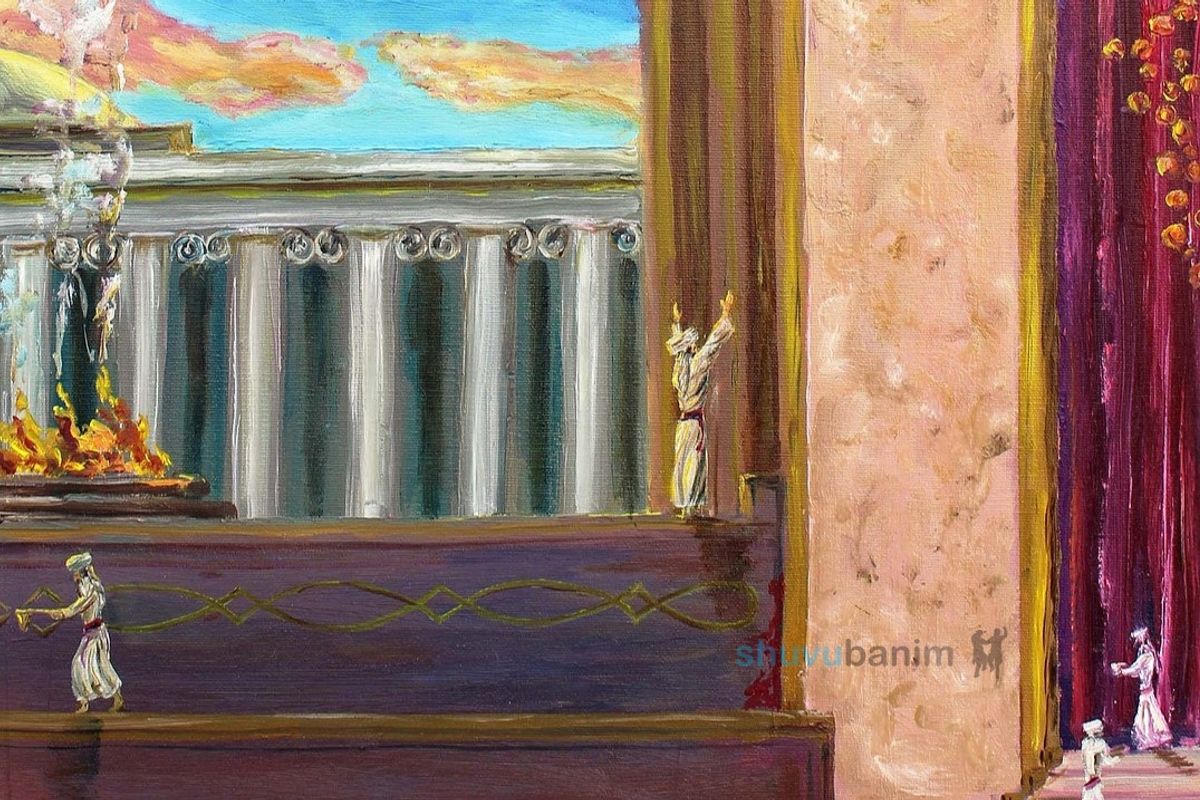
What is the secret of "a constant fire shall burn upon the altar; it shall not go out"? And why at the end of Parshas Tzav do we read about the matter of the tip of the right ear, and how is this matter connected to the signs that Rachel gave to Leah? Also, special for Parshas Parah: What do we merit through a drop of holy water? New insights and pearls for the weekly Torah portion of Tzav - Parah from the Gaon and Tzaddik Rabbi Eliezer Berland shlit"a (may he live long and good days).
Every Jew has a fire in their heart that is never extinguished, in the aspect of "a constant fire shall burn upon the altar; it shall not go out":
And this is what the Rebbe (Rebbe Nachman) tells us in Torah 9 (of Likutey Moharan). The Rebbe tells us that we must know that every Jew has a burning heart that can burn up the entire world; his heart can burn the whole world, the entire world. So the Rebbe says, you should know, the Rebbe says that every Jew has a heart, and upon this heart, he said there is dust, there are mountains of dust. Slowly, more rust accumulates, and more rust. Once he received a phone call from some Jew, once from a religious Jew, once he saw some injustice in a religious Jew, and thus mountains of rust are heaped upon him—mountains, mountains of rust. But inside, a flaming fire burns, a flaming fire. This fire can burn the entire world. What exists in every Jew is a flaming fire, and we need the leaders of the generation, these Tzaddikim (righteous ones) who know how to blow and fan the wind upon these mountains of rust. We need the leaders of the generation, who are in the aspect of "Ruach" (spirit/wind), to blow upon these mountains—upon the mountains of sand, the mountains of dust. Upon every single Jew lie mountains of dust, but inside burns a fire, "a constant fire shall burn upon the altar; it shall not go out," a flaming fire, a flaming fire. And because there is so much dust on the heart—every single Jew has the power to bring the entire world back in Teshuvah (repentance). Every Jew. Even the greatest wicked person. On the contrary—the greater the wicked person, the more power he has, a greater soul from the "Liba D'Alma" (the heart of the world). And we need to blow away all the dust from them, all the dust, the "Marah Shachora" (melancholy/depression) that falls upon them. Because of these mountains, because of these mountains, the person is in melancholy, in sadness, and through this, he cannot burn. But the moment he said that we blow away the dust found on the heart, such a fire will burn, there will be such a storm wind in the world that it could burn the entire world. Only Elijah the Prophet knew how to ride this fire. There is such a fire in every single Jew, that only Elijah the Prophet—who is called "the man who rode on horses of fire in a whirlwind"—knew how to reveal this fire burning in his heart, and to ride this fire and fly with it to the heavens, to bring down fire from heaven, to bring all of Israel back in Teshuvah (repentance). Therefore he says—indeed the Midrash Gadol says—that the greatest souls, he says, descend among the nations of the world; the greatest souls are the souls of the Gerim (converts). They are the greatest souls in the world; there is none like them and no second to them. These are the most special souls that reincarnate in every generation, for only they have a special power to break through such walls, such walls.
"Upon the tip of Aaron's right ear":
Now in Parshas Tzav, "upon the tip of Aaron's right ear," everyone should check if they have an earlobe (Tnuach), everyone checks if they have an earlobe, if they have a thumb (Bohen)—also a big toe on the foot is necessary—it's a must, like the Kohen Gadol (High Priest), who has an earlobe, a right thumb, and a right big toe, and then they sprinkle with the blood. For these were the signs that Yaakov (Jacob) gave to Rachel. What does the Ben Ish Chai (Rabbi Yosef Chaim of Baghdad) say? These were the signs that Yaakov gave to Rachel, because Laban, over the course of seven years, would erase the name Rachel and write Leah. Yaakov would write to Leah, "my dear, my betrothed," and Laban was the mailman; he delivered the letters. He had a good eraser—he erased the name Rachel and wrote Leah. And so for seven years, Leah knew she was the match, until Moshe Rabbeinu (Moses our Teacher) revealed it. That is why they sold Yosef (Joseph), that is why they called Binyamin (Benjamin) "a thief, son of a thief"—in the merit of finding the goblet with him, he received the Beis HaMikdash (Holy Temple).
The Kohen Gadol has [blood] sprinkled on his earlobe, on the ear, on the earlobe, on the thumb—these were the signs. And Rachel gave everything to Leah. Rachel said: I do not want my sister to have pain. My sister will now enter the Chuppah (wedding canopy) and suddenly she won't know the signs. She didn't know at all that Yaakov would take her as a second wife; she didn't know this at all. She didn't imagine to herself that she would merit to one day be Yaakov's wife, and she already gave up on everything. She already said: It's over, I have no Olam Hazeh (this world), I have no Olam Haba (the world to come). Who knows if Esav (Esau) won't snatch me, send masked men to kidnap me, and what can Laban do against masked men? And I will be Esav's wife and he will make me wicked like him. And for all this she gave up—all this so that my sister would not be ashamed, so that my sister would not have pain, that there should be no pain. A person must worry that there should be no pain for any Jew in the world, any Jew, that there should be no pain. This is all our work, which is the tenth of the month, this is the end of Parshas Tzav, where they sprinkle... in the sixth Aliyah, verses 22, 23, 24, where they sprinkle on the earlobe, on the right earlobe, on the right thumb, on the right big toe. Everyone must worry that they always have an earlobe, a thumb on the hand, and a big toe on the foot. Everyone needs to see if it truly grew for them, and everyone is worthy of being the Kohen Gadol. Everyone is worthy of being the Kohen Gadol. With Hashem's help, may we merit this Seder night that there will be a Beis HaMikdash (Holy Temple) of fire, and then everyone will serve in the Beis HaMikdash. Hashem be with you.
Parshas Parah
If a person merits that even one drop from the Tzaddik reaches him, he can be purified from the "Avi Avos HaTumah" (the primary source of impurity)—from the greatest impurities in the world!:
Migdal Eder (Tower of the Flock) hints at the Parah (Heifer); this is "Reisha D'Lo Ityada" (the Unknown Head/Supernal Crown), for the entire matter of the Parah Adumah (Red Heifer) is Reisha D'Lo Ityada. This had to be understood, for the heifer of Moshe (Moses) sufficed for eight hundred and ninety years. In the Second Temple, there were six more heifers; Ezra and Shimon HaTzaddik together had six heifers. The Second Temple stood for four hundred and twenty years; approximately every seventy years or every hundred years there was a heifer. Moshe's heifer had to suffice from the time the Mishkan (Tabernacle) was established, when the second year arrived—meaning the forty years in the desert plus another eight hundred and forty years together, which is eight hundred and eighty. Whereas in the Second Temple, they made one heifer every hundred and one years. How is it possible? They would take giant barrels of water and scatter a drop of ash. It was a miraculous act that this could suffice for eight hundred million people, all the days of the Mishkan in Shiloh. The Mishkan in Shiloh stood for three hundred and sixty-nine years, then in Nob and Gibeon, and after that four hundred and ten years of the First Temple. And every time they went up for the festival (Regel), they would purify themselves. The Levites would do this every day; anyone who arrives at the Beis HaMikdash (Holy Temple) needs to be sprinkled upon. Every day they had to sprinkle at the entrance of the Beis HaMikdash. There was some giant tower and people sat beneath the tower, and all the time they were spraying—spraying every day.
It is enough that one drop touches, but it must be on the back of the neck, on the hair, on the fingernail. Soon we will read this Halacha (law) in Chapter 12 of the Laws of the Red Heifer; the Rambam (Maimonides) writes that any tiny drop that touches the person is enough. But if it is a festival—a Chag—millions come, a billion. According to the calculation of the Midrash Rabbah, there were billions before the destruction. The Parah Adumah is Reisha D'Lo Ityada; this is the Tzaddik, that we should receive a drop from the Tzaddik. Migdal Eder, which is "woe to him for the Arod" (a type of venomous creature). We said the Arod is Amalek; the King of Arad is Amalek. "Woe to the man whom the Arod has bitten, and woe to the Arod that bit Rabbi Chanina ben Dosa." Rabbi Chanina ben Dosa was an Arod (in power) and he defeated the Arod. The Gemara says in Chullin 127 that I saw a snake wrapped around a tortoise and an Arod snake came out from between them—meaning the Arod is a hybrid, it is a hybrid animal, it is such a monster, it is something monstrous, it is such a fearsome animal.
And this is the whole secret of the Parah Adumah: Who can purify through the sprinkling of the ashes of the Red Heifer? Only the Tzaddik, who is burned every second—every second they burn him, every second he is burned. His ash suffices for eight hundred and ninety years. This is not simple at all. In the second year, the Mishkan was established; on the 2nd of Nissan, they burned the heifer. Aaron does not participate, only his son Elazar. Korach says, surely he doesn't participate—look, his sons Nadav and Avihu were burned—and it wasn't because Hashem commanded that specifically Eliezer should do this. Moshe is showing favoritism here, and truly Aaron is not worthy of the priesthood, and here is the proof that now his sons were burned, and therefore he does not burn the Red Heifer because he is afraid that now he too will be burned. Moshe says: No, now Aaron will not participate in the burning, otherwise he will be burned for us as well. Korach understands why Aaron cannot burn the heifer, but the Zohar says, G-d forbid, it is because Aaron is the Holy of Holies, and anyone who prepares the heifer becomes impure, and Aaron is forbidden from becoming impure even for a thousandth of a second, even the impurity of evening (Tumas Erev) is forbidden to him. It is entirely different. Not what Korach understood.
In any case, the burning of the heifer was on the 2nd of Nissan; there remained thirty-nine years that they were in the desert and another eight hundred and fifty years until the destruction, for four hundred and forty years after Israel's entry into the land, the First Temple was built, which stood for four hundred and ten years. That is almost eight hundred and ninety years that one heifer sufficed. Every day hundreds of thousands of people pass through; they come to the Beis HaMikdash during the festivals, billions arrive, millions arrive, maybe even billions, and they all need to be sprinkled, all need to be sprayed. So how much can one spray? I have here the commentary of Rabbi Chaim Kanievsky (zt"l); he says the main thing is that it touches the fingernail. A person can walk without shoes, it touches his toenail. Everyone is crowded there; a person doesn't know where it will hit him. They are spraying; someone stands on some balcony or on some roof and sprays, sprays. One needs a giant tank to suffice for a hundred thousand people, for a million people. It is enough that one drop reaches him. If even one drop from the Tzaddik reaches him—if a person merits that even one drop from the Tzaddik reaches him—he can be purified from the "Avi Avos HaTumah" (the primary source of impurity), from the greatest impurities in the world, and through this, we will merit the complete Geulah (Redemption) speedily in our days, Amen.
The lesson has undergone editing, and if any error has occurred, it should not be attributed, G-d forbid, to our teacher the Rav shlit"a, but to the writer, "and with us dwells our error."
Illustration courtesy of the artist R' Yehoshua Wiseman. To purchase: www.yehoshuawiseman.com
The Shuvu Banim website system wishes you, the readers and followers,
a Shabbat Shalom and Mevorach (blessed)!!!
Subscribe to Our Newsletter
Receive Torah articles and inspiration directly in your inbox