
"A Jew Fights Only Through His Peyos (Sidelocks) and He Defeats Everyone" •
Parshat Balak from the Gaon and Tzaddik Rabbi Eliezer Berland shlit"a
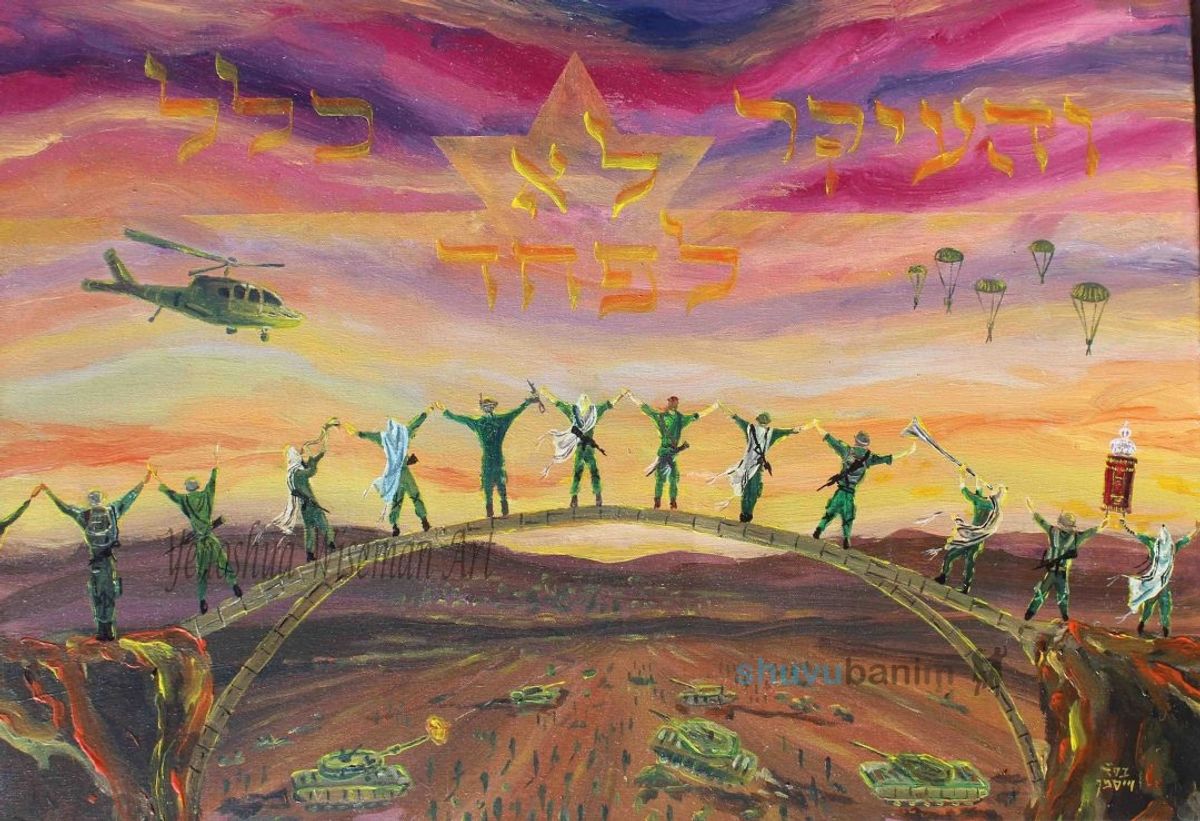
Insights and Pearls for the Weekly Torah Portion - Balak from the Gaon and Tzaddik Rabbi Eliezer Berland shlit"a:
"For He is Blessed"
Elihu ben Barachel the Buzite—Rabbi Elazar ben Azariah says this was Isaac; Rabbi Akiva says this was Bilaam ben Barachel, whom Hashem told, "For he is blessed" (Numbers 22:12), meaning you cannot curse the Jewish people, Barachel. And perhaps he was from Israel, for if we say this was Bilaam, the Gemara (Jerusalem Talmud, Sotah 5:6) says he was from the family of Ram, for Isaac despised all houses of Avodah Zarah (idol worship). The idol worshipers used to boast over the Jewish people, saying they sacrifice their children and that "you don't love Hashem at all, while we sacrifice our children." So Hashem said to Abraham, "Show them that we too can sacrifice our children." We sacrifice children every moment; in the Shoah (Holocaust) we sacrificed a million children, perhaps half a million. Every day we sacrifice children—they blow up buses for us with children and infants just because we are Jews. Even a secular person who is killed for Kiddush Hashem (sanctification of God's Name), it is written in Sefer HaYashar that he then learns with the Holy One, Blessed be He, because the moment he dies for Kiddush Hashem, all his sins are atoned for. For a soldier, the sins are atoned for, but if afterward he returns to his old ways and begins to speak against religious people and starts to revile and blaspheme, then he loses what he gained; his reward is consumed by his loss.
"And He Was Riding on His Donkey"
There is a terrible question: How could Bilaam, who was holy of holies, who was the greatest Tzaddik (righteous person) in the world, suddenly slip and "marry" a donkey, break his leg, and slide? For in the end, he was left with only one leg—"Vayelech Shefi" (he went limping/solitary), he remained on one leg. Regarding Shimshon (Samson), it is said "Shefifon" (Genesis 49:17), both his legs were gone, and yet Shimshon was so strong that he went to Gaza and uprooted all the gates. Now the question is, how can a man—Bilaam, who spoke with Hashem face to face, "who knows the knowledge of the Supreme One" (Numbers 24:16), "I see it, but not now; I behold it, but not nigh; there shall step forth a star out of Jacob, and a scepter shall rise out of Israel" (ibid 17)—how can such a man fall into such descents, to hold a wedding in a stable? He went to the stable and had a wedding without a bride's dress—like one (recently) who married a donkey and it had a wedding dress and everything... so how did he suddenly become so crazy? Rather, Bilaam's mistake was that he wanted to be a prophet—that was the mistake. A person needs to be holy, not a prophet. "Prophet" is a title, it is only pride. A person comes to the world only for holiness. The Patriarchs did not want to be prophets; Abraham received prophecy at age 75, Moses at age 80, Jacob saw the ladder at age 77. Abraham was 75 when Hashem said to him "Lech Lecha" (Go forth) (Genesis 12:1). All the prophets waited until age 75, 80, or 77. Only Bilaam wanted to be a prophet; that was his mistake. Since he was a prophet, and since he failed in his speech, the speech was drawn to the donkey. Speech is drawn from whoever a person is with. The donkey began to speak.
How does a donkey speak? Does it have free choice? How did she suddenly speak? Hashem made—created her not to speak. Rather, Bilaam became an animal and she became a human being. Through the abominable things Bilaam did, he descended from the level of man to animal, and he raised her to the level of man; thus she spoke and said to him what she said.
"And Hashem Opened Bilaam's Eyes and He Saw the Angel"
"For now I would have even slain you, and kept her alive" (Numbers 22:33). Atone (Donkey) - the "Heichal HaBracha" says these are the letters 'Ot Nun' (Sign of the 50th Gate). The moment Bilaam received the terrible humiliation (bizayon) from the donkey, the "Bat Ayin" says she humiliated him before everyone—before all the ministers, all the sorcerers, the elders of Moab, and the elders of Midian—and he accepted the humiliation with love. He fulfilled the verse, "Those who are insulted but do not insult back, who hear their shame and do not respond, who act out of love and rejoice in suffering." At that moment, the angel was revealed to him. For there is a question: How can a disgusting person like Bilaam see angels? How does a disgusting person like Bilaam speak with angels—with the Angel of Hashem?! Rather, the moment a person receives humiliation—someone shames him—at that very moment, angels are revealed to him.
"And He Set His Face Toward the Wilderness"
The Rebbe (Nachman) only spoke about judging others favorably (dan l'chaf zechus) and making melodies. They said there is a truly wicked person, but there is no such thing as a wicked person. This was Bilaam's mistake—he thought there were wicked people in Israel. Hashem told him, "And he set his face toward the wilderness" (Numbers 24:1)—there are no wicked people in Israel. Bilaam's mistake was thinking there are wicked people in Israel—there is no such thing as wicked people; all sins are only from the external shell. Someone asked him: if we see that he is completely wicked? The Rebbe shouted at him and rebuked him: "How can you say about one of Israel that he is completely wicked? Every single Jew is completely good!" Therefore, Bilaam could not curse. Bilaam knew that anyone else could be cursed because everyone has a drop of evil, but in Israel, there isn't even a drop of evil.
"Water Shall Flow From His Buckets and His Seed Shall Be in Many Waters"
"Water shall flow from his buckets and his seed shall be in many waters" (Numbers 24:7), Mazal Deli (the sign of Aquarius). Bilaam blessed the collective of Israel: "Water shall flow from his buckets and his seed shall be in many waters," and your offspring shall be like your innards, that every person should have 600,000. "You shall come to the grave in ripe age (bechelav)" (Job 5:26). Bechela"ch (בכלח) equals 60; Kaf-Lamed is 50, Bet-Chet is another 10. Reish Lakish says our father Jacob did not pass away until he saw 600,000 descendants. Rabbi Yossi says 300,000; he had three hundred thousand descendants, or six hundred thousand. "And your offspring like your innards," that the descendants should be like coins. And this "water shall flow from his buckets" is the Mazal (zodiac sign) of the month of Shevat, for anyone born in the Mazal of Shevat is promised that his seed will be upon many waters; his seed will be 600,000—there will be 600,000 from his seed.
"And Shall Smite the Corners of Moab and Break Down All the Sons of Seth"
Therefore he said, "I see it, but not now; I behold it, but not nigh; there shall step forth a star out of Jacob, and a scepter shall rise out of Israel, and shall smite the corners (pa'atei) of Moab, and break down all the sons of Seth." The "Mayim Addirim" says that Hashem will destroy the nations of the world only through the Peyos (sidelocks). A Jew fights only through the Peyos; he defeats everyone, as long as he does not remove the Peyos. No matter what he goes through, he does not remove the Peyos. "And shall smite the corners (pa'atei) of Moab"—the corners (pa'atei) of Moab are the Peyos—"and break down (v'karkar) all the sons of Seth."
Now he says something a bit strange, I don't know how to explain it. He says that "Karkar" (break down) is the Gematria (numerical value) of Pe'ah (sidelock). How much is Pe (פ)? 80. And how much is Aleph (א)? 1. How much is He (ה)? 5. How much together? 86. Karkar (קרקר)—how much is Karkar? Twice 300 (= 600). So I don't know how one can say such strange things, that 86 is 300? But really it is very simple, because Pe'ah (86) is the Gematria of Elohim (86), and Elohim in its spelled-out form (Milui) [Aleph 111, Lamed 74, He 15, Yud 20, Mem 80 = 300] comes out to "Kar" (300), and every "Kar" is 300. "Kirkur" (Karkar) is twice Pe'ah. It is written, "And shall smite the corners (pa'atei) of Moab" (Numbers 24:17). A person who walks with Peyos can cross all borders. A person in his foolishness shears his Peyos; he doesn't understand that with Peyos one crosses borders—you don't need passports, you don't need anything. They see Peyos, they let you through. The Russians themselves, if they see Peyos, they let you through the borders without anything. They asked me what these Peyos are; I told them it's radar. Peyos are radar; we receive transmissions from Heaven every second. Every second there is a transmission, every second there is a new station, every second we receive new information. We need to receive new information every second.
"Flee to Your Place"
"Flee to your place." Balak says to Bilaam: where have you fallen, where have you descended, how did you come to curse the Jewish people? The Zohar says in Idra Zuta, Parshat Ha'azinu, "Flee to your place" (Numbers 24:11)—return to your place. His root was very high. It is written in the Sifrei, "And there arose not a prophet since in Israel like Moses" (Deuteronomy 34:10), but among the nations of the world, one did arise (Bilaam). For Moses' prophecy was only while awake, but Bilaam's was even in a dream—"fallen down, yet with opened eyes" (Numbers 24:4). Even when he lies on his bed, he receives prophecies. The Sifrei counts three things in which Bilaam was ostensibly greater than Moses.
Balak asks him: where have you fallen? It is true, "To curse my enemies I took you, and behold, you have blessed them altogether" (Numbers 23:11), but this is your end. You say, "Let me die the death of the righteous (10), for from the top of the rocks I see him, and from the hills I behold him (9). Behold, the people shall rise up as a lioness, and lift himself up as a lion; he shall not lie down until he eat of the prey, and drink the blood of the slain (chalalim)" (24). Now is the moment that he shall drink the "blood of the slain" (dam chalalim)—this is the Chalal HaPanui (the Vacant Void).
"If one be found slain (chalal) in the land" (Deuteronomy 21:1). The Heichal HaBracha says that if a Jew is killed, G-d forbid, a void (chalal) is created in the worlds. Therefore it is called a "slain one (chalal) in the land." Desecration of Shabbat (Chilul Shabbat) creates a void (chalal) in the worlds; the Shechinah (Divine Presence) departs through the desecration of Shabbat. "And drink the blood of the slain (chalalim)," "He shall eat up the nations his enemies, and shall break their bones, and pierce them through with his arrows" (Numbers 24:8).
The lesson has undergone editing, and if any error has occurred, it should not be attributed, G-d forbid, to our Rav shlit"a, but to the writer, and "with us dwells our error."
Illustration courtesy of the artist R' Yehoshua Wiseman. To purchase: www.yehoshuawiseman.com
The Shuvu Banim website system wishes you, the readers and followers,
A peaceful and blessed Shabbat!!!
Subscribe to Our Newsletter
Receive Torah articles and inspiration directly in your inbox