
A Shabbos Without Melodies and Zemiros Feels Like a Dark Prison
The Daily Chizuk of Rabbi Eliezer Berland shlit"a
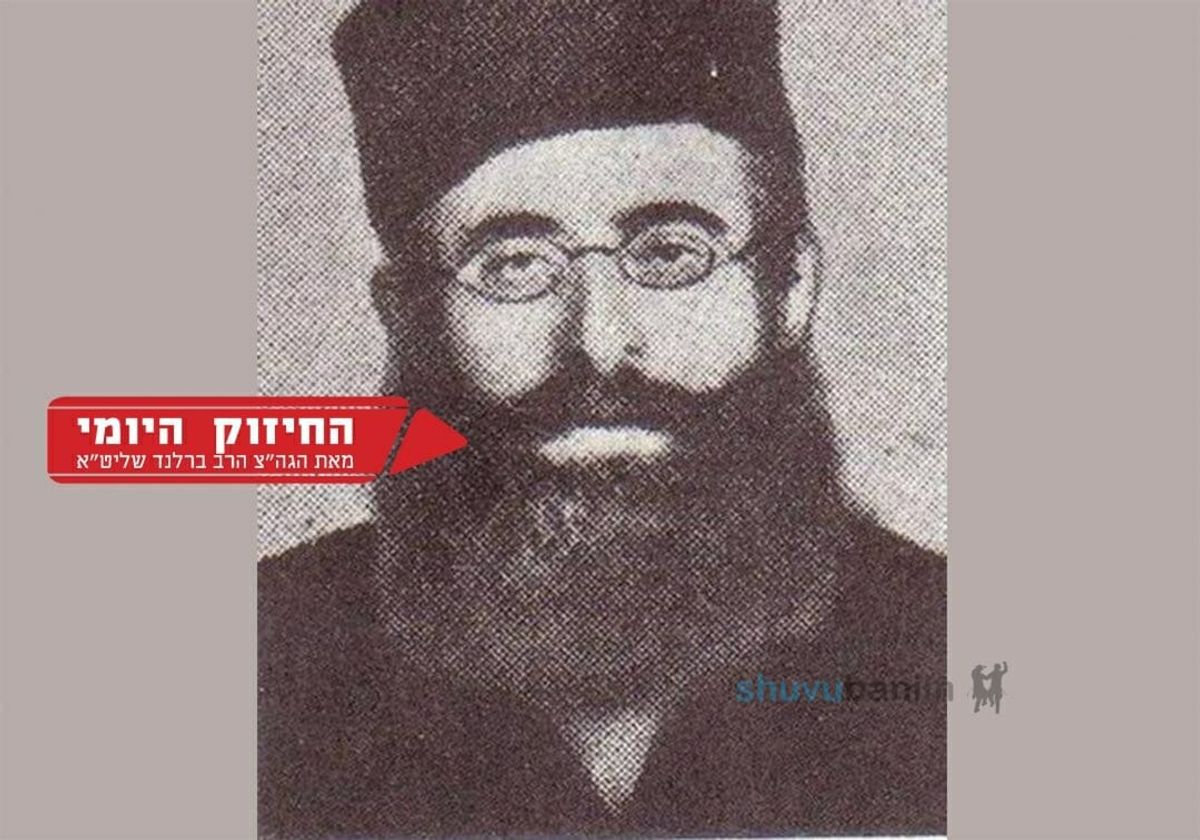
Prayer with songs and melodies opens all the gates of abundance, especially on Shabbat Kodesh, which is the choicest time to sing and play music to Hashem.
The daily chizuk of our teacher, the holy Rav Eliezer Berland shlit"a: Shabbat without the flavor of melody and songs feels like a dark prison.
Tuesday, 11 Cheshvan 5785 – These are his holy words:
"The grandfather of Yitzhak Dovid Grossman was called Rav Zalman. He was on a ship, and we were on the way to the Frankfurter—the 'Yenuka' of Karlin, who was called R' Yisrael (Rabbi Yisrael Perlov of Stolin was known as: The Yenuka or Der Frankfurter, 10 Kislev 5629 – 2 Tishrei 5682; the son of Rabbi Asher of Stolin and the sixth Admor in the Karlin dynasty). He was the youngest son of R' Asher (Rabbi Yisrael was born in Stolin to Rabbi Asher of Stolin the Second [the young Admor] and Sarah Devorah, daughter of Rabbi Elimelech Shapira of Grodzisk)."
"He would perform wonders and he had... they hoped he would obtain donations to buy quinine (quinine is an aromatic compound used primarily as a medication to treat malaria, malaria is a fever), to buy medicines against malaria."
"So he sits on the ship and sings songs all night. He doesn't care; he sits on the deck with a bucket, all alone."
"He sees that someone is following him from the FBI, from Interpol—I don't know exactly who it was. He sees someone following him all the time, concentrating, hiding there in some corner. He sees eyes fixed upon him, not knowing what they are plotting to do to him."
"He stays like that until the morning. He prays Shacharit alone; he is alone on the ship, he has no minyan. He prayed Shacharit until 1:00 PM with all the melodies; he is a Karliner Chassid, they sing the entire prayer."
"And he sings songs again. After being awake all night, he sings songs at noon, all the songs of the day, and repeats them. And again, and again, and Mincha arrives. He stands for the Amidah for an hour, and until 10:00 PM he continues Seudah Shlishit, and then he makes Havdalah and sings Melaveh Malkah."
"He finishes Melaveh Malkah and approaches the one who was stalking him, this detective from Interpol—I don't know where he was from, from the FBI, maybe he was from the Mossad."
"And he says to him, 'Listen, do you know who I am? Do you know who followed you for all 24 hours? It is I, Baron Rothschild!'"
"Baron Rothschild heard this and was in shock," he told him. The Baron said: "This is the first Shabbat in my life that I felt what Shabbat is. I am a religious, Charedi Jew; I have a shochet, but in my life, I never felt what Shabbat is. I didn't know that one sings songs, that one can dance on Shabbat. I always sat on Shabbat like in a prison, like some isolated dungeon; on Shabbat, one cannot do anything. Suddenly, I felt a Shabbat like I never felt in my life."
"All Shabbat I followed you; for 24 hours you didn't stop singing, you danced, you repeated all the songs, and after that, Shacharit with hitlahavut (enthusiasm). And everything was at the peak of hitlahavut—I started to feel a new vitality in my bones, my blood started to flow. Suddenly, I started to live on Shabbat; until today I wasn't living, I was deathly afraid of Shabbat."
"Shabbat was for me something black, black, black; forbidden to move, forbidden to do anything. And I didn't know that one sings on Shabbat. He is from France, from Germany—there they don't sing, there are no songs. I looked for a place where they would sing; I wanted to be a Jew, but I didn't see singing, I didn't see melody. So I pray alone with songs, with a violin, with everything, since I was 16."
"Among the Germans and the French, they didn't sing; they would eat and go to sleep. They pray quickly, they don't even know how to pray there. They flip through the siddur, open it, close it, and leave, and that's it. Suddenly, I have a Shabbat; you gave me a Shabbat, you revealed to me what Shabbat is, you enlightened my eyes to see what Shabbat is."
"'You know what? Whatever you ask for now, you will receive! But one request!'"
"He thought to himself, 'His children are walking without shoes, barefoot even in the winter; they walked barefoot, there was no other choice.' He said (to himself), 'I will ask for my children? Good, I will do hitbodedut for an hour.' In hitbodedut he said, 'What am I thinking about myself? Half of the Galilee has already died from malaria!'"
"'I need to ask him to save the Galilee, to save Eretz Yisrael. There is a disease raging; that is why I am traveling to Frankfurt. Behold, Hashem is already sending me an emissary.'"
"He came to him after an hour and said to him, 'You know what? I am now an emissary from Eretz Yisrael. A terrible disease is raging there; people are dying, casualties like dominoes—a game of dominoes, falling one after another. You must send quinine now, nurses, brothers, doctors, female doctors.'"
"'No problem, on the spot I will bring you an entire ship with medicines, with quinine, with nurses, with doctors'—he organized an entire ship for him."
"That is how he saved all of Eretz Yisrael from a strange death."
Subscribe to Our Newsletter
Receive Torah articles and inspiration directly in your inbox