After the Destruction Everyone Rolled in the Dust and Said Tikkun Chatzos
and Then a Heavenly Voice Went Out: "Now the House Will Be Built" • A Lesson for the 17th of Tammuz from the Gaon and Tzaddik Rabbi Eliezer Berland shlit"a
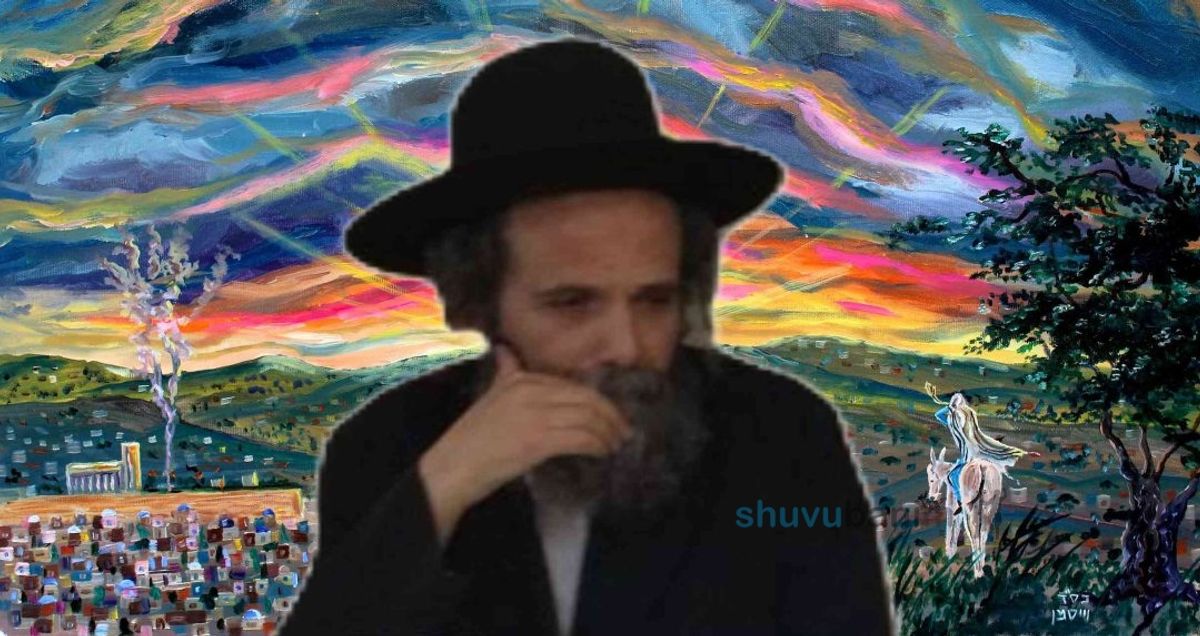
After the Destruction Everyone Rolled in the Dust and Said Tikkun Chatzos (the Midnight Lament), and Then a Heavenly Voice Went Out: "Now the House Will Be Built" - An awesome and majestic lesson delivered by our teacher, the Rav, Rabbi Eliezer Berland shlit"a several years ago regarding the 17th of Tammuz, why the events of that day occurred, and in what merit the Geulah (Redemption) will come:
Today is the day of Geulah (Redemption). Today is the day that Moshe Rabbeinu (Moses our teacher) spent the first forty days in heaven. During these first forty days, one can accomplish anything in the world; a person can finish the entire Shas (the Talmud). Rebbe Nachman says in Torah 85 that during the Three Weeks (the period of mourning between the 17th of Tammuz and the 9th of Av), it is possible to finish the entire Shas. The intellect opens up; the heavens are in their purity, and there are no barriers. "And on the crown of the head of him who was separate from his brothers" (Genesis 49:26)—everyone ascends to the "kodkod" (crown/top of the head). Benjamin reached until the shoulders, but every person can ascend to the "kodkod," the Keter (Crown). This is the Keter of Leah, and every person in the world can reach this level. There is no one in the world who cannot [-]. "I see a rod of an almond tree (shaked)" (Jeremiah 1:11)—this refers to the almond, which grows in twenty-one days (three weeks), just like a chicken's egg.
Moshe grabbed the Luchos (Tablets) and hung in the air. He held two handbreadths of the Luchos. Have you ever seen two people walking from Ashdod to Jerusalem holding onto a Tallit (prayer shawl) the whole way? One would snatch it from the other; such a thing doesn't exist. What does "two holding a garment" (a classic Talmudic legal case) mean? The book "Smichas Chachamim" explains that "two holding a garment" refers to when Moshe descended on the 17th of Tammuz. Moshe held two handbreadths, and Hashem held two handbreadths. Now we are before the 17th of Tammuz, the day Moshe descended with the Luchos. On this day, the entire Torah is revealed. But this is only possible if a person studies the "Ktzos HaChoshen" (a classic work on Jewish civil law). This is why the stones were folded; what happened at Gilgal? "And you shall carry them over with you" (Joshua 4:3).
This is the secret of the 17th of Tammuz: Moshe grabbed two handbreadths and hung from them. Moshe held two handbreadths and remained suspended in the air. Moshe pulled downward, and Hashem pulled upward. Now, who will prevail over whom? In the end, Moshe prevailed. Yes, Moshe brought us the Luchos. If not, we would have no Luchos; we would have no memory of the Luchos, even though they were broken, because he broke them. Now we are in the 17th of Tammuz, which is called the "Day of the Breaking of the Tablets." Everyone will need to truly see to reconnect the Luchos anew and to study Torah—a lot of Gemara (Talmud). Today, the Luchos are only the study of Gemara. Everyone needs to study Gemara for eight hours. From this moment until the morning, tonight we do not go to sleep; everyone will study until the morning to reconnect the Luchos.
The entire Churban (Destruction)—all of the 17th of Tammuz—is all because they destroyed Nob, the city of the Kohanim (Priests). "This very day he shall halt at Nob" (Isaiah 10:32)—the sin of the killing of Nob stands until the end of generations. Therefore, now comes the 17th of Tammuz when Moshe receives the Luchos. Today, the Luchos are the "Ktzos HaChoshen"—that is the Luchos. To know if a person can sanctify a fetus (betroth an unborn child)—all the opinions regarding a fetus. According to Rav Hai Gaon, it is impossible to sanctify a fetus, in no way at all. It's true he has no shidduch (marriage match), true he is ninety years old, true he is already childless, but it is impossible. If it's impossible, then it's impossible. But according to the Rambam (Maimonides), he says if the fetus was recognized, the Kiddushin (betrothal) takes effect. Even if a person is still at the beginning of the pregnancy—it is still a fetus. The Luchos were like a fetus.
Because there is no destruction at all. There is no such thing as Churban (Destruction). It is written in the Zohar that there is a certain ointment—puch (eye paint). Whoever puts this puch on their eyes sees the Beis HaMikdash (Holy Temple) alive and well. Eliyahu HaNavi (Elijah the Prophet) is offering sacrifices, checking them. Eliyahu HaNavi is the Kohen (Priest); Aharon HaKohen (Aaron the Priest) is lighting the Menorah. Everything is in its proper place. Now, on the 17th of Tammuz, we begin to say Chatzos (the Midnight Lament); from midday, we already say Chatzos.
And it is written in the Kabbalah of the Geonim that immediately after the Churban, everyone needed to say Chatzos. David (King David) rose at Chatzos even before the Beis HaMikdash existed. But after the Churban, there wasn't a Jew who didn't rise for Chatzos. Everyone was shocked by the sudden destruction. We were already born into this reality. But the Churban for the first time in life, the first time in history—all the children rolled in the ashes. They lay in it [perhaps before the evening prayer] and rolled in the dust. A Bas Kol (Heavenly Voice) went out: "Now the Beis HaMikdash will be built!" Now the Beis HaMikdash will be built speedily in our days, Amen!
Subscribe to Our Newsletter
Receive Torah articles and inspiration directly in your inbox