
All My Days I Was Pained
When Will This Verse Come Into My Hands So I Can Fulfill It? — The Daily Lesson from the Holy Tzaddik Rabbi Eliezer Berland shlit"a
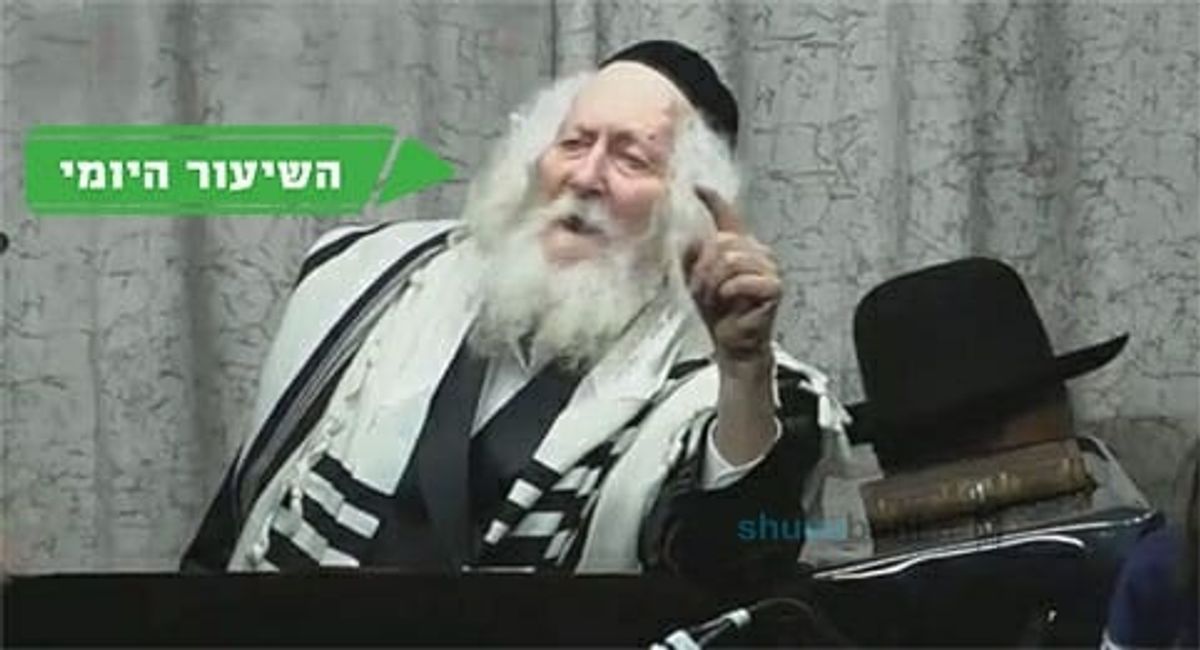
Here is the complete daily lesson as delivered by The Rav, Rabbi Eliezer Berland shlit"a, on Tuesday night, the eve of 29 MarCheshvan, Parshas Toldos, after the Ma’ariv prayer:
So Yoav thrust the sword into Avner. Avner asked him, “Why are you doing this to me? What did I do to you?” He answered, “You killed my brother—my beloved brother.” He had such a precious brother; he could run on the tops of the stalks. Everyone has seen in films how they run on branches, on trees. But among the Jews, they would run on the stalks—and the stalks would not bend.
Avner said to Asa’el, “Don’t run after me. Don’t get involved with me.”
If a man says to a woman, “I want to betroth you—I want to betroth you,” and she says, “On condition that you’ll be a mighty warrior—the mightiest in the world,” what kind of mighty warrior does he need to be? Like Avner—not like Shimshon; like Avner. Shimshon is not a mighty warrior; that’s just child’s play—he grabs a lion and tears it apart; that’s nothing. Even David fought with five lions—four lions—and three bears. To tear apart a bear or a lion is something very simple.
But to fight like King David—with four lions: “Your servant struck both the lion and the bear” (I Samuel 17:36)—and with three bears at once, when they all attacked him—no one is capable of that; there is no such thing.
In the jungle, it takes twelve men to overpower one lion—twelve men. The lion runs away; it sees twelve men and flees, even before they strike it.We searched for prides of lions—we were in the jungles of South Africa, looking for prides. They only smelled that we were getting close, and they were already running away—before we even saw them.
So how do you fight lions? Only David knows how to fight lions—four lions—and three bears at once, when they all fell upon him.
David says to Shaul: “Who is this Golyas…? Who is he…? He’s a dog! Get out of here!” He brought him a stick and said to him, “Come on—get out, get out, get out!”
[Golyas] said, “Am I a dog? Aren’t you ashamed?!” For that, he did not forgive him—on that there is no forgiveness. It is written, “We give honor to royalty.” To disgrace a king like this, to disgrace a general, to disgrace a chief of staff—like this! And not even with a rifle, not with a spear, not with arrows—just a stick. A stick with five slings—five stones.
He says, fine—how did he lift the helmet? There are two approaches [as to how Golyas was killed by David’s stone]. “And the stone sank into his forehead” (I Samuel 17:49)—the stone penetrated his armor. And there is an approach that precisely at the moment he lifted the helmet for a second, in that second [the stone sank into his forehead and he died].So it’s impossible to fight like David! David composed all of Tehillim—Tehillim every day. And with the power of Tehillim, David could overcome all the lions in the world. “I will not fear the myriads of people who have set themselves around me” (Tehillim 3:7)—let even myriads come, myriads of the whole world—seven billion.
Sancheriv reached two billion six hundred million—so that’s nothing; that’s not anything at all.
Also with Avraham: he threw dust—it became swords; he threw straw—it became arrows. Hashem said to him, “Why are you taking Eliezer [with you to war]? It’s unnecessary. You can throw dust by yourself—by yourself throw swords; by yourself throw straw—it will become arrows. Why do you need Eliezer?”
That is why there were four hundred years in Egypt. It needed to be four hundred; Hashem shortened it to two hundred and ten.
Iyov said: “Why, every moment, do You change Your word? Can Hashem not speak a word and fulfill it?”
He said to him: “Know for certain that your offspring will be strangers in a land not theirs, and they will serve them and afflict them four hundred years” (Bereishis 15:13)—and Iyov relied on this.
Everyone knew this statement; it spread to everyone. All over the world they publicized it; they put up announcements; in every newspaper it was the headline: that the people of Israel must be slaves for four hundred years.
And Iyov said to Pharaoh: “Here they are—slaves for four hundred years. Every twenty years is a generation; that’s twenty generations. Why are you worried about what will be in another twenty generations? What does that have to do with you? In another twenty, someone else will be here. You—afflict them; enslave them.”
That is why Iyov went through such suffering—because Iyov was a gilgul of Terach.
Terach was Terach—he was not Avraham. A person cannot be Avraham, so at least don’t be Terach.
There was, in City Hall 6, a certain speaker from the yeshivah. No one wanted to listen to him. Suddenly he shouted at them: “If you don’t want to be Avraham—fine. But don’t be Terach!”
And then everyone woke up; they did teshuvah. He came to Kfar Chassidim; they told us this story—how he succeeded in awakening them.
A person doesn’t want to be Avraham—don’t be Avraham; fine, it’s impossible to be Avraham; it’s hard. But Terach?! To be Terach?! There is no middle. Either Avraham or Terach—decide! Decide what you want—there is no middle. Either I go all the way and become Avraham Avinu, or you want to go backward and be Terach.
The most “modern” person—that was Avraham. He was truly modern: he shattered the idols. And after that, Nimrod threw him into the fire.
He said, “This is not fire; it’s just an illusion. It doesn’t burn at all.” He put his hand into the fire, put in his finger—it didn’t burn. “What kind of fire is this? There are tricks here, or frauds. I thought it would be real fire.” He waited for it to be fire.
Then they asked Haran, “And what do you say?” He said, “Avraham jumped—so I’m jumping too.” Therefore he merited that Rivkah, and Sarah, and Rachel, and Leah [would be among his descendants].
But he jumped into the fire thinking that this fire also would not burn him. Yet only Avraham is not burned by the fire. Someone who is a tzaddik—the fire does not burn him; he can enter the fire.
Like Rabbi Akiva—even with iron combs. When they told him, “Rebbe, until here—say ‘Ve’ahavta’—‘And you shall love Hashem your G-d’”—the final letters [of the words] spell “Takeh,” like “Etzyon Gever,” which comes out exactly “Takeh.” “Etzyon” is 220, and “Gever” is 205—together 425—“Takeh.”
Whoever says this Name, “Takeh,” annihilates all enemies; not one remains alive.
So they said to him (—Rabbi Akiva’s students to their teacher at the time they were combing his flesh with iron combs and he was saying “Shema Yisrael”): Say “Ve’ahavta es Hashem Elokecha”—the final letters [spell] “Takeh”—no trace of the enemies will remain.
Rabbi Akiva said: I have been waiting for this for one hundred and twenty years. He was 120 years old: “All my days I was pained—when will this verse come into my hands so I can fulfill it?”
Because a person needs to pray that he will live 120 years—and on the last day, in the last minute, he should merit [to die] al Kiddush Hashem. And then the Geulah will come speedily in our days, Amen!
For the replay — the lesson at minute 1:15:40
https://www.youtube.com/watch?v=Oy0DADtRunw
Subscribe to Our Newsletter
Receive Torah articles and inspiration directly in your inbox