“And this is the aspect of the Chanukah lamp—for the Tzaddik is called ‘light’”
• The Shabbos Chanukah Kibbutz in the Shadow of the holy gaon and Tzaddik Rabbi Eliezer Berland shlit"a
The Shabbos prayers ○ Extended Hallel singing ○ Lighting the Chanukah candles with a great multitude
The light of Chanukah teaches us—Rebbe Nachman, our holy Rebbe, is the light of Chanukah. One of the three great gatherings of Breslov Chassidim is Shabbos Chanukah. And whoever truly wants to merit being included in the gathering of all of Your people, the House of Israel—together with the “head of the household”—knows that he must come for Shabbos Chanukah in the shadow of The Rav, Rabbi Eliezer Berland shlit"a. As in previous years, this year as well the Chanukah kibbutz took place—apparently the greatest in the world—with the participation of The Rav shlit"a. Our people do not remember such an exalted Shabbos for years. Thousands from the House of Israel came to shelter in the shadow of the true sun, the Tzaddik of the generation—The Rav, Rabbi Eliezer Berland shlit"a.
Before you is a tiny glimpse of what we merited at the Shabbos Chanukah kibbutz 5784—hours upon hours of prayers, lessons, songs, and dancing that we merited on this wondrous Shabbos:
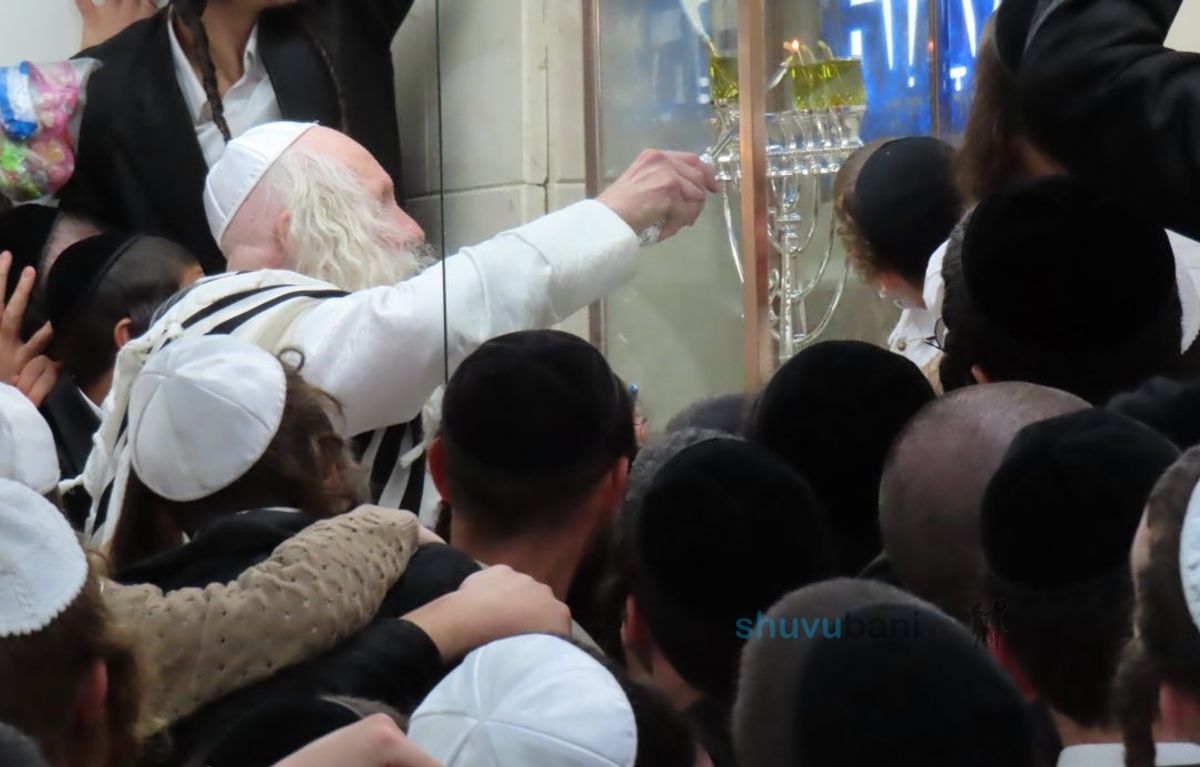
The Shabbos Chanukah kibbutz began—how could it not?—with the lighting of the second Chanukah candle. The Rav shlit"a stepped out onto the generation’s balcony, wearing his pure white Shabbos garments, with the white kippah and tallis—his entire presence proclaiming, “a messenger of Hashem Tzevaos.” In his pure voice, The Rav recited the two blessings and lit the second candle on the synagogue menorah. The Rav then said and sang “HaNeiros Halalu” and “Maoz Tzur.” Afterward, he went inside to light in his holy residence. Not even ten minutes passed, and The Rav shlit"a was already out again for Minchah with a great multitude. The Friday-night prayer was not longer than usual, but the number of people participating was beyond imagination—thousands from the House of Israel, from every group and every community, all gathered and came to You!
The peak of Friday night, of course, was the singing of “Lecha Dodi.” For thirty-five minutes, The Rav shlit"a welcomed the Shabbos with melodies and dancing. You could feel the extra soul entering each and every person through the moving song of “Lecha Dodi.” After “Lecha Dodi,” The Rav began Maariv for Friday night, and afterward the Shabbos zemiros that are said before Kiddush. After two hours and a quarter that we merited in the presence of The Rav shlit"a, he entered his beautiful holy home, saying that Shacharis would, with Hashem’s help, take place at 4:30 in the morning.
Even before the first lines of dawn rose over Jerusalem, the Holy City, The Rav shlit"a entered the balcony at 4:30 for Shacharis of holy Shabbos—Shabbos Chanukah. The prayer proceeded as on every Shabbos, with tremendous vitality—from the morning songs and the Korbanos. Then The Rav shlit"a descended to our Beis Midrash—the main prayer hall—after a break of about half an hour. At 6:02, The Rav entered our Beis Midrash and immediately began Pesukei d’Zimrah for Shabbos with immense liveliness. There was no unusual lengthening of melodies in Pesukei d’Zimrah, but those who know understand: even what is “not extended” is still “length upon length”—more than an hour of the songs of Pesukei d’Zimrah.
The true extension began at “Nishmas Kol Chai,” with the melody on “Ki chol peh lecha yodeh”—thousands dancing and singing, “Ayyy… v’chol ayin lecha t’tzapeh!!” Trembling seized the heart. And in the blessings of “Yotzer Or,” with the melody of “Ein Aroch Lecha,” not an eye remained dry, as The Rav shlit"a stood for a quarter of an hour in awesome deveikus—tears flowing from his eyes with longing and yearning. After that came Krias Shema and Shemoneh Esrei.
After the chazzan’s repetition, The Rav began the full Hallel for the days of Chanukah. And here came the Shabbos peak: for a full hour, The Rav shlit"a stood with vitality, facing the congregation, and with his holy movements he infused life into the entire crowd—ablaze with endless enthusiasm. Every minute of Hallel was another moment in a “Garden of Eden below.” In truth, this time cannot be measured—because with the Tzaddik we are above place and above time. Yet we counted the minutes “so that your generations will know.” In the melody of “B’tzeis Yisrael,” The Rav extended for about twenty minutes. He extended similarly with singing and dancing in the melody of “Hodu laHashem ki tov.” There are no words for the joy, the happiness, and the feeling of thanksgiving to Hashem for the miracles done “in those days, at this time.” A great awakening was also felt during Hallel in the melody of “Adir Ayom v’Norah”—the tune The Rav sings on Motzaei Shabbos at the passage “Ana Hashem hoshiah na,” “Ana Hashem hatzlichah na.” The Rav extended in this melody, which sealed the special and wondrous Hallel—such as we had not merited for a long time.
After Hallel, The Rav shlit"a delivered a lesson of about fifteen minutes, speaking mainly about the weekly parashah, and about the disputes between the brothers and Yosef—which are, in truth, a foundation for many discussions throughout Shas and the halachic authorities.
The Torah reading lasted close to fifty minutes (!) as The Rav called up guests who had come especially for Shabbos Chanukah—among them, a particularly notable guest who arrived from Johannesburg, South Africa. In addition, the grandson of The Rav shlit"a, R’ Avraham Rubinstein, called his daughter—born in good mazal—by the name Rachel, after Rachel Imeinu, the mother of Yosef HaTzaddik who is read about in the parashah.
As we mentioned, Chanukah during Parashas Vayeishev is rare—and likewise the haftorah “Roni v’Simchi” for Shabbos Chanukah is only read infrequently with Parashas Vayeishev. This special haftorah was read in a pleasant voice by a delightful young man—a bar-mitzvah boy, the son of R’ Moshe Lavi (may he live), from our people in Jerusalem.
After the haftorah, The Rav said “Yekum Purkan” and sang “Zar’a Chaya v’Kayama,” a segulah for children, for seven minutes. Only at 10:00 did they begin Mussaf of holy Shabbos—everything with melodies, and The Rav shlit"a, of course, served as the chazzan. By this time, nearly the entire crowd was already in prayer. Everyone wants to draw close to the focal point of fire—to The Rav shlit"a. And so, like the roar of waves, they stood packed tightly, the entire congregation becoming a single solid mass—like the stones beneath the head of Yaakov Avinu. Usually, the “waves of pressure” are only near The Rav shlit"a’s bimah, but because of the thousands who gathered and came for the Chanukah kibbutz in the shadow of the Tzaddik, the crowding was felt even in the courtyard outside the hall. Due to the pressure, the elder members of our community who sit in the back of the Beis Midrash were asked to remove the shtenders in order to clear a few more meters for those who wished to shelter in the holy shadow.
At the conclusion of Mussaf, The Rav delivered a short lesson—the Torah of the Tzaddik on Shabbos Chanukah. At 10:36, after nearly six hours (!), The Rav shlit"a went up to his beautiful holy home.
But even in his holy residence, The Rav did not rest for a moment. Immediately upon entering, he served as sandak for the son of R’ Yishai Mitzrabi, and the child was named in Israel “Meir.” At the end of the bris, he entered the sukkah of his residence, where the Kiddush took place in honor of the birth of his great-grandchild—a son born to his grandson R’ Avraham Rubinstein (may he live).
At sunset, The Rav shlit"a came down for Minchah, and after 38 minutes of singing “Baruch Hu,” he began the Torah reading of Parashas “Miketz,” and afterward Minchah for holy Shabbos.
At the end of Minchah, The Rav went out for a break of about ten minutes for washing hands for Seudah Shlishis. When he returned, he made HaMotzi on lechem mishneh, and for twenty-five minutes he distributed to our people leftovers from his meal—fruit and sweets for the children. After that he began the Shabbos zemiros. As is his holy way, he extended with “Rabravin” in the piyyut “Kah Ribon” for about ten minutes. After that he sang the song “Koh amar Hashem matza chen bamidbar” for a quarter of an hour.
After more than an hour and a quarter of Seudah Shlishis, The Rav shlit"a concluded with “Tzur Mishelo Achalnu” and led the zimun over a cup. After Birchas HaMazon, The Rav shlit"a delivered a lesson considered the Seudah Shlishis shiur. In recent months it had been postponed so that The Rav could take out the Shabbos and deliver the shiur with a microphone, so that the entire congregation would merit hearing his holy words. For seven minutes, The Rav delivered the regular lesson from the sefer “Pele Yoetz,” which speaks sharply about the holiness of a person.
Afterward he continued with Maariv for Motzaei Shabbos, followed by a few minutes of “Baruch Hu.” After Havdalah, The Rav shlit"a lit the third candle. The excitement was felt in the air—we merited to see the Tzaddik lighting the synagogue menorah up close; how splendid is this sight! Our people sang together with The Rav shlit"a the zemiros and piyyutim after the candle lighting for about twenty minutes. After that, The Rav shlit"a announced that everyone should light in his own home, and he went up to his holy residence.
In his home, The Rav lit the third candle, and afterward sat with the family for Melaveh Malkah. Before “Eliyahu HaNavi,” he delivered a lesson, as is his holy way. Only at 21:00 did The Rav shlit"a seal the exalted and wondrous Shabbos Chanukah kibbutz that we merited—blessed is His Name!
Subscribe to Our Newsletter
Receive Torah articles and inspiration directly in your inbox