
"And Your Heart Shall Not Be Grieved When You Give to Him" • Parshat Re'eh from
the Gaon and Tzaddik Rabbi Eliezer Berland shlit"a
Insights and Pearls for Parshat Re'eh from the Gaon and Tzaddik Rabbi Eliezer Berland shlit"a
"And Your Heart Shall Not Be Grieved When You Give to Him"
A person who makes a neder (vow) to give to the poor is obligated to fulfill that vow, as it is written: "And your heart shall not be grieved when you give to him" (Deuteronomy 15:10). A person thinks, 'How can I give tzedakah (charity)?', 'How can I?', 'I will lack,' 'How can I give a loan? They won't return it to me.' This is called a "davar bliya’al" (a wicked/worthless thing). When a person says 'They won't return it to me,' that is a davar bliya’al. A person is obligated to lend; this is the way Hashem manages the world—if the money doesn't come back to me, new money will come. So [thinking otherwise] is a davar bliya’al. Now it is the sixth year—already the end of the sixth. Someone asks for a hundred thousand shekels, and if he doesn't return it within a year, it is lost because the Shmittah (sabbatical year) cancels debts, such that the lender is no longer the owner and must waive the debt. Thus, the Torah says: "Beware lest there be a wicked thought in your heart" (Deuteronomy 15:9). A person must lend. You have a hundred thousand shekels that you just received as an inheritance—you sold an apartment, you don't need the money for now, only in another year—you are obligated to lend it. If not, you are a davar bliya’al. He needs to marry off a child, he has debts, they are coming to take his house; you are obligated to lend to him. And what will be? How will he return it? One must provide for the needy "sufficient for his needs" (Deuteronomy 15:8), even a horse (Rashi on the verse, Ketubot 67b) "which he lacks" (ibid). "Do not harden your heart nor shut your hand" (ibid, verse 7). When a person shuts his hand from giving tzedakah, he creates an "egrof resha" (wicked fist) (Isaiah 58:4). He makes a wicked fist—he doesn't want to give, so a wicked fist is created. This [term] equals three thousand, says Rabbi Shimshon of Ostropoli (in his letter read on Erev Pesach)—3,280. Every time he doesn't give tzedakah, he creates 3,280 mashchitim (destructive forces), Nazis, terrorists. Suddenly a hundred million Nazis appear, and people don't know where these hundred million came from—it is all because a person shuts his hand. There is a negative commandment—"Do not harden your heart, and do not shut your hand"—explicit prohibitions.
"Beware lest there be a wicked thought in your heart" (ibid 15:9). What is bliya’al? That he doesn't want to lend, doesn't perform tzedakah. He is always afraid and thinks, 'Maybe I will lack,' 'Maybe that person won't return it to me.' But know that this is a bliya’al thought, because in the end they will return it to you; at most it will be delayed another day, another hour, another minute. So beware of saying 'that one won't return it to me,' 'I put the money on the horn of a deer (a lost cause),' 'the money is lost.' Hashem will not be willing to forgive this thought. "Beware lest there be a wicked thought in your heart, saying, 'The seventh year is approaching'" and now it will be Shmittah, and during Shmittah it is no longer yours, since there is Shmittat kesafim (cancellation of debts).
It is written in the Mishnah: A story of one who took a basket of figs and betrothed five women with it (Kiddushin 50b). You can betroth a woman with a fig. If a person betrothed a woman with a fig, it is a sign that he rectified the "sin of the fig" (the Tree of Knowledge); this is the complete tikkun (rectification). "Kalkalah shel te’enim" (basket of figs = 936) is the gematria (numerical value) of "Gavia" (cup = 72) times 13 (= 936). 13 hints to the Yud-Gimmel Middos Rachamim (13 Attributes of Mercy), that a person receives such abundance that he can lend to the whole world. "And you shall lend to many nations, but you shall not borrow" (Deuteronomy 28:12). Hashem promises that we will lend to them and not that they will lend to us. Beware lest it be the Shmittah year now and you have an ayin ra'ah (evil eye), not wanting to lend. "And your eye be evil against your needy brother and you give him nothing." If you do not give to him, woe and alas, the curse "and your wives shall be widows and your children orphans" (Exodus 22:23) may G-d forbid be fulfilled. If someone asks for tzedakah or a loan and they are not given, and he calls out to Hashem: 'Hashem, see what they are doing to me, they don't lend to me, they don't bring me tzedakah,' "and it shall be a sin in you." "You shall surely give to him"—always give, even a hundred times (Rashi on the verse, based on Bava Metzia 31b). Do not get tired. Even a horse (Ketubot 67b), even a Mercedes. If someone used to drive a Mercedes and was accustomed to driving a Mercedes, and he lost his wealth and has no Mercedes, you need to buy him a Mercedes. Take out all the money you have in the bank or under your clothes and the pillow and the sheet and give it to him. Even a horse to ride upon—even a horse! Go, there isn't any? He wants a horse, you are obligated to give. Therefore Rashi says even a horse. He wants a horse, you have money in the bank, you have a hundred thousand shekels, and he says: 'Buy me a horse,' or a chariot with four horses—you must give him everything. Even four horses. "You shall surely give to him" whatever he asks for. Four horses? He asks for a yacht, buy him a yacht. He asks for a private plane, buy him a private plane. Always give the money; you will see that you will have a million times, a billion times, a trillion times more. "You shall surely give to him," do not get tired, more and more, as much as he asks. "And your heart shall not be grieved when you give to him, because for this thing Hashem your G-d will bless you in all your work and in all that you put your hand to." Hashem will see that you opened your hand to him, so He too will open His hand to you. If you make calculations, He too will make calculations. If a person starts making calculations, Hashem also makes calculations for him. Give to him without calculation. Even if he asks you for a horse to ride upon—he wants a horse, he wants a Mercedes, he wants a yacht—tell him, 'Whatever you want, I will give you.' Then Hashem will also give to you; He will let you fly in the air, He will give you kanfei nesharim (eagles' wings), you will reach Uman with the Shem HaMeforash (the Explicit Name of God). "You shall surely give to him" even a hundred times, even if you no longer have strength for him. "And your heart shall not be grieved"—that you should not have an evil heart when you give to him. "Because for this thing Hashem your G-d will bless you"—Hashem will bless you and open all the gates for you.
On Rosh Chodesh (the New Month), all the gates are opened, all the gates of Shachak (heaven) are opened. All the abundance is opened on Rosh Chodesh. We say Ya'aleh V'Yavo (the festival prayer): 'May there rise, come, reach, be seen, be accepted, be heard, be visited, and be remembered—our remembrance and our visitation, and the remembrance of our fathers, and the remembrance of Mashiach ben David Your servant, and the remembrance of Jerusalem Your holy city, and the remembrance of all Your people the House of Israel before You, for deliverance, for good, for grace, for kindness, and for mercy. For a good life and for peace on this day of Rosh Chodesh' which will be tomorrow night, Amen.
Even when Mashiach comes, there will be needy people: "For the needy shall never cease from the land." How is the attribute by which Hashem has mercy on a person? It is when he has mercy on the poor. A person [himself] does not deserve any mercy, having so many transgressions and sins, but if he has mercy on the poor man, Hashem has mercy on him. Therefore, there are always poor people, so that Hashem can test us to see if we have mercy on the poor, and we don't say to him: 'You are poor, go to work.' Afterward, they will tell you, 'Go to work.' Have mercy on the poor man, then Hashem will send to you. "For the needy shall never cease from the land... you shall surely open [your hand]." Again, just like "You shall surely give."
And do not be stingy with your hand, "and do not shut your hand." If a person shuts his hand, you have created an atomic bomb. "To strike with a wicked fist" (Isaiah 58:4)—this is 3,280 malachei chabalah (angels of destruction) (Letter of Rabbi Shimshon of Ostropoli read before Pesach). Every time you do not give tzedakah when you are asked, you have created 3,280 angels of destruction. These are the Nazis, Hamas, Al-Qaeda, ISIS. Every time you do not give tzedakah and you shut your hand, you violate the prohibition of "Do not harden your heart." You harden your heart, close your heart, shut your hand—from this comes the "egrof resha" (wicked fist) which is the Nazis. All the manifestation of the Nazis comes from you hardening your fist, you should know this.
Therefore, Hashem says to release the slaves: "If your brother, a Hebrew man or a Hebrew woman, is sold to you." A Hebrew woman is only until age 12; after that, she is free for life. A daughter may not be sold after age 12. But a son, you can sell him until age 13, but afterward you cannot sell him; he sells himself from age 13 and up until 120. "And it shall be, if he says to you, 'I will not go out from you,' because he loves you and your house, because it is good for him with you." The slave does not want to leave; he wants to stay with the master. 'I have food, and I have a bed, and I have a table, and I have a room.' With the master, it is a "keif chayim" (a great life), it is the greatest pleasure. 'I don't want to give up this pleasure of having a master.' He says, 'I will not go.' "I love my master, my wife, and my children" (Exodus 21:5). They pierce him—they make a hole in his ear, they put in a kind of earring for slaves, and he must be a slave until the Yovel (Jubilee). In the Yovel, he must go out; he cannot be a slave forever. A "slave forever" is only a slave to Hashem Yisbarach.
The lesson has undergone editing; if any error has occurred, G-d forbid, it should not be attributed to our teacher the Rav shlit"a, but to the writer, and "may our error remain with us."
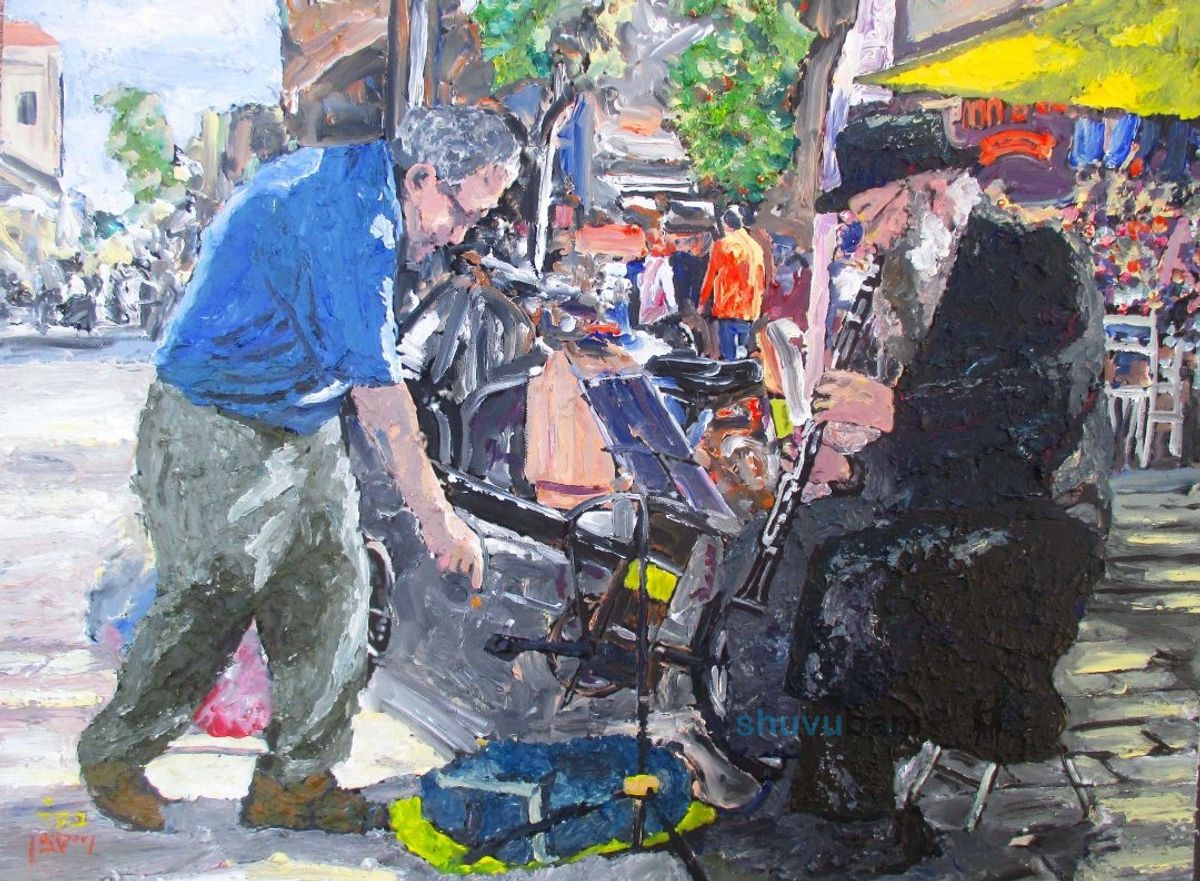
Painting courtesy of the artist R' Yehoshua Wiseman. To purchase: www.yehoshuawiseman.com
The Shuvu Banim website system wishes you, the readers and followers,
A peaceful and blessed Shabbat!!!
Subscribe to Our Newsletter
Receive Torah articles and inspiration directly in your inbox