
Approaching Rosh Hashanah - Parshas Nitzavim: The Power of a Broken Heart and the Secret of the Seventh Month
Rosh Hashanah: The Cry of the Broken Heart That Defeats the Accuser
"A broken and contrite heart, O God, You will not despise."
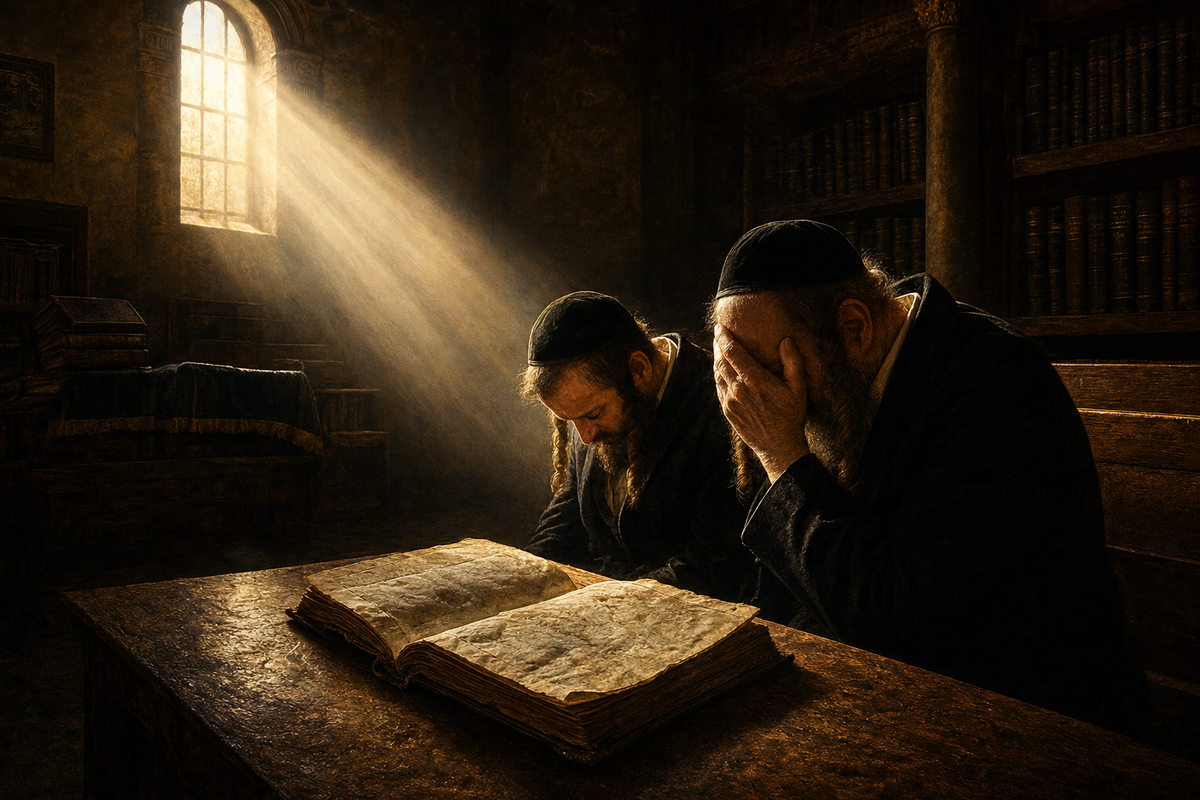
On Rosh Hashanah, two Chassidim sat in the corner of the Beis Midrash (study hall) of the Rebbe, Maran the Maharash zy"a (may his merit protect us), whispering to one another. Maran the Maharash sent his son, Maran the Mahari zy"a, to listen to the conversation of these two Chassidim. The son approached the two Chassidim without them noticing that someone was listening to their voices.
Suddenly, one of the Chassidim was heard saying, "Oy! Today is Rosh Hashanah! With what can we come before the King of kings, Hashem, who examines the kidneys and the heart (our innermost thoughts and feelings), on the great and awesome Day of Judgment...?" His friend sighed along with him, and both of them sank into a deep silence, gazing at each other for a long time in a screaming silence.
When Maran the Mahari returned and told his father what the two Chassidim were doing and what they had said, his father revealed to him that at the exact moment these two Chassidim were speaking to one another, there was a great accusation in Heaven. Against every word of defense, the Accusing Angel brought decisive answers to condemn the Jewish people, Heaven forbid. When the Defending Angel tried to say that the Jews give tzedakah (charity), the Satan replied that the non-Jews also give charity, and even brought proof of this. For every good deed of the Jewish people, the Satan brought up good deeds performed by the non-Jews.
Suddenly, a great and heavy sigh ascended, emerging from the broken and contrite hearts of these Jews over their sins and transgressions. Immediately, the Defending Angel stood up and said, "Master of the Universe, You have no other nation or tongue whose hearts are broken within them because they have sinned against You. 'A broken and contrite heart, O God, You will not despise.' This merit of a 'broken heart' belongs exclusively to the Jewish people." Faced with this claim, the Satan was silenced, and his accusations were completely shut down.
(May it be the will of our Father in Heaven that in the merit of the Torah study, the prayers, and the tzedakah that we fulfill, the claims of the Satan against the Jewish people should be silenced, and may we all be inscribed and sealed for a good life and for peace. Amen, may it be His will.)
Please Do Not Shame Us: The Rebuke of the Simple Woman
Once, a woman entered the room of the tzaddik, the Apter Rav, and asked to place a "kvitl" (a note of requests) on his table, as is the custom of Chassidim. However, the tzaddik hinted to his attendant not to let the woman approach his table, and he called out to her in a tone of resentment, "Just yesterday you committed such-and-such a sin, so how do you dare cross the threshold of my home today?!"
The woman grew pale upon hearing the tzaddik's rebuke, but she immediately recovered from the shock that had gripped her, and said with tear-filled eyes, "Hashem knows all the sins of every single person, and yet He does not shame the sinner, and even remembers them with forgiveness and atonement for every sin and iniquity. And you, the Apter Rebbe, cannot restrain yourself from revealing the disgrace of a poor woman who is seeking forgiveness and pardon for her sin?!"
The tzaddik did not answer the woman at that moment, but rather hinted to his attendant to take the note of requests from her hand. As he studied what was written, tears streamed from his eyes out of deep emotion... And when he later recounted the incident to his students and close followers, he remarked with a nod of his head, "No one has ever defeated me in words, except for this simple woman, who was right in every single word she sounded in my ears today..."
Torah Insights: The Secret of the Shabbos Mevarchim of the Month of Tishrei
"You are standing today, all of you, before Hashem your God" (Devarim 29:9)
The Shabbos of Parshas Nitzavim, which is adjacent to Rosh Hashanah, is not a "Shabbos Mevarchim" (the Shabbos when the new month is blessed) like other Shabbosos adjacent to Rosh Chodesh, where the upcoming month is blessed with a special prayer. And why is this so? In order to confuse the Satan, who seeks to accuse the Jewish people, so that he will not know when Rosh Hashanah falls.
A hint to this is found in the following verse, which mentions Rosh Hashanah:
"Sound the shofar on the New Moon, in concealment for the day of our festival" (Tehillim 81:4)
This means that the day of the festival (Rosh Hashanah, which falls on Rosh Chodesh) should remain concealed, and they should not publicize it to the masses.
In this regard, an interesting tradition is brought in the name of the tzaddik Rabbi Shneur Zalman of Liadi, the founder of Chabad Chassidus, and these are his words: "When I was in Mezritch, I heard from my master and teacher, the Maggid Rabbi Dov of Mezritch, in the name of his teacher, the Baal Shem Tov: The seventh month (Tishrei), which is the first month of the new year – Hashem Himself blesses it on 'Shabbos Mevarchim' (the Shabbos before Rosh Hashanah), and with this power, the Jewish people bless the rest of the months of the year."
Subscribe to Our Newsletter
Receive Torah articles and inspiration directly in your inbox