
Beauty Comes After the Wedding
The Daily Chizuk from Rabbi Eliezer Berland shlit"a
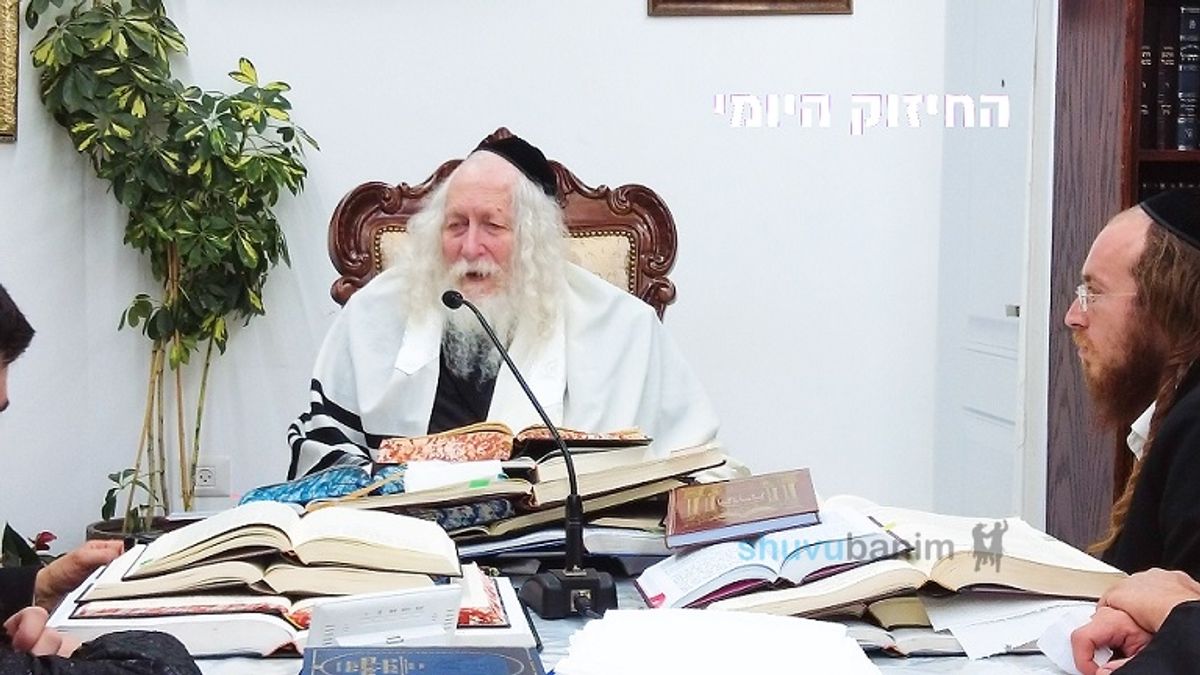
The Daily Chizuk from our teacher, the holy gaon and tzaddik Rabbi Eliezer Berland shlit"a — Why didn’t the parents want the shidduch of Rabbi Shmuel Shapira?
“Charm is false and beauty is vain” (Mishlei 31:30)
“And the man Moshe was exceedingly humble, more than any person on the face of the earth” (Bamidbar 12:3)
Monday, 4 Tammuz 5785 — What caused our teacher Rabbi Berland shlit"a to begin learning the sefarim of Rebbe Nachman?
These are his holy words:
A person is forbidden to focus on beauty—“Charm is false and beauty is vain” (Mishlei 31:30)—beauty comes after the wedding.
After the wedding, the kallah becomes like the sun at midday—like the story of R’ Shmuel Shapira. When Rabbi Shmuel Shapira was Lithuanian, his parents did not agree to the shidduch with Frida, because she had a red mark on her face. An entire side of her face was filled with red, like a beet. The parents said, now that you’ve become Breslov, we don’t care.
Rabbi Shmuel Shapira didn’t look at it. He said, now nothing matters to me— even if my parents oppose me, it doesn’t interest me. I want this shidduch.
As soon as they made the engagement, the next morning the mark disappeared— the entire mark disappeared. They saw an actual miracle.
Frida read Shivchei HaRan at age 13, and then she said, “I want a chassan like it says in Shivchei HaRan.” And that’s what she received—someone truly like Rebbe Nachman. From this shidduch came the entire Shapira family and all the Frankes.
The Rebbetzin Berland, already at age 16, finished all of Likutey Moharan. The Rebbetzin finished all the sefarim there—there were various sefarim there: Meshivas Nefesh, Shivchei HaRan—she had already completed all of it.
At the beginning of our marriage, before the Seventh Day of Pesach, when we returned from Haifa by train, she asked me, “Do you read Likutey Moharan a little?” She began testing me to see if I knew it—and I had no idea what she was talking about (The Rav had previously been Lithuanian). I had no choice; I began learning.
https://vimeo.com/1097376874?share=copy
So on the Seventh Day of Pesach I opened the Sipurei Ma’asiyos — I felt like an electric shock. Suddenly, in one hour a person knows all wisdoms, and he “creates the day.” We learn that through tzedakah one “creates the day”—how to create the new day, and that one must create the day with all wisdoms.
The Tzaddik creates the day with all the wisdoms in the world. In one hour he can learn what people learn in two thousand years. And therefore, “Moshe was exceedingly humble, more than any person” (Bamidbar 12:3)—Moshe said: everything I learned in 80 years, I can teach in one hour. What a person learned in 70 years, they learn in one hour.
Today, in five minutes you can learn what was learned over almost all six thousand years. All the formulas of Newton and of Aristotle—in five minutes you learned everything.
In my childhood, during summer vacation I finished all the school material, so during the school term I no longer had anything to do. I said, now we’ll learn Gemara under the desk—until the teacher caught me and said, “Go to yeshivah and learn Gemara, but right now you’re in school.”
I said, “What—are you restricting my Gemara?” I went to the synagogue and learned there for a week; I didn’t come to school at all. The teacher told me I had to come, so we stayed until the end of the year, until 17 Tammuz—on 17 Tammuz we moved to Kfar Chassidim.
Subscribe to Our Newsletter
Receive Torah articles and inspiration directly in your inbox