
Did You Stumble? At Least Don't Rejoice in It! The Daily Strengthening from the
Gaon and Tzaddik Rabbi Eliezer Berland shlit"a
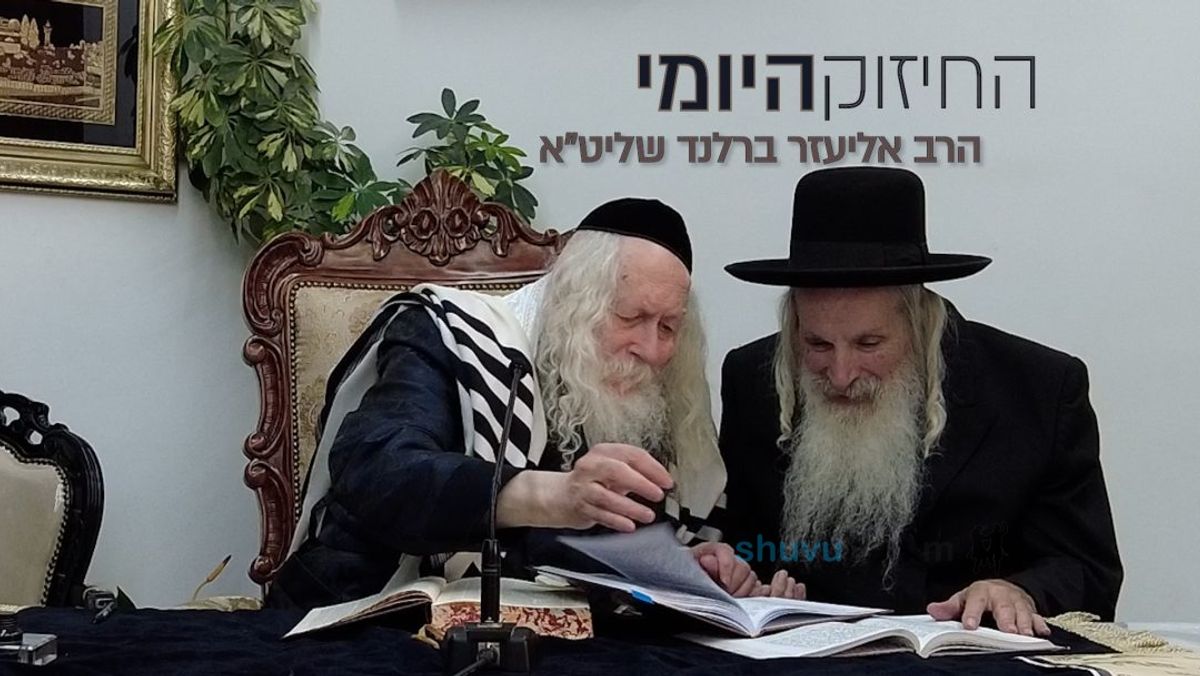
The great problem with an aveirah (sin/transgression) is not the fall itself, but what happens afterward. It is not the mere fact that a person stumbled, but that he learns to live with it. He gets used to it. He accepts it with serenity, perhaps even with joy. As long as there is regret, there is a chance for tikkun (rectification). But when a person rejoices in the evil, when he stops fighting and starts dancing with the sin—here, there is no longer forgiveness. Not because of the sin itself, but because of the apathy that follows it. One who falls and feels ashamed still has a place to return to. But one who falls and feels at peace with it is no longer looking for a way back. From there, the lowliness only continues to deepen.
Monday, 25th of Tammuz - The Daily Strengthening from the Gaon and Tzaddik Rabbi Eliezer Berland shlit"a (may he live long and good days), from a moving lesson held in the presence of the Gaon and Rabbi Eliyahu Meirav zt"l (of blessed memory) before his passing.
From Parshas Korach to Chukat, 38 years pass; suddenly 38 years jump, I don't understand this. "And not a man remained of them" (Numbers 26:65), from here we learn that not even one woman died in the desert.
The women do not die; the women live forever. The woman does not sin; it is only the man who sins. The woman sits at home quietly with 10 children; she doesn't even know that there is another world, that there are other matters, that another world exists.
https://vimeo.com/1102987011?share=copy
Rashi says, "And not a man remained of them" ¹—that no woman died; for forty years in the desert, not a single woman died. The women remained as poor widows because they did not protest the Calf; the women should have protested. The husband said, "Now you must bow to the Calf," first the Calf, then they saw them dancing and such celebrations. It was because of the dancing that he (Moshe) became angry. Fine, you made a calf, okay, it can still be understood—you were confused, you came from Egypt where they bow to a lamb. Now you bring a calf, maybe you were in India where they bow to a cow so you make a calf, it can be understood. But you are also making dances?
On this, Moshe could no longer forgive! "For when you do evil, then you rejoice" (Jeremiah 11:15). For the 'evil' itself, Hashem is willing to forgive, but Hashem is angry about the joy. You actually fell because you have a Yetzer Hara (Evil Inclination), but you are still happy and dancing and boasting? And after that, you persecute the religious people? For this, Hashem does not forgive.
Every soldier who goes to war has all his sins atoned for in a second. Afterward, he shames the religious, saying, "You go to the army too," what do you care? You went and returned alive—be happy, otherwise you would have been in Gan Eden (Paradise). A person receives a bullet to the head and goes straight to Gan Eden, but we want him to live to 120 years; we have laws.
But why did they travel to Be'eri? Because they wanted to enter Gan Eden!
1500 holy and pure young men, not knowing why—Hashem "bought" them so they would not commit any more sins. It is finished; they will enter Gan Eden. Today five young men were killed, and (among them) four were yeshiva students. Now a young man from Itamar was killed, the best boy there. Two months ago an 18-year-old boy was killed in Eli, and it connects, and every day another boy—only yeshiva students are enlisting, the secular are not enlisting, 70% of Tel Aviv does not enlist; enlist those in Tel Aviv first.
They also do not lack soldiers; next week 35,000 are enlisting, and they send them home. They are missing one division; they don't need another 10 divisions.
——————————
The women were not involved in the sin of the generation of the desert - "And the daughters of Zelophehad drew near":
In that generation, the women would "fence in" (protect) what the men would "break through." For you find that Aaron said to them: (Exodus 32) "Remove the golden earrings that are in the ears of your wives," but the women did not want to and they protested against their husbands, as it is said: "And all the people removed the golden earrings," etc.—but the women did not participate with them in the act of the Calf.
And so too with the Spies who brought forth an evil report: (Numbers 14) "And they returned and made the entire congregation complain against him," and against them the decree was made, for they said: "We are unable to go up." But the women were not with them in that counsel, as it is written above the portion (ibid 26): "For Hashem said to them, they shall surely die in the desert, and not a man remained of them except Caleb the son of Jephunneh."
A "man," but not a woman, because they did not refuse to enter the Land. Rather, the women drew near to request an inheritance in the Land. Therefore, this portion was written adjacent to the death of the generation of the desert, for from there the men broke through and the women fenced in.
Subscribe to Our Newsletter
Receive Torah articles and inspiration directly in your inbox