
Even the Most Wicked Will Ultimately Do Teshuvah | How Did Rabbi Arush Return?
The Daily Chizuk from Rabbi Berland shlit"a
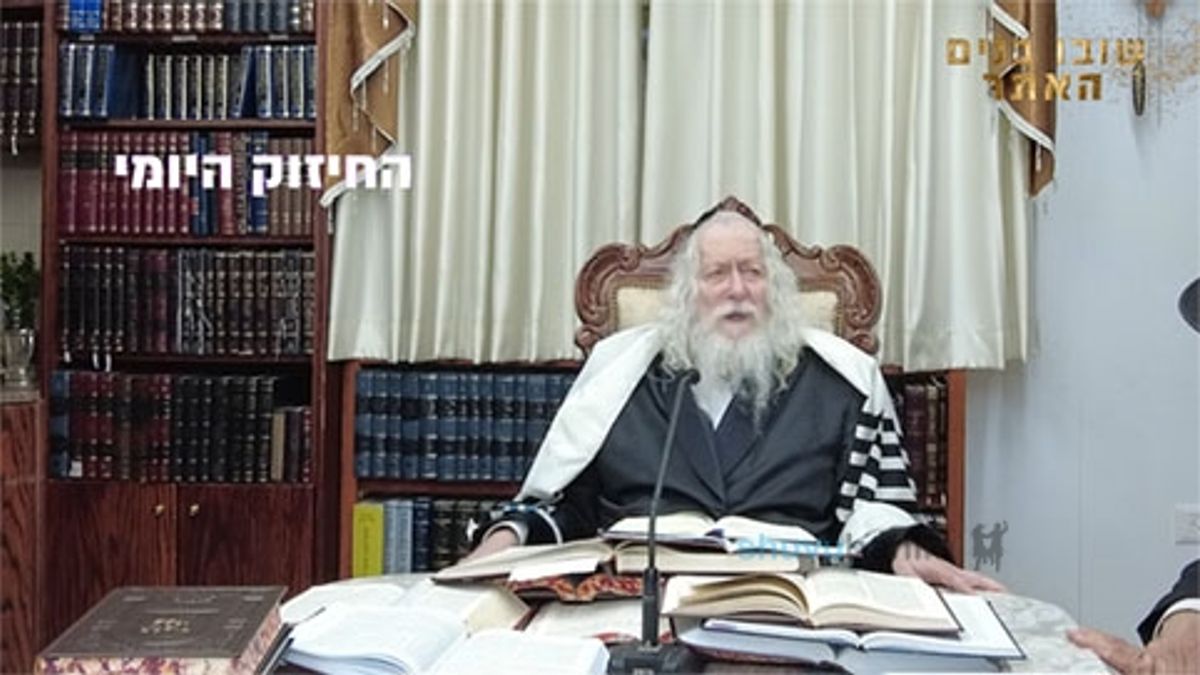
The Daily Chizuk from The Rav, Rabbi Berland shlit"a – What Should Rabbi Yochanan Have Answered Vespasian?
“‘This good mountain and the Lebanon’ (Devarim 3:25). And as for what you said: If I am the king, why didn’t you come to me until now?—because the biryonim were here; we did not allow it. He said to him: If there is a barrel of honey and a dragon is wrapped around it, would they break the barrel because of the dragon? He fell silent. Rav Yosef—some say Rabbi Akiva—applied to him the verse: ‘He turns wise men backward and makes their knowledge foolish’ (Yeshayahu 44:25) …” (Gittin 56a–b)
Thursday, 18 Elul 5785 – Judaism Is the Very Essence of a Person
These are his holy words:
Rabbi Yochanan said to Vespasian, “You will become the Caesar,” and then Vespasian wanted to kill him. What is this—what wrong did Rabbi Yochanan do? All he said was, “You will be Caesar.” Why kill him? For what reason should he be killed?
Vespasian said to him, “Don’t you see that I’m not Caesar? I’m going to kill you.” Vespasian asked, “Why didn’t you come to me until today? If I’m Caesar, then come! Why didn’t you come?”
Rabbi Yochanan answered, “It’s impossible to get out from the walls.”
What do you mean, “It’s impossible to get out”? Kill the biryonim who are rebelling inside the walls of Jerusalem—what is this? The biryonim are a minority, and you are the majority.
The Gemara says that Rabbi Yochanan “fell silent,” but Rabbi Yochanan should have told them: What do you mean? The biryonim will do Teshuvah. Even the most wicked will do Teshuvah.
Even the most wicked person has many kelipos. Right now the kelipos have overpowered him, but—every Jew is Kodesh Kodashim; even the most wicked wants to learn Torah. In the end, even the greatest rasha will become a Rosh Yeshivah as well.
There were great resha’im—resha’im who ate on Yom Kippur. We see Rabbi Shalom Arush, who is one of the greatest who bring people back in Teshuvah—he didn’t even know that there was Yom Kippur; he didn’t even know such a concept existed in the world.
Rabbi Arush related: When I flew in a helicopter during the War of Attrition against the Egyptians, I would be lowered down by rope and pull people out from the canyon; I would bandage them and lift them up into the helicopter. He said that when the Egyptians were shooting at them, he automatically shouted, “Hashem Elokim!” The biggest secular person shouted “Hashem Elokim” automatically.
https://vimeo.com/1117647127?share=copy
The war ended, and he forgot that there is a G-d in the world—until he went through a severe car accident, and the doctors told him he had no chance; only G-d will save you.
Rabbi Arush didn’t believe in anything. He didn’t know there is a G-d; it simply didn’t interest him. Yes/no—he didn’t argue with anyone. What did he need it for? He was a good soldier, a medic, a combat soldier. He flew in helicopters. In every operation they would lower him into cliffs where there were wounded soldiers; he would treat them and lift them up. What was he missing—G-d? Everything was fine.
Until one day he went through a very severe car accident. He lay injured for almost a year. The most secular doctors told him, “Only G-d will save you.” In the end they performed open-heart surgery for three hours and succeeded in saving him. And every time he came for a checkup they told him, “G-d saved you—you know it wasn’t us.” They told him themselves!
He told me word for word: they told him, “G-d saved you.” What is “G-d” to him, and what does he have to do with G-d? What was he lacking? He was living wonderfully.
In the end he grasped that there is a G-d—after all, everyone kept telling him, “G-d saved you.” Even the most secular doctors cry out “G-d.” We used to walk in Haifa with flags; afterward we began running with Sifrei Torah. In the right hand a Sefer Torah, in the left hand a torch, and we would run in the street—everyone, the most secular, the biggest apikorsim, would tell us: “A little slower, slower—we want to kiss the Sefer Torah.”
We brought all this because we are speaking about how even the greatest biryonim ultimately do Teshuvah—that is the essence. Now someone wrote an article against the apikorsim in which he writes that Judaism is not a religion like other religions. People are mistaken to think that there is Islam, there is Christianity, and then there is a third religion—but in truth, Judaism is essence; it is the person. The Torah is the person.
Subscribe to Our Newsletter
Receive Torah articles and inspiration directly in your inbox