
Everyone Says Tehillim at 4:00 PM—Whoever Doesn’t Say Tehillim Is Cruel
A Sacred Call from Rabbi Berland shlit"a
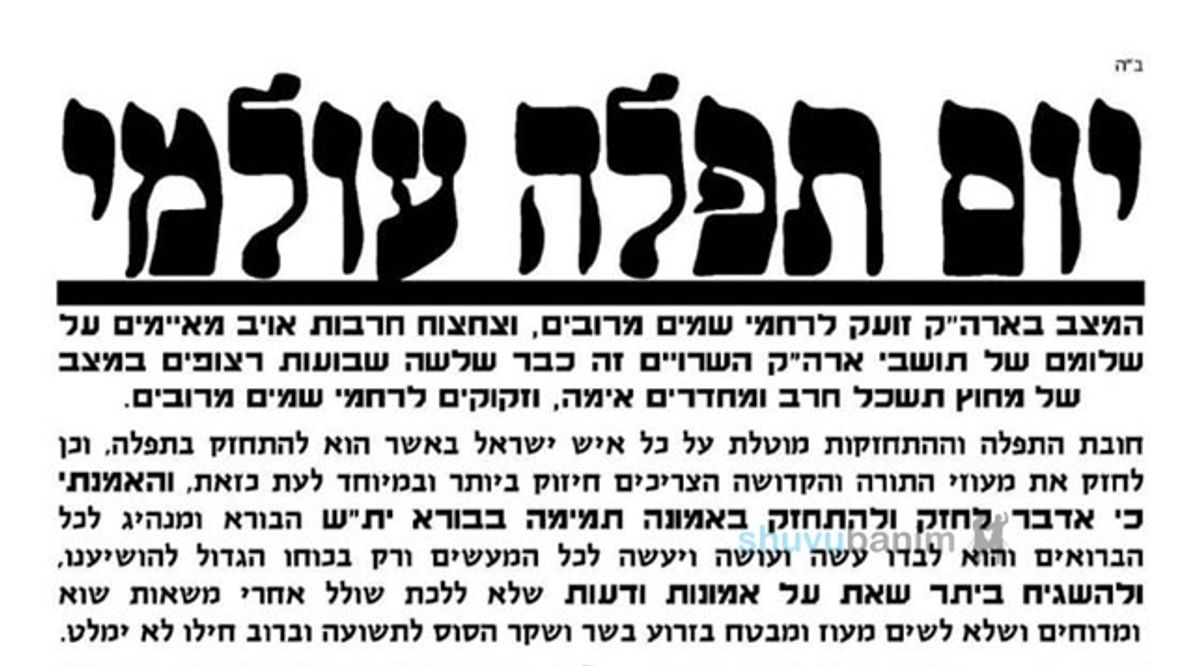
In light of the difficult situation facing the Jewish People—especially now that our soldiers have entered Gaza, which is swarming with terrorists and weaponry—this is a cry of pain from our teacher, the holy and righteous gaon Rabbi Eliezer Berland shlit"a, calling for prayer and Tehillim. Rabbi Berland shlit"a shares his view together with the Beit Din Tzedek.
The words of The Rav shlit"a are based on the Rambam’s halachos: “It is a positive commandment from the Torah to cry out and to sound trumpets over every trouble that comes upon the community, as it says: ‘Against the oppressor who oppresses you, you shall sound the trumpets.’ Meaning: any matter that causes you distress—such as drought, plague, locusts, and the like—cry out over them and sound the trumpets. This is among the ways of teshuvah. For when trouble comes and they cry out over it and sound the trumpets, everyone will know that it came upon them because of their evil deeds, as it is written: ‘Your sins have turned away…’ And this will cause the trouble to be removed from them. But if they do not cry out and do not sound the trumpets, and instead say, ‘This is the way of the world; this trouble just happened to us,’ this is a path of cruelty, and it causes them to cling to their evil deeds. Then the trouble will increase, bringing other troubles. This is what the Torah says: ‘If you walk with Me casually, I will also walk with you with the fury of casualness.’ Meaning: when I bring trouble upon you so that you will return, if you say it is mere happenstance, I will add to you the fury of that happenstance.” (Rambam, Hilchos Ta’aniyos 1:1–3).
These are his holy words:
The Beit Din Tzedek ruled that tomorrow (today, Monday, 15 Cheshvan), from 4:00 PM, throughout Eretz Yisrael and throughout the entire world—so that it will be 10:00 in New York—everyone is obligated to say the entire Tehillim starting from 4:00. In the whole world, across the entire globe, the entire planet.
Now I am reading the Rambam (which we brought above, Rambam Hilchos Ta’aniyos 1:1–3): it is a positive commandment—everyone who says Tehillim is fulfilling a Torah mitzvah, because now it is “a time of trouble for Yaakov, and from it he will be saved” (Yirmiyahu 30:7). Fifty thousand soldiers have now entered Gaza; each day they advance only 100 meters—more than 100 meters is impossible.
There are already two who are severely wounded. In the merit of the girls accepting tznius upon themselves and lengthening their skirts, so far no soldier has been killed. This is above nature—these are miracles in themselves. But if they advance only 100 meters, it will take half a year. It will take half a year, and people have no home—one hundred and thirty thousand people without homes, without parents. The parents were taken—they were turned to ash, like in Auschwitz where they were turned to ash.
You can’t even find the DNA, because the ash is mixed with bricks and boards. And people were burned inside cars—everyone ran to the cars, and then gasoline was poured on them. They prepared gasoline and set all the cars on fire; everyone was turned to ash—300 to 1,000 people were turned to ash. 300 were turned to ash—300 murdered at the party and 300 taken captive.
The Radbaz writes in siman 40 that captivity is worse than death, because it is impossible to know whom they are torturing; the soldiers are certainly being tortured with terrible tortures.
So now we are in a situation of a positive commandment: every letter of Tehillim that we say now is a Torah mitzvah. Because now it is “a time of trouble for Yaakov, and from it he will be saved”—to cry out and to sound trumpets. We need trumpets together with shofaros—may trouble not come upon the community—“as it says: ‘Against the oppressor who oppresses you, you shall sound the trumpets’” (ibid.). For three days they could not recapture the kibbutzim. The government abandoned everything; people screamed for help; the soldiers advanced, but they couldn’t enter, because in every kibbutz there were 500 terrorists—endless terrorists. It took three days to recapture the kibbutzim—when they should have been protected from the outset.
And we called, and they said 5,000 people crossed the fence—there is no fence. The most sophisticated fence in the world, which cost fifty billion dollars. If they would give 100,000 shekels to some yeshivah, the whole world would be outraged—those leeches (Torah learners), those bloodsuckers—Lapid goes out of his mind. But here they spent 50 billion on a paper fence; if they had made a fence out of cardboard and paper it would have been far better—there is no trace of a fence.
Now it is “a time of trouble for Yaakov.” There is no government. For forty hours people waited for the army to arrive, and it did not arrive. Meanwhile they burned everyone alive—there are no homes, there is nothing. A house can be built in one day. They are sleeping five people in a room one meter by one meter; they are not given food, they are not given anything—such a government has not arisen since the creation of the world, that abuses people who went through a Holocaust in this way.
The children are orphans—either there is no father, or no mother, or both are missing; they have already been turned to ash. And it is an obligation upon every person to know that now it is a time of trouble, and we are obligated by Torah law—just as the Rambam says it is from the Torah—to say, every moment, another chapter of Tehillim and another chapter of Tehillim.
Because now they fear they will launch a million rockets. They may have 100,000 rockets. Egypt doesn’t care; it is happy. And the entire Strip is full of rockets; they fire rockets without end. Except for Jerusalem, rockets don’t reach here, because we are exactly in the middle of the country—farthest from Gaza, farthest from Lebanon. The entire north is under rockets, the entire south is under rockets, Kisufim is under rockets.
And this is among the ways of teshuvah: when it is a time of trouble, a person must feel the pain of the Jewish People—one hundred and thirty thousand people without homes, without apartments, without clothing; they fled wearing only a nightgown. When you see the Jewish People in distress, everyone must say Tehillim. And girls who can say three books of Tehillim—that is above everything.
The bochurim should break their Xiaomi phones, because this Xiaomi brings all calamities. They see immodest images, and then immediately a thousand soldiers are killed in that very moment. We are in danger that at any moment a thousand soldiers could be killed. Because Hamas said they are 40,000— in truth they are 100,000—all armed with the most advanced weapons, because Iran gave them the most advanced weapons.
And even though here in Jerusalem we are the most protected—Jerusalem guards us—we still must pray for all of the Jewish People; it is a Torah obligation. To feel the pain, that we are as in the Holocaust.
This is all because they beat people (those who came to pray). Baruch Hashem, they saw public prayer in Dizengoff Square—people can pray; a thousand girls came to pray. Then Ron Huldai lost his mind—such a thing, all of Tel Aviv suddenly praying. They beat them with murderous blows—and immediately afterward they paid for it; after ten days, tragically, they paid a very heavy price. And those who went up to Gan Eden—those are tinokos shenishbu.
They beat people on Yom Kippur, and there are those who did not fast at all; in Be’eri maybe five people fasted. Now they admit everything; they say: it is all because we did not fast on Yom Kippur. A person full of sins should at least fast once a year.
Across the road it is all Hamas. Today all the Arabs are Hamas—everyone with weapons, with rockets, with artillery. We have nothing—we have nothing—like it was in Egypt: they went out, and the others came with tanks, with 600 vehicles. It is an obligation to say Tehillim at the very least.
If people do not cry out and do not sound the trumpets, and they say it happened by chance—this is cruelty. When you see that everyone is in mortal danger and you do not say Tehillim, the Rambam says this is the most cruel person possible. It is cruelty not to say Tehillim—it is cruelty. One must finish three books of Tehillim every day. Someone who does not pray—this is real cruelty, because he causes soldiers to die.
And there will be another trouble, and another trouble—because it is impossible to know. In Germany they always said: this is the last trouble. At any moment they are ready to add trouble upon troubles, to conquer us. The Germans want to conquer Eretz Yisrael again—this is all so that we will do teshuvah.
Subscribe to Our Newsletter
Receive Torah articles and inspiration directly in your inbox