
Everyone Who Was in Shuvu Banim for Shavuos Merited to See the Voices and the
Lightning • A Shavuos Holiday Lesson from the Gaon and Tzaddik Rabbi Eliezer Berland shlit"a
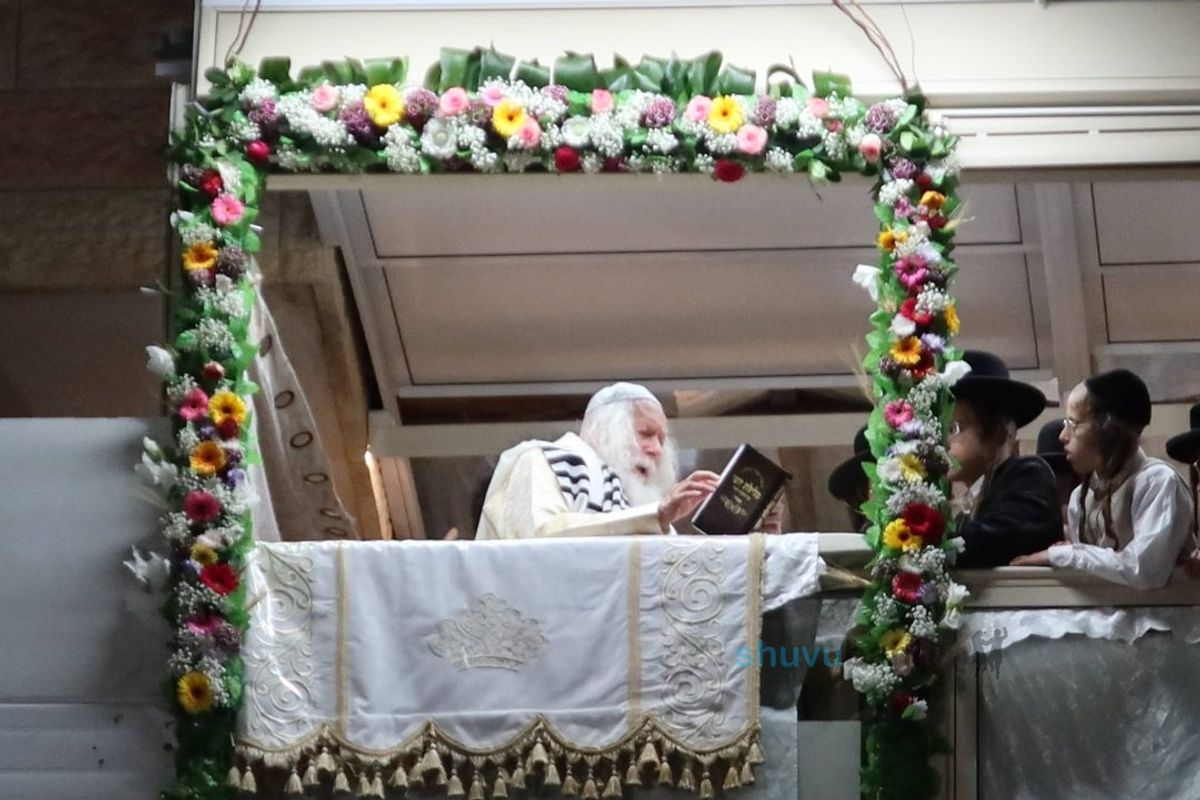
Before you is the full lesson delivered on the holiday of Shavuos during the Kiddush (sanctification over wine/meal) following the conclusion of the Musaf prayer for the Three Pilgrimage Festivals:
This lesson was transcribed according to the listener's understanding; if there is any error, it should be attributed to the writer and not, Heaven forbid, to our teacher, The Rav (Rabbi Berland) shlit"a.
Now is the Giving of the Torah. Everyone is surrounded by fire. Whoever was in Shuvu Banim merited to see the voices and lightning and to be surrounded by the fire of the Giving of the Torah, and they merit that all the sins of all their gilgulim (reincarnations) are forgiven. Just like with Adam HaRishon (the first man), where they bring silver bowls weighing 130 [shekels] to rectify him. They brought 12 silver bowls, and they didn't bring even one to the Rav; they also brought gold spoons and didn't bring anything to the Rav—can you at least take care of one spoon? Fine.
Adam HaRishon lived for 930 years and did nothing. The whole world was destroyed, I don't know why. There was an atomic bomb and the whole world was destroyed. Because Adam HaRishon didn't sing or play music; he didn't dance with the grandchildren and didn't make a Melaveh Malkah (the post-Shabbat meal); he let the grandchildren wander wherever they wanted. So they bring silver bowls. We will read this in another four days—every time they bring silver bowls, and to the Rav, it's impossible to bring even one. Nachshon [ben Aminadav] sacrificed first; it is written in Tractate Bechorot, page 5, that he had 90 donkeys full of silver and gold—so it's impossible to give me even one bowl? They say, "May my prayer be accepted like the sacrifice of Nachshon." Nachshon focused his intentions on all his grandchildren, so he merited that they all returned in teshuvah (repentance), and even Menashe returned in teshuvah; the male goat for a sin offering corresponds to Menashe.
A wind came and blew Menashe away. He was inside a pot and they roasted him like a Passover sacrifice; they thought he was a lamb. Like Adel [the Baal Shem Tov's daughter] whom they caught and wanted to roast like a Passover sacrifice. She had "tasty meat" (a metaphor for her spiritual essence). Truly, the story with her happened on the holiday of Pesach. They also caught the Baal Shem Tov and Reb Hersh and wanted to roast them. The Baal Shem Tov said to Reb Hersh, "Rebbe, do something!" Then the Baal Shem Tov said, "My mochin (higher consciousness) have left me; I don't remember anything, but maybe you can say something." Reb Hersh said, "My mochin have also left me, and I only remember the Aleph-Bet (alphabet)." [The Baal Shem Tov replied,] "You remember the Aleph-Bet? That's the best! Say the Aleph-Bet." And then a chariot arrived, and it was Eliyahu HaNavi (Elijah the Prophet); the F.B.I. arrived. I don't know if it was with "kosher phones" (filtered mobile devices). You are an American and should know, but I checked and they were non-kosher phones.
When the Baal Shem Tov traveled to Eretz Yisrael (the Land of Israel), he didn't want to travel by ship at all. Who invented the idea that one must travel by ship? A ship isn't needed at all. In the end, the Baal Shem Tov arrived at the port and looked for a ship until he chose the most broken and dilapidated ship, like scrap metal, and traveled on it. It turned out that this was the ship on which the Rokeach [Rabbi Elazar Rokeach of Amsterdam] traveled to Eretz Yisrael. He traveled in 5502 (1742) and was in Eretz Yisrael for a whole year and was the Rabbi of Tzfat; his signatures are there where this is written. Rabbi Elazar Rokeach wrote a commentary on the Mishnah. The Baal Shem Tov didn't want to travel by ship at all. Also, Reb Yitzchak of Drohobych, when he traveled to Eretz Yisrael, sat on the shore and waited for a ship to come. Reb Yitzchak of Drohobych was the father of Reb Michel [of Zlotshov]. When his first child was born, he sent him away (he passed away)—"I don't need such a child." When the second child was born, he also sent him away. And when the third child was born, he also sent him away. And when the fourth child was born, he also wanted to send him away, but his wife came and started shouting, "I also deserve something, leave him!" A person must be considerate of his wife; he cannot do whatever he wants. So she said, "Leave him for me," and he left him, and that was Reb Michel of Zlotshov, who said about himself that such a pure soul as his body had not existed for 500 years. He had such a pure body—so what then is Rabbeinu (Rebbe Nachman)? There is no grasp of this at all. Rabbeinu is the revelation of Moshe Rabbeinu (Moses). Now, at the Giving of the Torah, it is the revelation of Moshe Rabbeinu.
Moshe Rabbeinu is the Nefesh of Yechidah; Rashbi (Rabbi Shimon bar Yochai) is the Ruach of Yechidah; the Arizal is the Neshamah of Yechidah; the Baal Shem Tov is the Chayah of Yechidah; and Rabbeinu (Rebbe Nachman) is the Yechidah of Yechidah (the highest levels of the soul), where there is nothing else—one can travel to Eretz Yisrael. Reb Avraham ben Reb Nachman told everyone to move to Eretz Yisrael, but they didn't listen to him; only Reb Meir Anshin moved to Eretz Yisrael. Reb Avraham ben Reb Nachman (the Ra'abarn) said [in Yiddish], "I should live to see your children put on Tefillin." The Ra'abarn was "against" Tefillin (a paradoxical statement emphasizing the difficulty of the times), I don't know why. He said, "I will live if your children put on Tefillin." In the end, the Communists slaughtered everyone.
There was Trotsky; he established the Communists. I just read an article that all of Communism was [led] by the Jews. Trotsky was killed by someone who entered his room with an ice axe and struck him in the back of the neck with the axe, but it didn't cut through completely, and he lay there for 4 days until he finally passed away on Tu B'Av. Lenin died on Tu B'Shvat and Trotsky on Tu B'Av. This was in 1924 and that was in 1940. Trotsky said not to let Stalin lead after Lenin, but they interpreted it differently and Stalin rose to power. He killed 80 million people. Khrushchev said he only killed 20 million, but in truth, it was 90 million people. Hitler killed 9 million, and Stalin killed 90 million. The Ra'abarn once immersed in the mikvah (ritual bath) and said he saw skulls floating in the water. There were bowls there, but he said, "I see skulls." They thought he was crazy and talking nonsense. In the end, everyone was slaughtered.
Now we have read the Ten Commandments, and the main thing is "Do not commit adultery"—to leave these [immoral] things. A woman doesn't want this at all, and after she has a child, the story is over. It is written in the Baal HaTurim regarding "the sons of Aaron" and not "the daughters of Aaron," that women are not associated with sin at all, unless there is bad company that causes her to sin, but on her own, she has no Yetzer Hara (evil inclination). The Shelah HaKadosh says that during the Sin of the Golden Calf, the zuhama (spiritual impurity) returned only to the men and not to the women. The Kotzker Rebbe says that "Do not commit adultery" regarding another man's wife also refers to a person's own wife [meaning one must maintain holiness even with his own wife]. This is the meaning of "Do not commit adultery."
Subscribe to Our Newsletter
Receive Torah articles and inspiration directly in your inbox