
"Facing the Menorah" • Parshat Behaaloscha from the Gaon and Tzaddik Rabbi
Eliezer Berland shlit"a
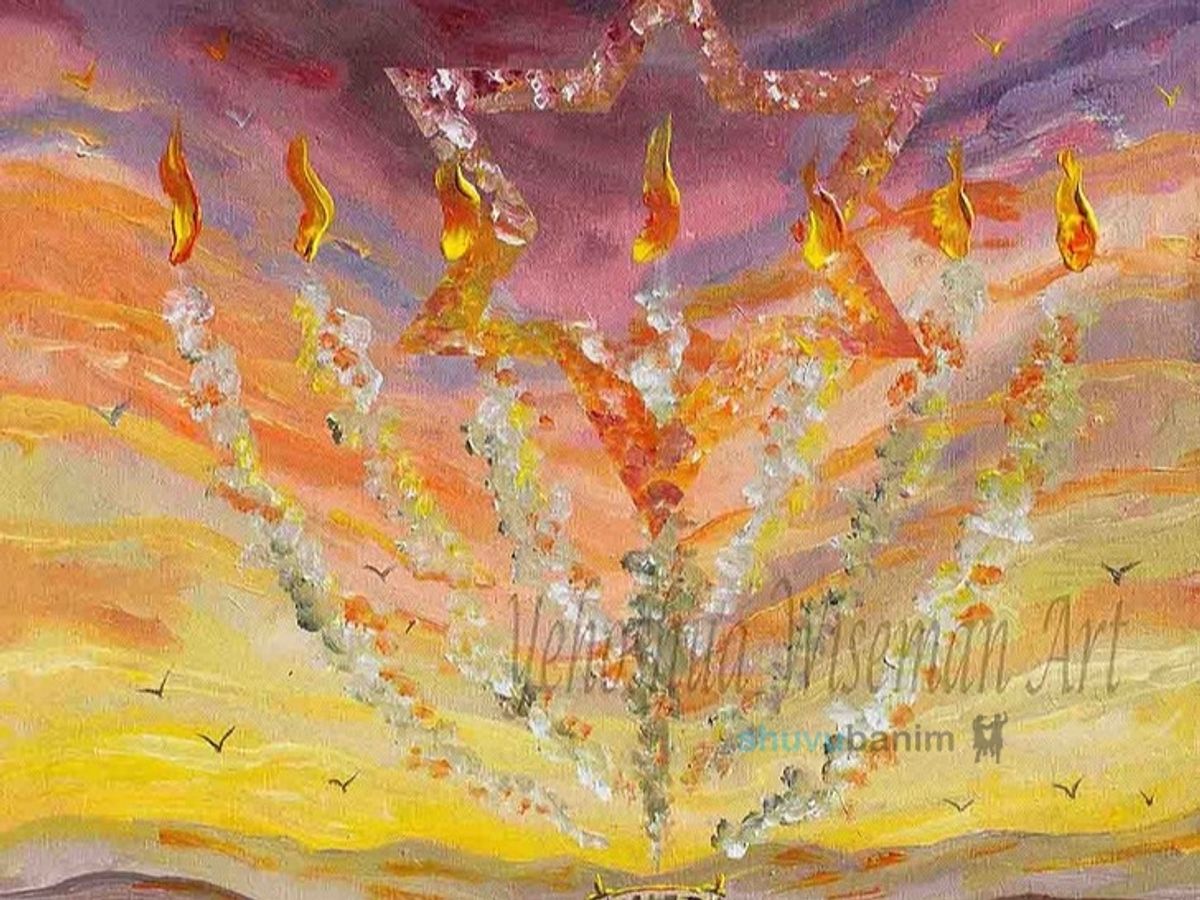
Wonderful insights and pearls from our teacher, the Gaon and Tzaddik Rabbi Eliezer Berland shlit"a, for Parshat Behaaloscha:
"When you raise the lamps" – Raising the Malchus to the Keter
Rebbe Nachman says in Torah 85, Part II - Shabbat Nachamu (the Shabbat of Consolation) after Tisha B'Av, this is to connect the *Shin* with the *Nun*. The *Shin* is Hod (Splendor) and the *Nun* is Netzach (Victory), and through this, one merits "A woman of valor is her husband's crown" (Proverbs 12:4). Because the woman is higher than the man; the woman is always in the Sefirah (Divine emanation) of Atara (Diadem) - in Keter (Crown). "When you raise the lamps" (Numbers 8:2), the holy Arizal says this hints that the Malchus (Kingship) will rise to the Keter (Crown), because the woman is the Malchus and she rises straight to the Keter. Therefore, every woman can be a Kohen Gadol (High Priest), every woman. Like Yael who became Eli. Every woman, in a future gilgul (reincarnation), can be the Kohen Gadol.
"Facing the Menorah" – The home as a Sanctuary
It is written that the home is a Beis HaMikdash (Holy Temple). What is the Mishkan (Tabernacle)? Mishkan is *M*itah (bed), *Sh*ulchan (table), *K*iseh (chair), *M*enorah (lamp). For the table is the table of the Beis HaMikdash, the bed is the Aron HaKodesh (Ark of the Covenant) – it is the Ark of the Beis HaMikdash, the Menorah – it is the Menorah of the Beis HaMikdash. For soon it will be "When you raise the lamps," "When you raise the lamps, facing the Menorah the seven lamps shall shine" (Numbers 8:2). When a person learns Torah, he lights the Menorah. Every letter in the Torah lights the Menorah; every letter. With one letter, it is possible to revive the dead – one letter.
"And Aaron shall wave the Levites" – On the shaving and the controversy
Even though in the Passover Haggadah, the one who "does not know how to ask" is a million times worse than the wicked one. Why don't you know? Why don't you ask? At least the wicked one asks, "What is this service?" However, since he asks, it is possible to answer him and he will receive the answer and return in teshuvah (repentance). But because he does not ask, he will never receive an answer and will remain in his folly. And seemingly it is difficult: what is the difference between the wise son and the wicked son? For the wicked son says, "What is this service to *you*?" – to you and not to him. And because he excluded himself from the klal (collective), he denied the fundamental principle. You too, "blunt his teeth" and say to him: "Because of this Hashem did for *me* when I left Egypt." For me – and not for him. Had he been there, he would not have been redeemed. But he too – the wise son asks, "What are the testimonies, statutes, and laws that Hashem our G-d commanded *you*?" He also said "you" and did not include himself with the klal by saying "us." Rather, the son is wise; only after forty years can you ask questions. But the wicked one – let's see you, if we were in the time of Korach, we would be the first ones, we would be the first ones throwing stones at Moshe Rabbeinu. For Korach argued against Moshe and Aaron: "What is this? Here he shaved everyone's beard and peyos (sidelocks)!" For at the time Aaron sanctified the Levites to work in the Mishkan, it was said: "Take the Levites... and thus you shall do to them to purify them: sprinkle upon them the water of purification, and let them pass a razor over all their flesh, and Aaron shall wave the Levites as a wave offering before Hashem from the Children of Israel, and they shall perform the service of Hashem" (Numbers 8).
It's not simple; everyone comes home without a beard and peyos because they passed a razor over all their flesh. What's going on here? Where have we gotten to? Heavens be appalled! I don't know. This is what the Gemara says (Sanhedrin 110a): Korach's wife was a righteous woman, and when Korach returned home after they shaved his whole body, she lost her mind. She didn't understand what was happening here. "Where are your peyos? Burned! What's happening? Who stole your peyos? Did they open a museum of peyos? Where are your peyos?" She screams at him. He was afraid to speak. "Tell me, who sheared you? Tell the truth, come on, tell me who did this to you? I'll burn his head! I'll burn him! I am a woman, I don't know tricks."
A woman is like a ruler (straight); she doesn't know tricks. Therefore, they need to be told what is permitted and what is forbidden. If Moshe is a shearer of peyos, then he is a shearer of peyos, and that's it. What can you do? She doesn't understand who Moshe is; she knows that it's forbidden to cut peyos, that's what she knows. But you (the Levites) worked with the Golden Calf. Even though the Levites didn't actually worship it, they didn't protest the Calf, so the peyos became defiled. It's true you didn't worship, but you didn't protest. Why didn't you start a milchemet achim (civil war)? Why, when they returned eight journeys back, did you start a civil war and twelve families were killed – seven from Benjamin and five from Levi? Some say the opposite, seven from Levi and five from Benjamin, and this is learned (Rashi, Numbers 26:13) because families are missing from Benjamin. Why, when the Jewish people were returning to Egypt when the Clouds of Glory departed, did the tribe of Levi go out to war, but here they didn't go to war? In the incident of the Concubine in Gibeah, for one woman seventy thousand were killed (see Judges 19-20). Here they are going to make a Calf, half of Israel should be killed! There they destroyed an entire tribe – the whole tribe of Benjamin; by a miracle six hundred men remained. Fine.
"We are impure because of a human soul"
Everything we came into the world for is to recognize Yosef HaTzaddik. The world was only created to command this (Berachos 6b, Shabbos 30b), to create a connection (*tzavta*) with the tzaddik. Everything a person comes into the world for is to reveal the True Tzaddik. A person comes into the world for only one purpose: to reveal the True Tzaddik. Therefore, one must learn Shas (the Talmud), Gemara, all to reveal the True Tzaddik. "We are impure because of a human soul" (Numbers 9:7). All of a person's work from the moment he is born is to reveal the True Tzaddik. There is a Tzaddik of the generation – the True Tzaddik. All generations are drawn from the True Tzaddik. All generations – all souls are all sparks of the True Tzaddik, who is the secret of Bereishis (the Beginning). On Simchat Torah we will begin reading the book of Bereishis, and after that will be Shabbat Bereishis. Bereishis is the *Rosh Bayis* (Head of the House), the Head of the House upon whom the whole world and all generations stand.
Rebbe Nachman said, "I could bite wood from the intensity of the suffering I have." Rebbe Nachman came to the world and says (Shivchei HaRan 25): "I could bite wood and cut it with my teeth from the intensity of the suffering I took upon myself until the end of all generations." Rebbe Nachman took upon himself all the suffering of the Holocaust; Rebbe Nachman took everything. We just need to know how to use the merit of Rebbe Nachman, for Rebbe Nachman is the True Tzaddik, the True Tzaddik of all generations. Rebbe Nachman came to the world to sweeten the judgments.
"Stand and I will hear what Hashem will command you"
And the fourth matter is that for all the prophets, the spirit of prophecy would not rest upon them at their will, except for Moshe, who whenever he wanted, he would receive prophecy. Moshe wants prophecy, he receives prophecy, as he says, "Stand and I will hear what Hashem will command you" (Numbers 9:8). He receives prophecy every day. A prophet receives prophecy when Hashem wants, suddenly. "And Hashem said suddenly to Moshe and to Aaron and to Miriam" (ibid 12:4). Only by Hashem's will does He inform him of the matter through prophecy, and he might wait until he prophesies for days or years. He can play harps and drums and not receive prophecy. There are prophets who prepare themselves for whole days to receive prophecy, and he waits until he prophesies after days or months and it won't help him. He prepares himself for months to receive prophecy and it won't help him, by no means. And there were already groups of them who would prepare themselves and refine their thoughts, as all the prophets go and play music, like Saul who encountered a band of prophets trying to prophesy – trying, not succeeding. They said: "Is Saul also among the prophets?" (I Samuel 10:11). He fell on his face to the ground. They prepare themselves for years upon years to play harps until he receives some prophecy after days or months, or they won't inform him at all. And there were already groups of them who would prepare themselves, prepare themselves and refine their thoughts as Elisha did, as it is written (II Kings 3), "And now, bring me a musician." The first thing is the niggunim (melodies). One who plays music will eventually merit prophecy. The first thing a person should do is start playing music, that's the first thing, that's 'A', before everything. "Bring me a musician," and then the prophecy came to him. But it's not like that with Moshe – with Moshe, prophecy must come. Moshe Rabbeinu entered the Holy of Holies at every moment, every second between the Cherubim. And Moshe Rabbeinu, peace be upon him, at any time he wanted. It is written regarding the daughters of Zelophehad, "And Moshe brought their judgment (with a large *Nun*)" (Numbers 27:5), for they merited the 50 Gates of Binah (Understanding). He receives prophecy at any time he wants. "Stand and I will hear what Hashem will command you" (Numbers 9:8) – he says to the daughters of Zelophehad: "Stand, wait a second, I'm going into the room, I'm coming out, I will tell you what Hashem said to you."
For the Gemara says: What? They didn't know that a daughter inherits? Everyone knows that if there are no sons, the daughter inherits. So Moshe didn't know? He specifically didn't know? He forgot when a daughter inherits when there are no sons? If there are no sons, she receives the whole inheritance. And here there were no sons. What? Over forty years there weren't people who had only daughters who received the diamonds and jewelry? What is Moshe doubting? One explanation is the portion of the firstborn – if they deserve the firstborn portion of their father, perhaps that belongs to the brothers. And a second explanation, Tosafot says, is that the Spies and the assembly of Korach lost their portion in the Land; now the question is if perhaps they also lost their portion.
Because he did a terrible thing – he gathered wood on Shabbat. The Gemara says: No, the fact that he gathered wood on Shabbat was not a rebellion against Moshe. On the contrary, he wanted to show the law that there is sekilah (stoning). People didn't know that if you put one branch on another branch, you are liable for stoning. They didn't know this; even though they were taught, they didn't believe it. He showed them that he puts branch on branch, because on Shabbat it is forbidden to pile (*me'amer*). If oranges fall, it is forbidden to put one on the other. Suddenly a mountain of oranges spills or a crate, so you can't put one on the other. You have to sweep them to the corner and leave them scattered like that. You cannot make a structure – one on the other. This is called *me'amer* (gathering) – a prohibition of stoning. So he came to show them that if one places branch on branch, there is a prohibition of stoning, to teach. On the contrary, he didn't come at all to disagree with Moshe, but he came to strengthen Moshe. But one who disagrees with Moshe – with the tzaddik – did not receive a portion in the Land; only Caleb and Joshua received the portions of everyone.
Here we see that Moshe says to the daughters of Zelophehad: "Stand and I will hear what Hashem will command you." And it is said, "Speak to Aaron your brother, that he should not come at all times into the Sanctuary" (Leviticus 16:2), but Moshe can come at any time.
The lesson was edited, and if any error has occurred, it should not be attributed G-d forbid to our teacher the Rav shlit"a, but to the writer, "and with us remains our error."
Painting courtesy of the artist R' Yehoshua Wiseman, for purchase: www.yehoshuawiseman.com
The Shuvu Banim website system wishes you, the readers and followers,
a peaceful and blessed Shabbat!!!
Subscribe to Our Newsletter
Receive Torah articles and inspiration directly in your inbox