“For He Will Conceal Me in His Sukkah” • Coverage of the Sukkot Holiday in the
Presence of the Gaon and Tzaddik Rabbi Berland shlit"a
Prayers of the holy holiday with the participation of the Rav shlit"a ○ The Musaf prayer with singing and melodies ○ Simchat Beit HaShoeva (celebration of the water drawing) on the night following the holiday
With Siyata d'Shmaya (the help of Heaven) and through His great kindness, we were privileged this year, Sukkot 5785 (2024), to have the prayers in the presence of the Rav shlit"a. Before you is an extensive report of the prayers of the first day of the Yom Tov (holiday) of Sukkot, which took place in our Beit Medrash (study hall/synagogue) in Jerusalem with the participation of the Rav shlit"a:
At 6:27 PM, the Rav shlit"a came out to the balcony of his home, dressed majestically in pure white holiday garments for the Mincha (afternoon) prayer of the eve of the holiday. After nearly ten minutes of singing 'Or Zarua Latzaddik' (light is sown for the righteous) with great chayus (vitality), he stood for the Mincha prayer.
After the Chazarat HaShatz (the cantor's repetition), the Rav recited the psalm 'Hashem Melech Ge'ut Lavesh.' After the conclusion of the Mincha prayer, the Rav shlit"a recited the Seder HaHiskashrus (order of connecting to the Tzaddik) word for word, with the entire congregation repeating after him. Afterward, the Rav began the melody of 'Barchu' (the call to prayer) before Maariv (the evening prayer). After the roar of 'Barchu' from the pure mouth of the Rav shlit"a, they began the Maariv prayer for the Shalosh Regalim (three pilgrimage festivals) for the night of the sanctification of the Sukkot holiday—with chayus (vitality) and enthusiasm, accompanied by all the traditional melodies. After the Maariv prayer, the Rav recited the psalm 'Samachti B'omrim Li...' (I rejoiced when they said to me...) as is customary, and after Aleinu L'shabeach (the closing prayer), he entered his holy home at 7:25 PM to the singing of 'V'samachta B'chagecha' (and you shall rejoice in your holiday) after a prayer service of nearly an hour.
"Save us, please, for the sake of our being uplifted like angels of fire"
For the Shacharit (morning) prayer, the Rav shlit"a came out at 5:12 AM and began with some of the verses of Tikkun Chatzos (midnight lamentations) that are recited, as well as the piyut (liturgical poem) 'Sha'arei Zion' in the sections customary to recite on Sabbaths and holidays. Afterward, the morning Zemiros (songs of praise) were sung with wonderful chayus (vitality). After a break of about five minutes, he descended to the hall of our Beit Medrash and began reciting the Pesukei D'Zimra (verses of praise) as on every Sabbath and holiday with great awakening and like a blazing fire. We should note the special lengthiness during the Shacharit prayer during the singing of 'Ki Chol Peh Lacha Yodeh' (for every mouth shall thank You) during the recitation of 'Nishmat Kol Chai.' The Rav extended this for about six minutes.
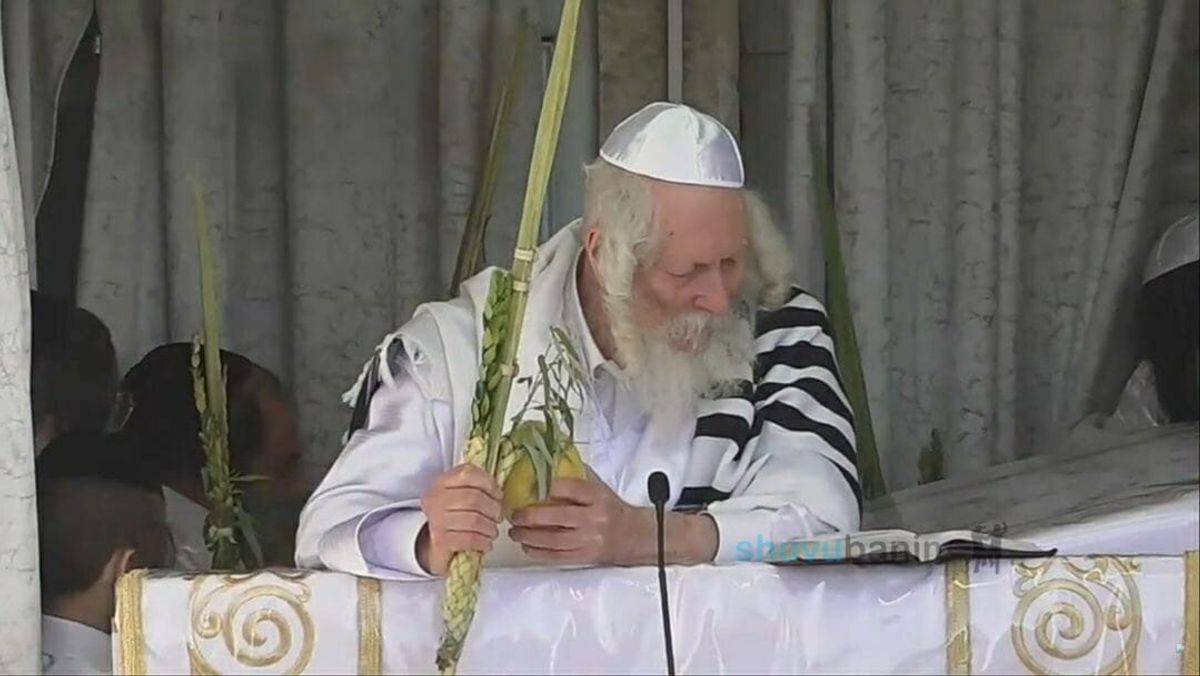
Afterward, the blessings of the Shema and the Shacharit prayer for the Shalosh Regalim (three pilgrimage festivals) were recited; the Rav shlit"a stood for the Shemoneh Esrei prayer exactly at the moment of Netz HaChama (sunrise). Immediately after the Chazarat HaShatz (the cantor's repetition), the Rav shlit"a announced that there would now be a break for a few minutes so that everyone could go and take their Arba'at HaMinim (four species). The Rav shlit"a took the trouble to ascend to the Sukkah in his holy home to take the Arba'at HaMinim. After about a ten-minute break, the prayer hall was already filled from wall to wall, with everyone holding their Arba'at HaMinim in hand. How magnificent and heart-stirring it was to see the Tzaddik re-enter our Beit Medrash with the beautiful Lulav (palm branch) and Etrog (citron) in his holy hands. Facing him were nearly a thousand people from Anshei Shelomeinu (our community of followers) who came to celebrate the Sukkot holiday in this great and holy house, in the Tzila d'Mehemanuta (the shadow of faith—the Sukkah).
The Rav shlit"a began the singing of Hallel (psalms of praise), which lasted over forty minutes with chayus (vitality) and a blazing fire, including all the melodies. 'B'tzait Yisrael MiMitzrayim...' (when Israel went out of Egypt) alone lasted twenty-five minutes; it is impossible to describe the intensity and the singing over and over again, like an ever-strengthening spring—the vitality only rose from moment to moment as the joy of the holiday burst forth all at once. Similarly, during the melodies between the verses of 'Hodu L'Hashem Ki Tov...' (give thanks to Hashem for He is good) and 'Ana Hashem Hoshia Na' (Please, Hashem, save us), the holy melodies lasted for several minutes each. All this, of course, while at the times customary to wave the species, he would stop the singing and wave them as is the practice together with the entire congregation. Immediately after the conclusion of Hallel, the Rav shlit"a began the recitation of the Hoshanot (processional prayers) with the Sefer Torah (Torah scroll) beside him, 'Hoshana L'ma'an Amitach...' (Save us, please, for the sake of Your truth). At the conclusion of the Hoshanot, he began the singing of 'Hoshia Et Amecha...' (Save Your people) for several minutes.
After the conclusion of the Hoshanot, the Rav instructed to take out the Sefer Torah (Torah scroll), and together with the congregation in a state of great awakening, he recited the Yud-Gimmel Middot (thirteen attributes of mercy) three times as is customary on the Shalosh Regalim, followed by the full 'Yehi Ratzon' (may it be Your will) prayer. During the Torah reading, several people were called up, with the Rav shlit"a taking the Aliyah (call to the Torah) of Rabbeinu HaKadosh (Rebbe Nachman)—the fourth Aliyah. Afterward, he read the Haftarah (prophetic reading) from the book of Zechariah regarding the prophecy of the end of days and the sin of Egypt and the sins of all the nations who will not ascend to celebrate the Sukkot holiday. It is worth noting that although there are only five people called to the Torah on the holiday, the entire Torah reading along with the Haftarah lasted about half an hour.
"And gather our dispersed from the ends of the earth"
At the conclusion of the Torah reading, the Rav shlit"a began the piyut (liturgical poem) 'Yah Eli V'Goali...' (G-d, my Power and my Redeemer) with the special Breslov melody as led by the Rav shlit"a, and then he approached the Musaf (additional) prayer of the Shalosh Regalim.
During the Chazarat HaShatz (the cantor's repetition), the Rav extended particularly on the melody of 'V'karev Pezureinu MiBein HaGoyim...' (and bring our scattered ones close from among the nations) for several minutes with a blazing fire. Afterward, during the singing of 'V'havianu L'Zion Ircha B'rina...' (and bring us to Zion Your city in song), the Rav inspired the entire congregation with his holy hand movements as they jumped and danced in supplication... 'And to Jerusalem, the house of Your Sanctuary, with everlasting joy...' the entire congregation was revitalized with a blazing fire and hand-clapping with great Mochin (spiritual consciousness). After nearly twenty minutes of the Musaf prayer, the Rav shlit"a finished the Chazarat HaShatz and concluded the prayer service in order, starting from 'Kaveh El Hashem,' 'Aleinu L'shabeach,' 'Adon Olam,' and 'Anim Zemirot.' After everything, he even recited the Tikkun HaKlali (the General Rectification). Following the conclusion of the Tikkun HaKlali, he delivered a Shiur (Torah lesson) of about two minutes on the matters of the holiday—words of the Living G-d. He entered his holy home at 9:20 AM, after more than four hours of the holiday prayer together with the Rav shlit"a.
"Save us, please, save those who call to You"
During the Mincha (afternoon) prayer in the afternoon of the holiday, we were also privileged that the Rav shlit"a came out to pray with us at 6:23 PM, close to sunset. He stood immediately after the Kaddish for the Shemoneh Esrei of the Mincha prayer of the Shalosh Regalim. Surprisingly, after Mincha, the Rav shlit"a said 'Hashem Melech,' even though the holiday can never fall on a Friday. This matter drew the attention of those who follow the prayer versions of the Rav shlit"a, who in most years would sing 'Samachti B'omrim Li,' and in a few years 'B'tzait Yisrael' or 'Lamnatzeach BiNginot.' After the conclusion of the Mincha prayer, the Rav shlit"a began the melody before 'Barchu' and started the Maariv (evening) prayer for the conclusion of the first day of the holiday with melodies, chayus (vitality), and endless enthusiasm.
"I rejoiced when they said to me, 'Let us go to the house of Hashem'"
After the Maariv prayer, the Rav shlit"a immediately conducted the fifteen verses of 'Shir HaMa'alot' (Song of Ascents) as is customary to say during the Simchat Beit HaShoeva (celebration of the water drawing). The Rav would say a verse and the entire congregation would repeat after him. One could truly feel in every single psalm the Levites on their platform singing, ascending another level in the fifteen steps, while all of Israel dances.
After finishing the recitation of the Simchat Beit HaShoeva verses, the Rav shlit"a performed Havdalah (the ceremony marking the end of the holiday). It should be noted that this is the first time in this period that we have been privileged to have Havdalah at the conclusion of the first day of Sukkot with the Rav shlit"a. This is because this year, the Rav's household arranged a Sukkah over the heads of the Jewish people [on the balcony], and thus, throughout all the holiday prayers when the Rav was on the balcony, he was under the Sukkah.
At the conclusion of Havdalah, the Rav shlit"a entered his holy home at 7:10 PM, and Anshei Shelomeinu (our community of followers) continued the joy of the holiday with the dances of Simchat Beit HaShoeva with a blazing fire in the prayer hall, which continued until close to the hour of midnight.
Subscribe to Our Newsletter
Receive Torah articles and inspiration directly in your inbox