
For the Yahrzeit Day — the Chassid Rabbi Naftali HaLevi Chanael’s zt"l (11
Nissan 5680)
Outlines of the Character of the Chassid Rabbi Naftali HaLevi Chana'les zt"l • His Childhood and Days of His Life • His Activity for the Benefit of All Israel • His Journey to Uman to the Gravesite of Rebbe Nachman of Breslov • His Tragic Passing and Burial Place
A Holy Activist
Between the alleyways of the Tzfat of Above, one of its men of ascent walks about, namely the righteous activist Rabbi Naftali HaLevi Chana'les. He stands at the head of the campaign for the purity of the holy; he feared that the Haredi institutions would be subordinate to the Zionist institutions, and on this, Rabbi Naftali stood on guard. And on the other hand, at that very moment, he was busy saving from death one of the leaders of the Zionist leadership, who had been caught by the tyrannical governor Djemal Pasha. Such was Rabbi Naftali; the love of Hashem, His people, and His land were what moved him, and as Rabbi Shmuel Horowitz writes about him (Yemei Shmuel, Chapter 42): "And the rule is that such an activist of Israel - it is hard to find!"
His Lineage and Childhood
Rabbi Naftali was born in the year 5617 in the city of Bohopoli (today Pervomaisk) in Ukraine to his father, the Chassid Rabbi Shaul Shalom HaLevi Doktorovitz of Bohopoli, and to his mother, the righteous and famous Rabbanit Chana, who was a descendant of the holy Baal Shem Tov and Rabbi Yechiel Michel of Zlotshov. Rabbi Naftali used to always sign his signature: 'Naftali Chana'les, grandson of the Baal Shem Tov'.
When Rabbi Naftali was young, about ten years old, he performed an act of self-sacrifice in his city; Rabbi Naftali went and smashed the cross, the idol of the Christians. The matter became known to the government, and an order was sent to capture him and put him on trial for this act. Rabbi Naftali had to hide from the authorities who were searching for him, and because of this, the thought of fleeing Russia strengthened in his parents' minds. Through miracles, the family members managed to leave Russia, and in the year 5628 – when Rabbi Naftali was eleven years old – the family ascended to the Land of Israel and settled in Tzfat. The residents of the city of Tzfat recognized their greatness; Rabbi Shaul Shalom and his wife, the Rabbanit Chana, were among the most important and honorable people of the city of Tzfat.
The Days of His Life and His Work
"One of the unique people of Tzfat, a sublime, holy, and pure Chassid, a man of good deeds, a friend of Hashem and a friend of all Israel, a fruit of the Holy of Holies" - this is how his friend and acquaintance Rabbi Yeshaya Horowitz (the father of Rabbi Shmuel Horowitz) writes about him. Not only did he hold him in great respect, but the rest of the people of Tzfat who knew him also valued and honored him greatly. The residents of the city would bring him notes with names (kvitelach) for prayer for those in need of salvation, and Rabbi Naftali would bring about salvations for them through his prayer. Rabbi Naftali was not only beloved among the people of the Old Yishuv, but even the Jews who were far from Torah and mitzvot loved and respected him. And as Rabbi Yeshaya Horowitz writes about him: "In every place he came to, in the countries of Russia, Poland, and Austria, they would be stirred by his name and his good memory."
Rabbi Naftali was a holy man, elevated above the people, a servant of Hashem and a Torah scholar. The words of our holy Rebbe to increase the recitation of Psalms were a lamp to his feet, and he would say the entire Book of Psalms every day, in addition to several other orders of the holy books. Rabbi Naftali was also an expert mohel, and thousands of children were circumcised by him; being a clean and orderly person, they accepted him as the mohel of the Hadassah Hospital in Tzfat. Additionally, Rabbi Naftali was a teacher of young children, educating them in Torah and fear of Heaven.
Before Kings He Shall Stand
Rabbi Naftali, in his self-sacrifice for his people, did not recoil even before the tyrannical governor of the region, Djemal Pasha, and dealt with him for the benefit of the people of Israel. The governor Djemal Pasha did not account for anyone and would kill as he saw fit without mercy. The mere mention of his name would arouse horror. But Rabbi Naftali was different from other people; he found favor in the eyes of the governor, who respected and valued him greatly. His dignified form and impressive appearance also contributed to this.
Rabbi Naftali saved many souls of Israel from the wrath of Djemal Pasha, even those for whom a death sentence had already been decreed; Rabbi Naftali put his life in his hands, spoke in their defense, and saved them. Even Jews who were not observant of Torah and mitzvot, and even those from the heads of the Zionist leadership, he worried for and acted to save from the hands of the cruel governor.
In the Shadow of the Rebbe
Rabbi Naftali Chana'les was close to the teachings of the Rebbe. Although not much is known about him, as Rabbi Shmuel Horowitz recounts, Rabbi Naftali traveled specifically and intentionally to Uman to the holy gravesite, in order to fulfill the testament of our holy Rebbe, Rebbe Nachman of Breslov, that they should come to his grave. And this must be understood, that a journey in those days was full of hardships and difficulties; at first, one had to ride a donkey or a mule to the city of Beirut in Lebanon, climbing mountains and descending hills. There were even people who lost their lives on this ride. From there, one had to sail by ship in the stormy sea to Istanbul, Turkey, or Galati, Romania, and from there continue in the hardships of the journey until the place of the Holy of Holies in the city of Uman. And all this Rabbi Naftali did, and he eventually merited to prostrate himself on the holy gravesite.
It should be noted that at that time, it was not a great honor to be a Breslov Chassid, and that is putting it mildly... And even this obstacle Rabbi Naftali overcame, being respected in many circles, and even those who were not in 'great friendship' with Chassidut and the Chassidim of Breslov.
Rabbi Yisrael Karduner sent a letter with Rabbi Naftali to Rabbi Natan Trubitzer and his son Rabbi Sender Chaim, among the important members of our community (Anash) in Tzfat. In his letter, Rabbi Yisrael Karduner writes to Rabbi Natan Trubitzer and his son: "Surely my letter that I sent via the Rabbinic Rabbi Naftali Chana'les, may he live... has reached your hands." We see that he was in close contact with Anash.
His Lips Murmur
Rabbi Naftali once said, when eulogizing a great man: "A sacrifice requires libations. When bringing the sacrifice of a great man for the atonement of the generation, one must bring libations, pour out tears, and shed a river of tears over the brokenness of the daughter of my people, and pour out his heart and soul before Hashem in complete teshuvah (repentance)."
His Tragic Passing
In the year 5680, towards the month of Nissan, several crates of clothing were sent from America for the poor of Tzfat in honor of the holiday of Passover. Rabbi Naftali took upon himself the task of bringing them to the city of Tzfat. On this trip, Rabbi Naftali also traveled to Jerusalem on a mission regarding charity matters, and he also took with him the crates of clothing for the poor of Tzfat.
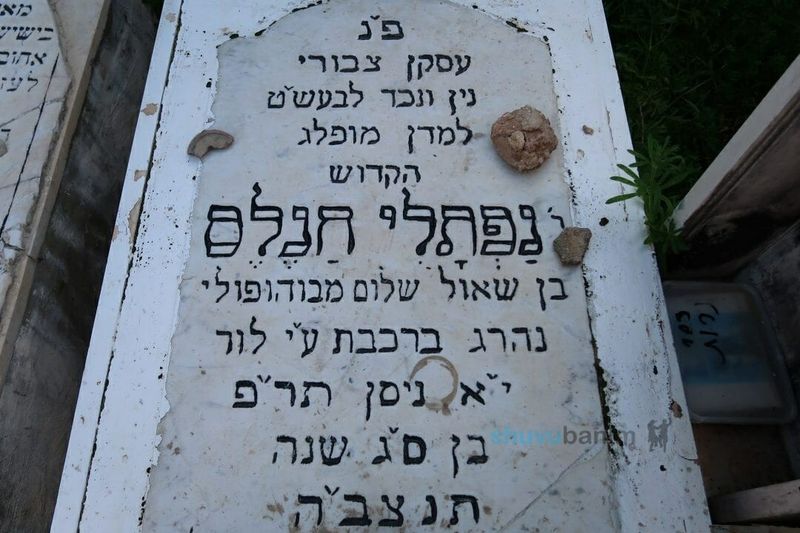
On the 11th of Nissan, four days before the holiday of Passover, Rabbi Naftali returned by train towards Tzfat. In those days, the Arabs, may their names be erased, were planning a mass-casualty attack, and therefore these murderers sabotaged the train tracks on a mountainside near Lod, which was a central place in the train system in the Land of Israel. When the train reached the place, the train overturned and several carriages rolled down the mountain onto their passengers, among them Rabbi Naftali, whose soul ascended on the spot to the celestial heights.
When the news of his sudden and shocking passing became known, all the Jews in the Land of Israel wept and mourned for Rabbi Naftali, and especially in his city of Tzfat, there was great mourning for him. And as Rabbi Shmuel Horowitz describes: "The grace and beauty of the city were truly taken away. Its glory departed, its radiance departed, its splendor departed. And a Sabbath and festival were truly ceased for us. For how much vitality we had just by looking at his holy form. It is impossible to estimate or elaborate on the magnitude of the loss we have lost. Our hearts truly melted and became like water. Even infants in their cradles wept for this..."
Sixty-three years Rabbi Naftali lived on earth, and he engaged in the three pillars of the world; Torah, service, and acts of kindness according to his level. Thus Rabbi Shmuel Horowitz summarizes his praise: "And the rule is that it is impossible to speak, tell, and describe the greatness of this tzaddik, and his beauty, his goodness, and his grace in the eyes of all."
Location of His Gravesite and Access Routes
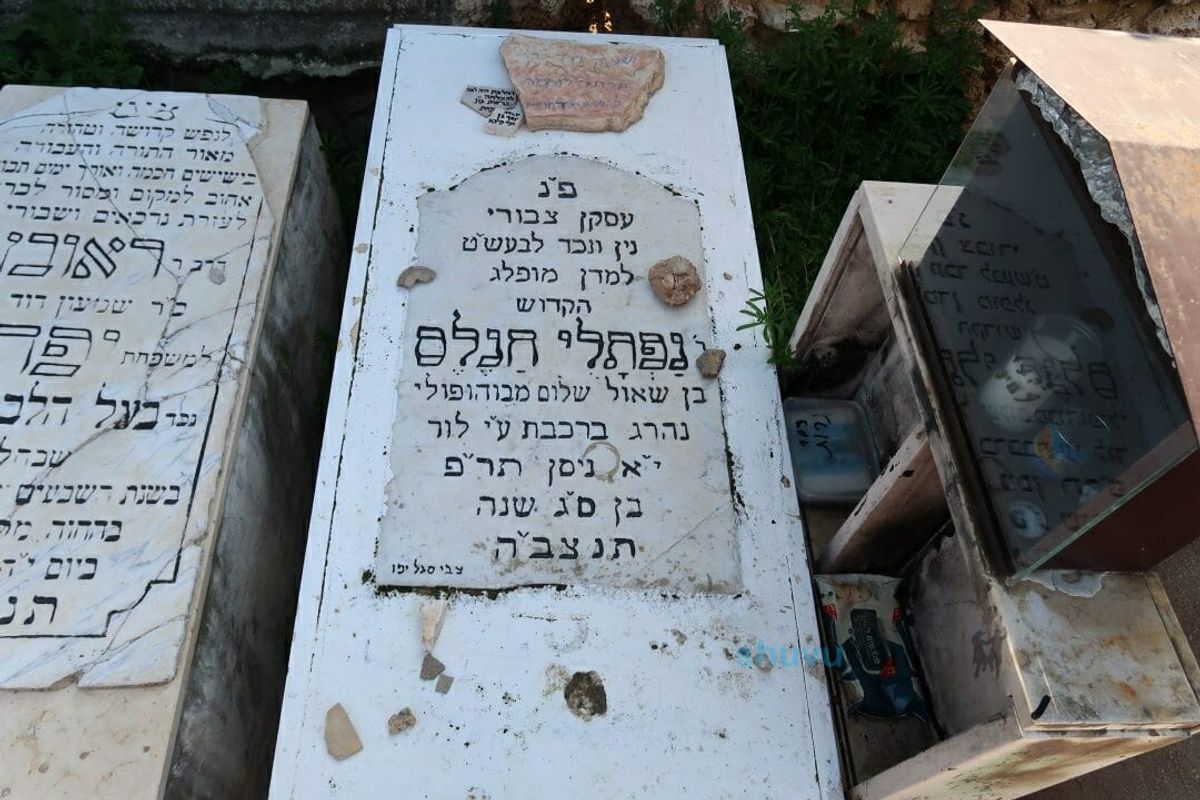
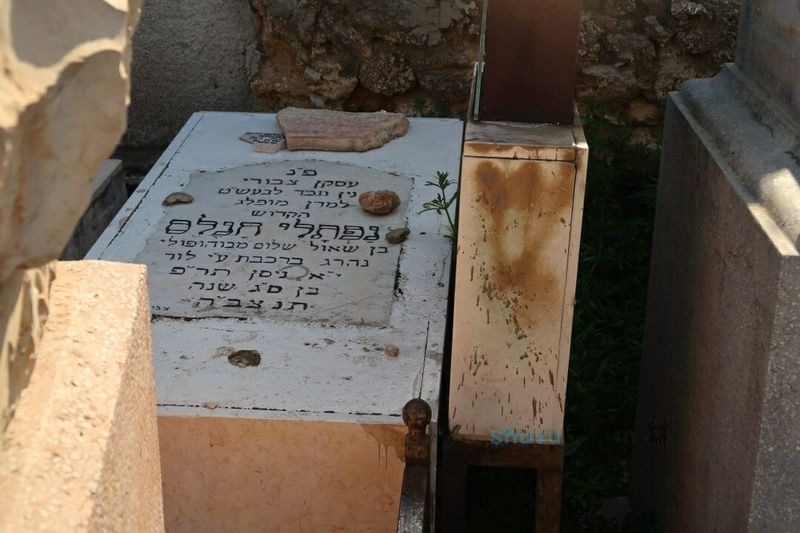
Upon hearing the terrible disaster, the people of the city of Jaffa went and brought his body to their city, where they buried him with great honor. His grave is located in the new cemetery of the city of Jaffa, in the first row adjacent to the eastern fence. In this row, which is in the 'East', the dignitaries of the community of their time were buried; after his passing, they buried the first mayor of Tel Aviv, Shimon Rokach, next to him. Today, this cemetery is located in the center of the city of Tel Aviv, which was then in its early days.
The cemetery is located on Trumpeldor Street, adjacent to Allenby Street, and is called 'Trumpeldor Cemetery'. At the entrance to the cemetery - immediately after the mass grave on the right - turn right until the end of the cemetery. In the row adjacent to the wall, in the middle of the wall, is the grave of Rabbi Naftali. Many have been saved through prayer at his grave, and many stories of salvations are told by those who prostrate themselves on his gravesite.
Subscribe to Our Newsletter
Receive Torah articles and inspiration directly in your inbox