
From Between the Two Cherubim
Parshat Terumah by the Gaon and Tzaddik Rabbi Eliezer Berland shlit"a
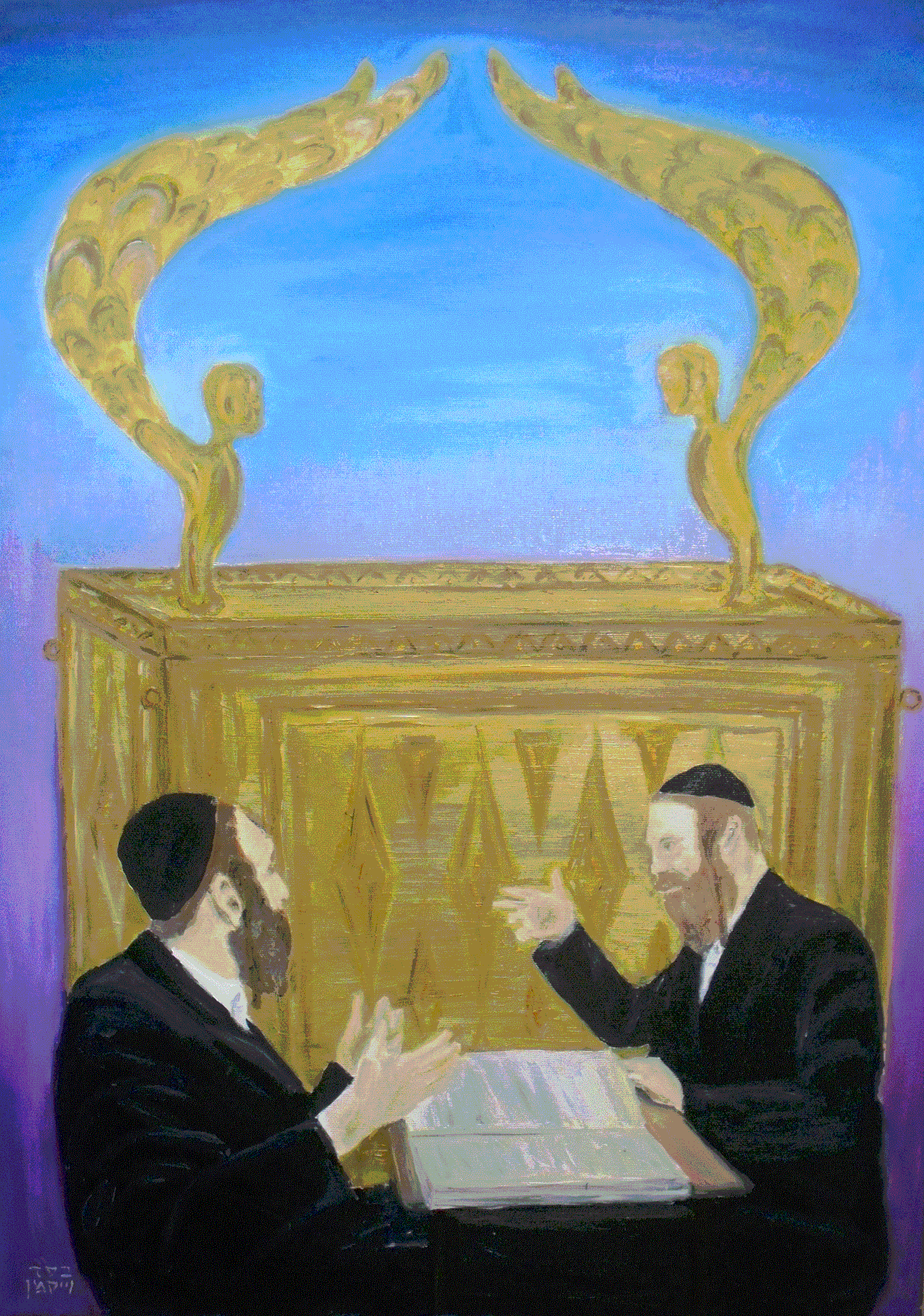
"From between the two Cherubim" (25:22)
When the desire arose within Him, blessed be His Name, to create the world in order to bestow good upon the created beings, and so that they would recognize His greatness and merit to cling to Him, blessed be He—even before everything, before Creation itself—He emanated a single point that is higher than high... He emanated a point that is light and vitality! And from this point, all the souls were drawn down, and each and every one was created from that very point. "And I will speak with you from between the two Cherubim." Man is formed from between the two Cherubim; this point is drawn down from between the two Cherubim. Each and every person must see how to reach that same point; everyone must return to their root and be included in this point. All our lives and all the incarnations (gilgulim) we have passed through are all for the sake of ascending to that wondrous point, which is the letter "Yud." Therefore, we are called Yehudim (Jews) named after the "Yud." The entire Jew is a small point. Everyone must ensure that their entire essence and reality transforms into a small point, a simple point, the letter "Yud." Rabbi Pinchas of Koritz says: What is the meaning of this point of Keter (Crown)? Keter means "Ayin" (Nothingness). And who can merit the Keter? Who can merit this point? Only one who possesses humility.
How does a person acquire humility? Through Torah and acts of loving-kindness (Gemilut Chasadim) together, one can merit humility! As the Gemara says in Avodah Zarah (17b): Rav Huna said: Anyone who occupies himself with Torah alone is considered as one who has no God, as it is said (Chronicles II 15:3) "And for many days Israel was without the true God." The Gemara says that if a person studies Torah without helping another, without performing kindness, then this is called "without God"! "Without the true God"—there is no truth in it whatsoever! In the time of King Asa, everyone studied Torah; there was not a single person who did not study Torah! Asa purged all the idolatry, opened yeshivas, and nevertheless, it is written in Chronicles, "Without the true God." Asa educated everyone to study Torah! But he did not educate them to perform kindness! He did not educate them to help the weak! To study with weak study partners (chavrusas)! This, he did not teach them! This was without the true God.
If a person studies Torah and does not also engage in kindness, does not engage in helping friends, helping the weak, it is as if he has learned nothing. When he learns alone, learns for himself, he thinks he is the greatest in the generation; he falls into the illusion that he is the greatest in the generation! Slowly, slowly, he loses God. When he studies Torah for his own sake, he acquires pride! He says, "Soon I will be a Maggid Shiur (lecturer), soon I will be a Rav, soon I will be a great Rosh Yeshiva!" Due to pride, he also does not perform acts of kindness! He has no time to do kindness! He feels it is a waste of every second to help another! A waste of every second to speak with another, to bestow kindness—he needs to become a great Rav!! It is a waste of his time. Torah alone brings pride, as it is written regarding anyone who is arrogant: "I and he cannot dwell together in the world" (Sotah 5a). Anyone who is arrogant pushes away the feet of the Shechinah (Divine Presence)—simply pushes away the feet of the Shechinah! He removes the Shechinah from the earth! And when the Shechinah departs from the earth, then there are murders, disasters, and accidents, may we be saved. With every thought of arrogance, the Shechinah departs from the earth. But if it is Torah together with kindness, this lowers the pride! Torah with kindness nullifies the pride! Because if he studies Torah and also does kindness, he begins to see that there are people better than him! If he starts to learn with another, to learn with a person who is weaker than him, he begins to discover that the other person has better character traits (middos) than his own, better qualities, more holiness, more lowliness—he begins to acquire humility! And conversely, if a person performs kindness without Torah, he will also acquire pride! When he opens a large Gemach (charity fund) and distributes baskets to everyone, he becomes arrogant and thinks he is the greatest benefactor in the world! If he does kindness without Torah, he will think he is the greatest distributor of funds in the land! After all, he supports thousands of families—who can compare to him! Who is his equal! And since he has pride from the kindnesses he performs, then perforce—even if he does not want to do kindness—perforce he will run after everyone to help them. He will run to poor families, he will run and find families in basements who have no food for Shabbat, he will save thousands of families and do things no one else does, because the kindness brings him pride! He always feels that he is the only one saving! He is the redeemer! He is the savior! He thinks he is the greatest in the world! He is at the peak of arrogance. But if he begins to also study Torah, this will lower his pride! He will see that this one knows how to learn better than him, and that one knows Tosafot better than him, and that one knows Halacha more than him. He will see that there are people better than him! Greater than him! All the air will come out of the balloon! He will acquire humility! So, Torah without kindness leads to pride, and kindness without Torah also leads to pride! Only when a person studies Torah and also performs kindness does he acquire humility.
Courtesy of Tzam'ah Nafshi 052-763-9126
Illustration by Yehoshua Wiseman shichy www.yehoshuawiseman.com 054-844-1131
Subscribe to Our Newsletter
Receive Torah articles and inspiration directly in your inbox