From Two Ends of the World
The Novel Insight that Rebbe Nachman and the Chida Said in the Same Language • For the Day of the Hillula
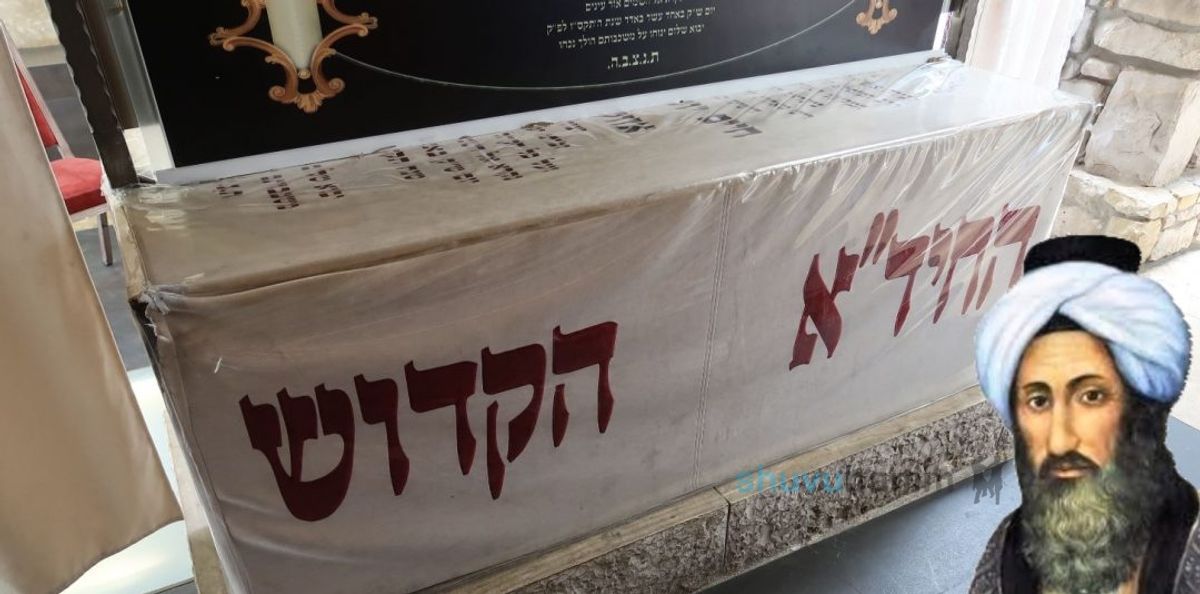
Today, the 11th of Adar, marks the day of the Hillula (anniversary of passing) of the holy Chida—our master, Rabbi Yosef Chaim David Azulai zt"l. In a lesson delivered twenty-seven years ago on Isru Chag Succos 5756, our teacher, the Rav, Rabbi Eliezer Berland shlit"a, tells of a rare insight shared by the Chida that appears in almost the exact same wording in the words of our holy Rebbe [Nachman] in Torah 4 of the second volume [of Likutey Moharan]. Here is the fascinating lesson:
The Chida says that there are twenty-two conditions preceding every single mitzvah (commandment). The Chida explains that this order follows the Aleph-Beis (alphabet); the third condition is 'Gimmel' for 'Gilah'—simcha (joy). He says that every mitzvah requires all twenty-two conditions. Now, let us speak a bit about the condition of joy: the third condition according to the Aleph-Beis is 'Gimmel' for 'Gilah'—that a person should rejoice in performing the mitzvah more than "thousands of gold and silver," entering into a state of immense joy. When one goes to study Gemara (Talmud), with Hashem's help, he should learn as much as possible and truly feel, "I rejoice at Your word as one who finds great spoil" (Psalms 119:162), and "The Torah of Your mouth is better to me than thousands of gold and silver" (Psalms 119:72). As we said, if "the Torah of Your mouth is better to me than thousands of gold and silver," then it truly can be like thousands of gold and silver; then one may merit thousands of gold and silver.
The Chida says that there is no [earthly] reward for the mitzvah itself. This is similar to what the Baal HaTanya (Rabbi Shneur Zalman of Liadi) brings in Likutey Torah, in Torah Ohr. He brings that Nebuchadnezzar took just one step [in honor of Hashem] and received kingship over the entire world, even though he slaughtered half the world. Well, he took another step, and they gave kingship to his son, Merodach, who was called Evil-Merodach. His son was called "Evil" (foolish)—all his enemies asked why? His father called him "Evil" (foolish); he said, "Shall I leave my kingdom to this fool?" "I received the kingdom, shall I give it to him?" He always called him "Evil." These names were like Hebrew names; all the Semitic languages, what they called Arabic and Aramaic, they are all almost the same words. So he called him "Evil," that was his name, Evil-Merodach. And indeed, his father had literally been like a beast, and he became king after they put him in prison, and then they crowned him again. He didn't believe it until they took his father out of the grave; then he said, "Here," and he slaughtered another half of the world. How much was left? A half. Then a quarter was left. After that came Belshazzar, the third son, because Nebuchadnezzar took another step—for every step, one receives kingship, it is no simple matter. What did Belshazzar do? Another half of the world, and an eighth of the world remained... how much was left? It is written that if he had taken one more step, not a trace would have remained of the world. So the Angel Gabriel came and stopped him—"That’s it, you’ve taken three steps, that is enough."
So the Torah Ohr asks: what then is coming to a Jew whose entire life consists of nothing but steps toward holiness, dancing, and running after mitzvos? Where will we put his mitzvos? Where will we give him his reward? For one step, he [Nebuchadnezzar] receives kingship over the whole world; for a second step, his son; for a third step, his grandson—and meanwhile, they are just slaughtering people! That is all they do. Nevertheless, they deserve kingship because he took one step in honor of Hashem. So where will we put the reward of a person who performs mitzvos? How will there be shefa (divine abundance) for the world? The shefa in the world comes from the simcha (joy) of the mitzvah; the abundance for the world comes from the joy. The more a person danced, the more he rejoiced. As the Rebbe [Nachman] says, "Truth and Faith" (Emes v'Emunah) draws the abundance for the entire year. We learned this before the lesson on the night of Simchas Torah—that one can truly draw down all the influence. From there, Hashem "performs miracles and wonders alone" (Psalms 136:4). In all of this, "The Torah of Your mouth is better to me than thousands of gold and silver"—if the Torah is "good" to a person, if he is happy with the Torah, then it is more than thousands of gold and silver. "And our Sages of blessed memory said that the Holy One, Blessed be He, establishes reward for the joy"—Hashem establishes reward for the joy one feels in the mitzvah, more than for the mitzvah itself! And it is here that I wanted to show you that the exact same words the Rebbe [Nachman] says, he [the Chida] also says. This one [Rebbe Nachman] passed away in 5571 (1810) in Uman, and that one [the Chida] in 5566 (1806). A five-year difference, and the exact same words! The same words written in Likutey Moharan, saying that a person needs to rejoice in the mitzvah more than the mitzvah itself. This is not found in any other book in the world; perhaps if we go through another thousand books, we might discover it. And the Chida says it in Italy—apparently, he wrote "Tehillah L'David" there, where he lived for twenty years—and the Rebbe says it in Uman, in Breslov. The exact same words. Torah 4 [of the second volume]—he even wrote it before Breslov. It was before [the Chida's] Birkei Yosef.
[The aforementioned words are from the Torah] "Chatzotzros" (Trumpets); this is the Torah of the Baal Teshuvah (penitent), the second Torah he [Reb Noson] heard. Reb Noson says this is the Torah [delivered] after Rosh Hashanah, on Shabbos Shuva (the Sabbath of Repentance). The Rebbe says that a person should rejoice, and whoever performs the mitzvah with joy, [should rejoice] more than the mitzvah itself. Where is there such a phrasing? In what book in the world? To perform the mitzvah with such joy, more than the mitzvah itself. Who had such an hasgachah (spiritual attainment)? Whoever has this attainment can write it. So it is a wonder that the Chida writes the exact same line, almost the same words, and the Rebbe [also] writes it. This one received the attainment in Italy, and this one received the attainment in Breslov. This was the first Shabbos that Reb Noson drew close [to the Rebbe] after Rosh Hashanah; it was the second or third Shabbos there. This was the first Shabbos that occurred in 5563 (1802), which was three years before the Chida passed away. It is possible they said it in the same year. Perhaps, as the Rebbe says—when the Tzaddik says a chiddush (novel insight), it is immediately revealed throughout the entire world. So this was three years before the Chida passed away, on Shabbos Shuva 5563. The Chida passed away three years after that. He says to rejoice in the mitzvah more than the mitzvah itself—such a joy that it should be more than the mitzvah itself. The Rebbe says the exact same phrasing. How is it that Tzaddikim—this one at one end of the world and that one at the other end of the world—come out with the exact same phrasing? To reach such a joy, more than the mitzvah itself, can only be written by one who held by this, who attained this, and who felt this as his way of life.
Subscribe to Our Newsletter
Receive Torah articles and inspiration directly in your inbox