"Have You Not Set Aside a Blessing for Me?" Why Did the Chief of Robbers Sit and
Cry Like a Baby? — Rabbi Eliezer Berland shlit"a
Why did Yaakov sit in suffering for twenty years, and how is this connected to Esav? Did Yitzchak know that Esav was a murderer? And why did Esav think he would receive Olam HaBa?
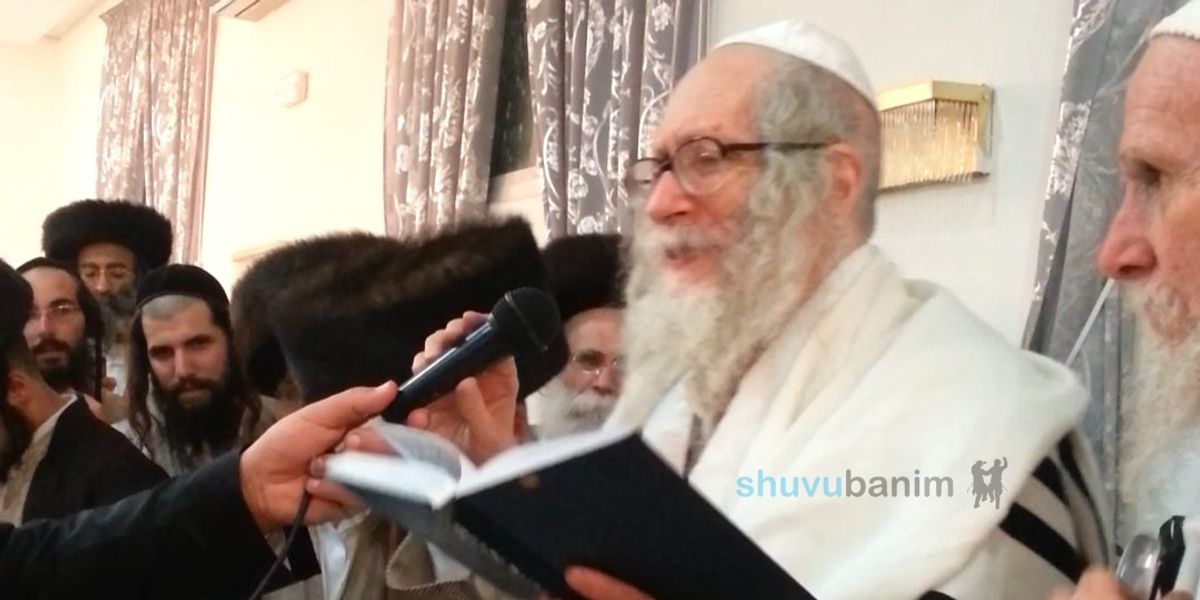
Before you is a fascinating and engaging shiur delivered by The Rav, Rabbi Eliezer Berland shlit"a, a number of years ago. Copy it, print it—read and enjoy:
Leah calls him Reuven—“See the difference between my son and the son of my father-in-law.” Who is “the son of my father-in-law”? It is Yaakov’s brother. Once, instead of saying “brother-in-law,” people would say “the son of my father-in-law.” In any case, “the son of my father-in-law” means Esav: “See the difference between my son and the son of my father-in-law”—a completely wicked man, a brutal murderer. At age fifteen he had already murdered Nimrod. Avraham didn’t even want to see it. That was the first murder he committed, and he said: first of all, I’m avenging my grandfather’s honor. Now I’m avenging my grandfather’s honor—I must kill Nimrod. I want to save my grandfather’s honor; he threw my grandfather into the fire; I did it for my grandfather’s honor. The grandfather didn’t want to see it; the grandfather died five minutes earlier. Hashem did not want the grandfather to see how his grandson murders—so He did not “seek him out.”
He came to Yaakov and said he wanted to avenge his grandfather’s honor—really, he just wanted the garments. And he wanted this, and he wanted the money, the wealth—fine. You want to avenge your grandfather’s honor? We’ll give you advice.
It is written in the sefarim: this was the moment when Yaakov could have brought him back in teshuvah! There are always moments when you can take even the greatest rasha in the world—whether it’s Esav, whether it’s Lavan. There is a second, a few seconds in life—some flashes of truth—when you can take even the greatest rasha, even like Esav, and bring him back in teshuvah. And that was that moment, when they were children at age fifteen.
All this is brought in the sefer Rishonim K’Malachim. He says it is also hinted to in the Sfas Emes: and therefore Yaakov had to be in exile for twenty years, and another two years on the road—because he missed it. Instead of “fixing” Esav—tricking him, “I’ll handle him, I’ll show him I’m smarter than him”—instead of that, Yaakov should have used that moment.
Yaakov was only a fifteen-year-old boy, but still he already knew the entire Torah. And there was a moment when Esav truly admired Yaakov. Until then, Esav thought Yaakov was an innocent man, sitting in tents, not going outside—knowing only the path from his father’s tent to the tent of Shem and Ever. Beyond that, he knows nothing about the world. But Esav—Baruch Hashem—“managed,” he knows the world, he knows worldly realities; he knows what’s going on in the world—one also needs that.
Rabbi Pinchas of Koretz writes: if a person wants to bring others back in teshuvah, he must be fluent in worldly realities. If he meets all kinds of people in the world, what will he speak with them about—Rashi and Tosafos? Will he speak with them about Gemara—“come learn a daf with me”? Rather, he shows them he understands what’s happening, what’s going on. That’s how he shows he’s wiser than everyone. So Hashem arranges that a person should know a bit about worldly realities, because it’s impossible—when dealing with people far from Torah, even people who aren’t such resha’im—to begin speaking to them immediately about Rashi and Tosafos, or “an ox that gored a cow,” or “these are found objects,” and thereby bring him back in teshuvah.
So you can take Esav—who is the chief of criminals—and bring him back in teshuvah! There are always moments!
Now, after Esav saw that Yaakov’s advice succeeded—because the whole point was to defeat Nimrod, whom no person in the world could defeat, because he always wore the garments of Adam HaRishon. All the animals would see him and fall down, immediately kneeling, because all the animals were depicted there; and the moment he entered the field, all the animals would kneel beneath him. Everyone saw how he defeated all the animals—tigers, lions, leopards—he defeated them all. He went out to the wars of Amrafel; everywhere he won. And why? Because he had the garments of Adam HaRishon.
Yaakov knew the secret of how he won; Esav did not know. As much as Esav was fluent in worldly realities and everything, he did not know Nimrod’s secret. Yaakov knew it—only Yaakov knew it. Certainly Yitzchak revealed it to Yaakov; he did not want to reveal it to Esav.
So Yaakov told him: first of all, if you want to fight him, get him to remove the garments. The moment he removed them, Esav grabbed him and immediately overcame him—because he truly was stronger than him.
In that moment Esav grasped it—on that day. The next day he already forgot that Yaakov was infinitely wiser than him; Yaakov knew Nimrod’s secret.
Now everyone is chasing him; he already sees “I am going to die.” He already saw how they were truly about to catch him—boom, at the last moment he managed to reach the tent, the tent of Yitzchak, and they search and search. And he is already in Yitzchak’s tent.
And Yaakov brings him lentil stew—“I am going to die.”
At that moment—so says the sefer Rishonim K’Malachim, and the tzaddikim said (he brings it in the name of tzaddikim), and he says it is also hinted to in the Sfas Emes—at that moment, when Esav was completely broken, at the ultimate breaking, he saw how he was a hair’s breadth from death, and he was truly ready to accept whatever Yaakov would tell him. If Yaakov would have told him: come to the yeshivah now; start learning; stop your nonsense; you killed Nimrod—fine, you did nothing. He should have told him: you did nothing—what, everyone is Nimrod? There is also Kedorlaomer, and there is no end; and there is Og king of Bashan. Og king of Bashan already built sixty cities; it is written that Eliezer is Og. What is this? It is written in Maseches Sofrim: Eliezer is Og; and the Gemara and Midrash say: Eliezer is Canaan.
In truth, everyone was there at that time; he lived, he outlived Avraham by thirty-five years—because whoever came to Sarah’s funeral was also at Avraham’s funeral. People were at the funerals of tzaddikim.
It is written in Parshas Vayeira twice “Vayeira”—why twice “Vayeira”? The first time he saw the angels. The second time he saw all those who go with Kiddush Hashem—he saw Chananyah, Mishael, and Azaryah, because the second “Vayeira” is extra. What is “Hashem appeared to him in the plains of Mamre, and he was sitting at the entrance of the tent in the heat of the day”? It is a difficult verse to understand—who is Esav, who is Yaakov?
What does it mean that Yitzchak “made a mistake” about Esav? Are we going to teach Yitzchak who Esav is? Yitzchak sees from one end of the world to the other! He sees what will be until the end of generations! He doesn’t know who Esav is?
Rather, it is impossible to describe the burning that was in Esav. We do not know—within the greatest rasha in the world—what inner burning there is! What a flame, what thirst! On the contrary: the more wicked he is, the greater his thirst.
And this is “the children struggled within her.” Already after three days the fetus feels; so the baby in his mother’s womb already sees from one end of the world to the other, and he knows what will be, and he knows what will be until the end of generations, and he sees his father and mother. Father and mother think no one sees what they do—the baby sees everything. He sees from one end of the world to the other; he sees everything they do.
Esav sees what will be until the end of the world, and Yaakov sees. And Esav says to Yaakov—in the womb they wrestle—he says: look, I will be a murderer, I will be a criminal, I will steal, I will do this and that—and I will also have Olam HaBa. I will come to Heaven, I will show Him; I will tell Him whom I killed—Nimrod—what I did was a mitzvah. One less Nimrod—one less Nimrod—isn’t that a mitzvah? It is written “when the wicked perish there is song,” and when they kill a rasha they should make a celebration, they should make a festival. And it is written in Midrash Pinchas, part two, that when they kill resha’im, they remove anger from Above. In Midrash Pinchas it brings regarding the killing of Zimri that there is a special mitzvah to kill resha’im—Midrash Rabbah.
So now he says: what, I killed Nimrod! Did I go kill yeshivah boys? I went and killed criminals, murderers, robbers. Whom did I kill? I only eradicated evil; I only eradicated evil. I killed a few robbers, a few thieves.
Of course, he did it all for his own lust; he did not do it to redeem the world.
So “the children struggled within her”: Esav says to Yaakov, I will kill Nimrod. Esav sees everything he will do: I will kill this rasha, this thief, this robber. He is not going to Shem and Ever to kill tzaddikim; each time he slaughtered another rasha, another rasha, another thief—he stole his money, his gold, everything he had. He had storehouses of gold, all from his robbery. He did it all under the disguise of a mitzvah; it was simply a lust for murder.
So Esav promises Yaakov: you will see—I will do what I want, I will rob and murder and steal, and I will have Olam HaBa. I will show that I only murdered resha’im, only thieves—that’s what I murdered. So what’s not good here? It’s wonderful—he will have two worlds, says Midrash Rabbah.
No—it doesn’t work like that. It’s not so simple to kill resha’im, to kill thieves, to kill robbers. Whenever you go to kill someone, you must consult with another person—consult with someone else. No, it’s not so simple. You always need—if you go on your own—maybe you want his money, his gold; maybe he angered you. Who says you are fighting for the sake of Heaven? Who says that?
He never consulted with anyone; he asked no one. Because when a person—under the laws of Bnei Noach—wants to kill someone, whether he wants to or not, whether he has a personal interest or not, he must consult with another. Esav never consulted. Since he never consulted, there is no mitzvah in what he killed.
But Esav says: I murdered resha’im, I murdered robbers, I murdered thieves; I took the garments—that’s already incidental. But in practice I cleaned the world; I cleaned the world.
And Rabbi Nosson says this was Esav’s mistake. Esav knew he was killing thieves, knew he was killing robbers; he thought he was like Rabbi Elazar b’Rabbi Shimon.
This is what Rabbi Nosson says: he knew he went and killed and robbed. What does “robbed” mean? After he murders, he takes the money. Who will take the money? He already killed him—so his property is ownerless. If he killed, then he takes; he is first on the scene; he acquires it. He digs around the place, gives a blow, closes the door, locks the door—it becomes his.
So Rabbi Nosson says in Likutey Halachos: what was Yitzchak’s “mistake”? We always learn that Yitzchak didn’t know who Esav was—one is forbidden to say such a thing! What does it mean Yitzchak didn’t know who Esav was? He didn’t know he was a murderer, a robber all day, never opening a sefer? Certainly he knew.
But Yitzchak knew that inside, in the depths of his heart, a fire was burning—such a fire, such a flame! For it is written: “He cried a great and bitter cry, exceedingly.” “Exceedingly”—there is no such cry in the entire Torah like Esav’s! The greatest cry is by Mordechai—what is written by Mordechai? “He cried a great and bitter cry.” It does not say “exceedingly.” “He cried a great and bitter cry, exceedingly”—this is written only by Esav.
A cry so great that all of Chevron gathered. They see Esav—the chief of robbers, the chief murderer, who already murdered hundreds and thousands of people—sitting on the ground and crying like a little child, crying. What does he want? A blessing. He wants a blessing. That’s all he wants: “Father, a blessing… give me, Father, a blessing… I want, Father, a blessing… what I want is a blessing, nothing more than a blessing… don’t you have one? Don’t you have one? What’s the problem to bless now—what is lacking in blessings in the world?”
The Megaleh Amukos says: Esav did not mean physical blessings! He doesn’t need “the fatness of the earth.” He doesn’t need “the dew of Heaven.” He doesn’t need that.
“And Esav hated Yaakov because of the blessing”—he receives “the fatness of the earth”: oil, diamonds, gold, silver. Here in the Land there is nothing—nothing. Moshe brought us; we came to a place that has nothing. Only here there is “dew of Heaven”: look at the heavens—dew will fall; don’t look at the heavens—dew won’t fall. Here there is no oil, no stones, no diamonds, no pearls—nothing, nothing. And all around there is oil and everything you want: Africa is full of diamonds, Australia is full of gold. Here there is nothing.
And Esav says: it doesn’t interest me. It doesn’t interest me—not gold, not silver, not oil—it doesn’t interest me. That’s not what I meant by “Esav hated Yaakov because of the blessing.” Esav does not forgive Yaakov for taking from him the true blessing: “And may Elokim give you…”
So what does Esav want? What does he want?
So the Megaleh Amukos on Parshas Toldos says: “Have you not set aside a blessing for me?” Esav says: Father, I want a blessing from the World of Atzilus, like you blessed Yaakov! You said “And may Elokim give you”—that is the World of Atzilus! “From the dew of Heaven” refers to the World of Atzilus. “From the fatness of the earth”—if you say “from the fatness of the earth,” that is dew of Heaven, but it is dew that descends here, dew that belongs to the “fatness of the earth.” But Yaakov received dew from the World of Atzilus. I want a blessing from the World of Atzilus.
He said: “Have you not atzalta (set aside) a blessing for me?” So the Megaleh Amukos asks: he said, Father, why did you bless Yaakov with blessings from the World of Atzilus, and me you bless with “the fatness of the earth”? For that I will not forgive! Yaakov stole from me the blessing of the World of Atzilus!
“Have you not atzalta a blessing for me?”—he used the word atzalta, says the Megaleh Amukos, because he too is “emanated” from the World of Atzilus. I want a blessing from the World of Atzilus.
“Don’t give me ‘the fatness of the earth.’ I know on my own—I’ll kill a few thieves and I’ll have a billion dollars; it’s not a problem. And what will be with my children and grandchildren? They too will kill a few people and they too will have a billion dollars. That’s not my problem. I want blessings from the World of Atzilus. I want Olam HaBa too. I believe in Olam HaBa. I know this world is vanity. I need a blessing from the World of Atzilus.”
That is why “he cried a great and bitter cry, exceedingly”—a cry from the depths of the heart. Like Esav’s cry—no Jew ever cried such a cry in his life, such a cry from the depths of the heart.
And Yitzchak knows Esav’s heart—that Esav’s heart knows everything; Esav’s heart knows the truth. He wants a blessing from the World of Atzilus; he wants Olam HaBa. He fights with Yaakov; he says: I will have two worlds—this world, I will kill resha’im and murderers, and I will also receive Olam HaBa for it—like Rabbi Elazar b’Rabbi Shimon, who received Olam HaBa because he killed the murderers and the robbers. I too will receive Olam HaBa for it.
This is like what is written in Megillas Esther: by Mordechai it is written that he went to awaken Am Yisrael to teshuvah, so it says: “Mordechai knew what had happened, and he put on sackcloth and ashes within the city, and he cried out a great and bitter cry.” It does not say he cried tears. Others cried: “In every place where the word of Haman arrived, there was great mourning for the Jews—fasting and crying and lamenting.” It does not say Mordechai cried.
Mordechai knew they would do teshuvah and it would be annulled. Even to cry, one must know when. Here he knew: the Jews will do teshuvah; three days they won’t eat; and that’s it—we will hang Haman. He already saw it.
“And Mordechai knew all that had happened”—he also saw what would be. He knew: just do teshuvah, and Achashverosh’s mind will flip. First he hanged his wife because of his friend; now he will hang his friend because of his wife. We will switch his mind. One must know how to switch it: through prayer you can switch the mind of the greatest rasha—switch the mind of all resha’im with one prayer. Just as Achashverosh’s mind was flipped.
So it says: “he cried a great and bitter cry.” It does not say he cried tears, because he knew that what everyone else would do—everyone would cry, everyone would fast, everyone would lament, and everyone would do teshuvah for eating from Achashverosh’s feast—would happen anyway.
But by Esav it says “Esav hated…” What is “he hated”? You have gold, silver, “the fatness of the earth”—what are you lacking? He says: that’s not what I meant. I mean “atzalta”—the World of Atzilus. I want spiritual blessings. I want the blessing of Avraham. I want it.
And this is what no one notices: there is another blessing. Where is the third blessing? There is “And may Elokim give you from the dew of Heaven and from the fatness of the earth.” There is “From the fatness of the earth shall your dwelling be, and from the dew of Heaven above.” And after that there is the most important blessing.
Rabbi Eliyahu Lopian zt"l told us that this shows that Yitzchak knew exactly who Esav was—it is the opposite of what everyone says. He knew who Esav was; only the “mistake” was that he thought Esav would do teshuvah. He thought that if his heart burns inside, then he can break through all his screens.
But the fact that your heart burns inside—that doesn’t mean you can break through the screens. Your heart burns now; you pray on Yom Kippur; suddenly you get some excitement—this is nothing. You go to sleep and it all disappears.
If you don’t begin going out to the field, and going to Me’aras HaMachpelah, and connecting to Yaakov, and going with him together to Hisbodedus in the field—if you go alone to the field, tomorrow it will be extinguished. Go with Yaakov; search; cling to Yaakov.
You take for yourself an old man, age 123, blind, sees nothing, and you say: “This is the tzaddik; I’m traveling to Uman; this is the tzaddik.” What does Uman help you? What—does the Rebbe speak with you? The Rebbe tells you: I was in Uman with lusts, with bad middos, with illnesses of soul and body that you were born with from all the gilgulim—and you think it will move you?
Yitzchak says: I am a chassid of my father. What does that mean? “I am a chassid of Yitzchak,” and he cries out—“he cried a great and bitter cry, exceedingly”—more than Mordechai the Jew. And he cries and sits on the ground and cries like a little child, and the whole city gathers: what happened in my house, Yitzchak? Esav—the chief of robbers, the chief of murderers—sits on the ground and cries, wants a blessing. What do you have to do with a blessing? What do you have to do with a blessing?
A blessing—you need to work sixty-three years to receive a blessing.
When Rabbi Nosson ran after Rebbe Nachman as he traveled to Krasne, the Rebbe stopped—someone stopped the Rebbe. He stood there on a bridge, and the wagon had to go a bit uphill; it was a narrow place. Someone stood in the middle of the road, so the wagon stopped. Meanwhile Rabbi Nosson ran and ran and ran and caught up to the wagon. There was a bridge, a narrow place, and there he stood; the wagon stopped, and he spoke with the Rebbe. How many blessings he asked for! Meanwhile Rabbi Nosson managed to arrive.
The Rebbe asked: what do you want—blessing or Torah? He said: I want Torah—say Torah. So the Rebbe told him Torah 282. In that moment, in those five minutes, ten minutes, that the Rebbe was on the wagon, he told him the entire Torah 282: “Tzaddikim build the Mishkan; there are no resha’im in the world.” There is no such thing as resha’im, because among Am Yisrael, in truth, there are no resha’im. Among Am Yisrael there is no such thing as a rasha who cannot be brought back in teshuvah. There is no such concept—even if he is the greatest rasha.
As the Midrash says: “And he smelled the scent of his garments”—the scent of his traitors. It immediately tells us stories here about the greatest resha’im who were in the world, in every generation.
It tells of one, Yakum Ish Tzeroros, who came to mock Yosei ben Yo’ezer. Yosei ben Yo’ezer was from the Zugos. And now they are going to crucify him—crucifixion is the greatest suffering. He sees how they prepare his uncle for crucifixion; he sees how they prepare his uncle for crucifixion—these are the greatest tortures in the world. And he laughs at him in the middle; he laughs at him: “Uncle, look—uncle, this is what came out of you, this is what came out of your Torah. For this you learned Torah 120 years.” It is written he was already 120 years old. This was before the Chashmona’im, before Chanukah; it was in the time of the Greeks. The Greeks ruled 180 years; they made decrees. The Gemara says in Avodah Zarah 9.
“This is my uncle. And look—whom does Hashem love, me or you?” he asks his uncle. His uncle—before the crucifixion, they are only preparing it—“me or you?” He says: “Look what a beautiful horse my Creator gave me.” It was Shabbos. He rides the horse and says: “Look, look—ah… look what a beautiful horse my Creator gave me.” That’s what he says to his uncle.
What does his uncle say? His uncle doesn’t rebuke him, doesn’t say anything. His uncle, before crucifixion, answers him calmly and with a smile: “If this is so for those who anger Him, if this is so for those who transgress His will—then for those who do His will, how much more so.” If you have such a beautiful horse, such a beautiful horse Hashem gave you, and that’s how Hashem loves you—did you ever do a mitzvah in your life? And still Hashem loves you like this. Then I, who am entirely mitzvos from the day I was born, all these 120 years—there isn’t a second I didn’t do mitzvos—then all the more so, all the more so, I will receive for every mitzvah horses even more beautiful and things even more beautiful.
He says: a beautiful horse? Beautiful horses—here is your horse. He points to the crucifixion post: soon you’ll ride this horse; this is the horse Hashem gave you.
So what does he answer him? His uncle answers him with a smile: “Look—if I have such a horse, when all my life I only learned Torah, I didn’t sleep any night, I didn’t eat, I didn’t drink—then what kind of horse is prepared for you?” How many such horses, how many crucifixion posts? He said: make a calculation; let’s speak logically. There is another world. It’s not so simple. Here you ride horses; soon you’ll see. Make a calculation—what is prepared for you there? If they do to me such a terrible crucifixion, then what is prepared for you?
In short: these simple, pleasant words—a person must speak to the other, even to the greatest rasha, with gentleness. Never to get angry at him—speak to him pleasantly, with a smile. And these pleasant words entered him like the venom of a snake. It began to bubble within him, to burn him: my uncle is right. Yosei ben Yo’ezer, who is my mother’s brother—he spoke to the point; he spoke correctly. I am a criminal, a thief, a robber; I did all the sins in the world—so what will they do to me in Heaven? There is Olam HaBa.
All resha’im believe in Olam HaBa. Everyone believes that angels come and take them. There is no rasha who doesn’t believe in Olam HaBa. There is no such thing. They wait for the angels to come and take them and bring them into Gan Eden. Which Gan Eden? Gan Eden according to what they earned here—according to what they earned here, so will their Gan Eden be.
In any case, there is no one who doesn’t believe in Olam HaBa. There is no such thing. Make a calculation: see what they do to me—maybe for one time I looked, a thousandth of a glance—who knows for what, that I stumbled in a thousandth of a thousandth of a glance. So see what they do to me—then what is prepared for you?
So the Midrash says: the words entered him like the venom of a snake, and it began to burn him and burn him and burn him. And he ran home at top speed. Immediately he tied a rope to the ceiling and brought a sword under the rope, and wood around the sword, and stones around the wood. He lit the fire and jumped into the noose of the rope, and immediately began to burn with the rope, and fell on the sword, on the fire, and all the stones fell on him. He succeeded in fulfilling upon himself the four death penalties of Beis Din.
And they still had not crucified Yosei ben Yo’ezer. He did it with such speed, with such alacrity, that Yosei ben Yo’ezer was still waiting—because they do it as slowly as possible, like the Germans would do: everything slowly, dragging it out slowly, slowly, slowly. They drag it out. Meanwhile more people gather, more people, more people—to make it as public as possible: the more “splendid” the spectacle, the more Jews will come, the more non-Jews will come, Greeks will come, to see how the Greeks rule the Jews, torture the Jews. And they do it slowly, slowly, until they prepare the board, prepare the crucifixion post. They need to nail boards together, connect them.
Meanwhile Yosei ben Yo’ezer dozes there, leaning on a post, dozing. Suddenly all the students around him see that he is smiling. “Why are you smiling, Rabbi? Rabbi Yosei ben Yo’ezer—what is this smile?”
He said: “See, see—I see the bed of my sister’s son floating in the air, truly with angels. I see how angels escort the bed of my sister’s son, and in a short time he preceded me into Gan Eden.” He managed to precede me into Gan Eden. I see his bed with angels now; the gates of Gan Eden are open before him.
Because if a person truly accepts teshuvah upon himself even in the last second—especially with such terrible suffering, to die—such a true teshuvah, then immediately all the gates of Gan Eden open for him, even if he is the greatest rasha.
And this is what is written: “And he smelled the scent of his traitors.” The Midrash says: “the scent of his traitors”—that there is no Jew who will not do teshuvah in the end. There is no Jew—there is no such reality that a Jew will not do teshuvah, because every Jew knows the truth, and every Jew has the spark, the inner burning fire, that the moment will always come when he will do teshuvah.
Only one must know how to seize that moment—that minute, that second—to aim for that second.
And after that: Yosef Meshisa, who took out the Menorah. He joined the Roman soldiers—this was before Chanukah. Yosei ben Yo’ezer is before Chanukah; it begins with the Zugos, long before Chanukah. And then, at the Churban, Yosef Meshisa joined the Romans, the army. When they reached the Kodesh HaKodashim in the Beis HaMikdash, they were afraid to enter. They said: who can enter the Kodesh HaKodashim? Who would dare enter? They knew that even the Kohen Gadol could be burned; they would bring him in with a chain. Even to the Heichal they were afraid to enter; to the Ulam they were afraid to enter.
They said: first let a Jew enter; we’ll see if he stays alive. They took Yosef Meshisa, who was already a soldier in their army, and said: enter, search for an object, take it out; we’ll see if you come out alive. He entered; after him—fine.
He saw many Menoros there; there were many Menoros. He took out a Menorah. They said: you can’t take a Menorah—it’s too precious. Enter a second time and take something else.
Suddenly his Jewish spark ignited. He said: enough—I won’t give you any more. I’m not willing that you enter. You won’t get the Menorah from me.
What mitzvah is here? Give the Menorah, stay alive, do teshuvah, go learn Torah quietly. Not now.
But his spark ignited; he was not willing. “Cut me into pieces, into pieces.” They put him into a saw—into a carpenter’s saw that saws wood—into clamps. They put his whole body into clamps and began to saw him. They saw him while he is in the clamps, and he is filled with joy, filled with excitement. He says: “Master of the World—woe to me that I angered my Creator! Woe to me that I angered my Creator! I accept upon myself teshuvah; I accept upon myself with joy the afflictions.”
And the entire hour, two hours, that they cut him into pieces—until he still had a drop of soul—he only grew more excited; he only sang from joy. He said: “Oh… not only did I anger my G-d once, a second time…” and every moment, every moment, he sang and sang and sang while they sawed him.
So the most distant Jew—the most distant—who already joined the Roman army, who mocked his uncle as they went to crucify him—even such a Jew awakens in teshuvah. Suddenly the spark ignites.
And one must always know to seize that spark.
And this is the chiddush: even in Esav there was a spark—only he needed to connect with Yaakov. Instead, he connected with an old man, age 123, blind, sees nothing. Now he is 63; he wants the blessings. He says to him—Yitzchak says: I don’t know if you will receive the blessings; I don’t know. Do teshuvah and bring me truly a deer, or a goat, or a lamb. In the end he brought him a dog.
Do teshuvah truly, and lower your arrogance a bit—then there is a chance. I have blessings to give; I have from the World of Atzilus, from Adam Kadmon, from Atik—I have blessings. But you must have vessels.
Yaakov received a blessing from the World of Atzilus because Yaakov worked on it for 63 years. He worked on it from the womb—“from the womb they are called by Your Name; from the womb they are circumcised.”
So Yitzchak says: I don’t know if you will receive the blessings.
All this we see: Yitzchak knew exactly who Esav was. The mistake was something else. We do not see that he didn’t know who Esav was. The mistake was that he already thought the days of Moshiach had arrived, and it was already possible to bring the Geulah, to build the Beis HaMikdash now. Esav would go out and fight the wars of Hashem—he thought he would be Moshiach ben Yosef. That was his mistake—not that he didn’t know who Esav was.
The Sfas Emes says a completely new idea: every father has a personal bias when he blesses his son on Friday night—“May Hashem bless you and guard you.” He has a bias: I have a son, Baruch Hashem, learning Torah; I bless him. I have, Baruch Hashem, five sons, great in Torah; they all get 10 on tests; they already know masechtos by heart, Baruch Hashem. A father is happy. Friday comes; they come with report cards—10, 10, everything excellent, excellent plus. The father blesses with joy: “May Hashem bless you and guard you… May Hashem shine His face to you and be gracious to you… May Hashem lift His face to you…” “May Elokim make you like Ephraim and Menashe.” Certainly your children will be like Ephraim and Menashe—certainly, why not? The father is full of pride from the blessing.
The Sfas Emes says: Yitzchak feared he would have a thought of pride. Yitzchak feared that if—after all, Yaakov is a tzaddik—blessing Yaakov is the greatest delight. To bless the rasha, the murderer, the criminal, whom I hate—him I bless. I will overcome my yetzer hara and bless this criminal; I will bless this rasha; and perhaps, through this, he will do teshuvah. That is what the Sfas Emes says: this was the test. The test was not to bless Yaakov—Yaakov would manage even without my blessing. He learns Torah and has his own merit.
How do we say? We always say: “Elokey Avraham, Elokey Yitzchak, and Elokey Yaakov.” In Bechukosai we say: “And I will remember My covenant with Yaakov, and My covenant with Yitzchak, and My covenant…” The Midrash asks: why do we reverse the order? Because Yaakov is worthy on his own, and Yitzchak is worthy on his own, and Avraham is worthy on his own. Each one, with his own merit, is already fit for all the blessings—every blessing written in the Torah that Avraham, Yitzchak, and Yaakov received. Each one, by his own merit, is fit for it.
We have three—the threefold cord is not quickly severed—that is even better. But Yaakov, by his own merit, doesn’t need my blessing at all.
So on the contrary: I will subdue my yetzer hara, and I will take this wicked child who murders and robs and steals—him I want to bless. Him—perhaps the blessing will catch something; perhaps a spark will ignite in him.
So all the geirim—all the geirim—this is the merit of Yitzchak’s blessing: Rabbi Akiva, Rabbi Meir, Shemaya and Avtalyon, Onkelos the ger—all the geirim are his merit.
This is what the Midrash says: “Take, please, your weapons.” “Your weapons”—this is the sword, the knife, a slaughtering knife. “Your quiver”—this is the hanging case of arrows, the arrow sheath, the pouch. That is the simple meaning. “And your bow”—the bow carried on the shoulder.
But the Midrash says: what is “quiver” as a hint? “Quiver” means “hanging,” “dependent.” He told him: it is hanging and standing—I don’t know if I will bless you. I don’t know. I look—I don’t see. I don’t see that if I bless you, something will come of it. I don’t see.
You didn’t make any vessels; you didn’t prepare any vessels. You only stole and robbed. Now you want blessings—why? Because you murdered Nimrod? You murdered another murderer? Everything you did was for your own pleasure; you didn’t go to cut off resha’im from the world.
So he said to him: “Take your quiver.” He told him: the blessings are dependent—l’man d’chami lei—the blessings are dependent. Know that the blessings will go to whoever is fit; whoever is fit will receive the blessings.
And everyone says Yitzchak made a mistake—he didn’t know who Yaakov was, who Esav was. But it is written in the Gemara that he did know. He said: I don’t know who will receive the blessings; whoever is fit will receive the blessings.
This is what the Midrash says: “your quiver” means “dependent and standing,” and the blessings will go to l’man d’chami lei—whoever is fit will receive the blessings. I cannot promise you; I cannot promise you. Whoever is fit will receive the blessings. If you will be fit, you will receive the blessings.
I know you are a thief; I know you are a robber; I know everything. I know everything about you.
Only Yitzchak thought—as it is written: “Let the wicked abandon his way, and the man of iniquity his thoughts.” What does it mean “let the wicked abandon his way”? That wicked man who once was a thief and a robber—you were once a thief, once you rode horses; now ride the horse to the field. Once you went to rob, to break safes; now break your mind—open your mind—saw your mind. You learned how to break in—fine. You have such brazenness: “bold as a leopard, light as an eagle.” Be bold as a leopard—be bold against yourself.
The whole concept of mesirus nefesh is only against oneself—not “mesirus nefesh” that I do by speaking with people. That is not mesirus nefesh.
Subscribe to Our Newsletter
Receive Torah articles and inspiration directly in your inbox