
Historic Discovery: When The Rav, Rabbi Eliezer Berland
and His Students Hauled Marble Stones from Jerusalem to Uman
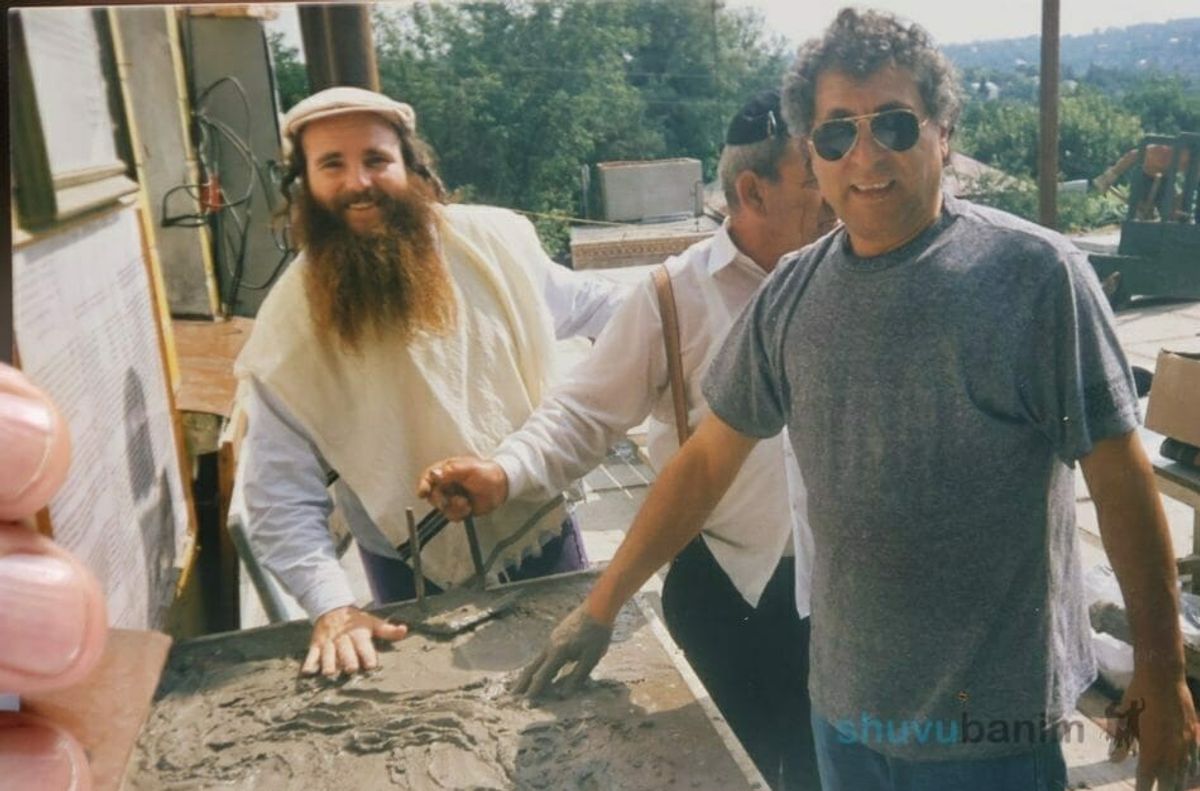
In honor of Rosh Chodesh Nissan, the birthday of our holy Rebbe, Rebbe Nachman of Breslov, may his merit protect us, we present to you a historical discovery regarding the construction of the matzeivah (tombstone) on the holy gravesite in Uman: The first elevated matzeivah on the holy gravesite was built by Rav Berland and his students, who carried the marble stones all the way from Jerusalem to Uman! • R' Ofer Balti, who organized the marble stones, and the participants of the trip recount the holy and special journey.
5751 (1991). The first matzeivah, from Jerusalem to Uman.
In the year 5750 (1990), the Iron Curtain collapsed and fell with a quiet silence that shook the world. Immediately after the fall of the curtain and the establishment of the independent state of Ukraine, the Chassidim of Breslov united, led by our teacher Rav Berland shlit"a, who, as is known, was the leader in all the journeys in the years that preceded this, and worked endlessly at every stage. They began to work on restoring the gravesite and preparing the infrastructure for the holy Kibbutz at the gravesite of our Rebbe, may his memory be a blessing.
Intensive negotiations were conducted with the Ukrainian authorities to purchase the area. At the same time, they began operations to erect a matzeivah on the holy gravesite. In those years, the maintenance manager at the Shuvu Banim Yeshiva in the Old City was R' Ofer Balti (brother of the esteemed R' Yaakov). He was busy at the time building the mikvah in the yeshiva, as the Arabs who had begun the work backed out and did not finish the construction. R' Ofer and his father (of blessed memory) took the task upon themselves, and indeed finished the construction in the best possible way.
Since Rav Berland saw his expertise in construction, he approached him and asked him to obtain marble for the construction of the matzeivah for the holy Rebbe's gravesite, as R' Ofer himself recounted in a special interview for the "Hitchadshut" magazine, and we bring his story before you:
"It was thirty years ago. I was then the maintenance manager of Shuvu Banim. Rav Berland approached me and told me to organize white marble at a height of 30 cm. Rav Berland also told me the length and width based on what he had received regarding how the size of the gravesite should be—two meters by eighty centimeters—and the height of 30 cm, Rav Berland said, so that people would be able to prostrate themselves on the gravesite, and on the other hand, that it would be a respectable marker for the gravesite. I went to 'Shish Beit Yisrael,' ordered white Italian marble, and we built wooden crates for it so that they could carry it. Each slab was in a crate lined with Styrofoam so it wouldn't break. It took us a few days to organize it.
Back then, there was no direct flight from Israel to Kiev, and they traveled through other countries. I myself was not a participant in the journey itself, only in preparing the marble for the gravesite."
"Back then, they weren't organized in Uman. It was the first year after the Iron Curtain fell; they didn't know anything, and even food and everything else was brought only from Israel. There was no such concept yet of buying things there from a gentile."
The journey to build the matzeivah led by our teacher Rav Berland
The partners in the special journey, students of Rav Berland, recall the holy journey:
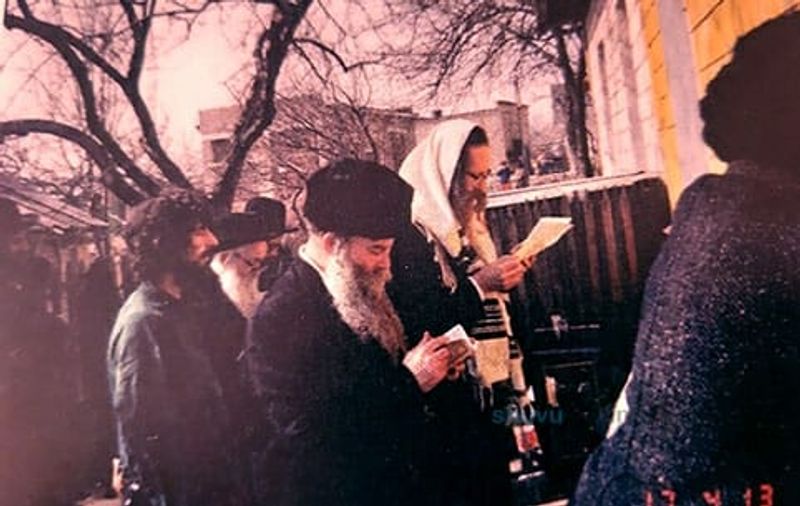
R' David Ben Yishai: "It was in the year 5751 (1991). Everything was still in complete darkness. Everything was done in a very suspicious and very hidden manner, with suspicion and hostility. It wasn't like the situation today where everything is open. The Ukrainians were suspicious; there was no good communication with them. We were constantly under close surveillance, so it was mandatory to bring it from Israel."
"It was in the middle of the year. We traveled through Romania, meaning we landed in Romania, and from there we took trains to Ukraine. When in the middle of the way, at the Kishinev border, they change the train wheels, as in the Soviet bloc countries the train tracks were a different size than in other countries, in order not to allow the possibility of enemy trains entering during wartime. Therefore, every time you arrive in Ukraine, you have to change all the wheels; it's a matter of several good hours."
"Afterward, we traveled by bus to Uman. Our teacher Rav Berland, of course, participated in this trip. I remember that on the way, a piece of marble broke, but they managed to glue it back together."
Rav Yalon Yitzchaki: "This trip cannot be forgotten. I dragged and carried the marble inside the wooden crates, and I even worked a little on the construction at the gravesite. This carrying was not simple. Back then, everyone had to bring everything, so for a week in Uman, a truly heavy load was required. But for the honor of our Rebbe, everyone pitched in."
"The one who was actually responsible for the construction itself was R' Asher Omedi of blessed memory (brother of the holy R' Eliyahu, may Hashem avenge his blood). R' Baruch Sharvit was also a partner in the construction. I helped them clear out all the dirt and stones from the floor tiles so they could pour concrete and mount the marble on it. After we dismantled the floor tiles, I myself took some of the stones from the gravesite. It had the inscription 'HaNaNaMaCh' on them, the inscription of R' Binyamin Knapelmacher. We used them for segulot (remedies) for the sick and more, and it worked wonders. These were holy stones that had been on the gravesite for many years..."
Rav Yitzchaki recalls an amusing anecdote that happened in Romania: "We placed the marble together with our personal equipment in a pile, and someone came and tried to steal suitcases next to us. He was someone with a tie and a suit, looking like a decent person, and he came to steal. We got proof of what they say about the Romanians... He picked up a suitcase and kept walking, and everyone yelled at him, so he said 'Scusa'—that's 'sorry' in Latin—put the suitcase down, and kept walking..."
We clarify if this was a trip for Rosh Hashanah. Rav Yitzchaki: "As I remember, it was in the middle of the year. We didn't have apartments in Uman; we were in Kiev and from there we traveled to Uman each time, staying for an hour or two at the gravesite and returning."
R' David: "You have to understand that in those years, every time the trip could be arranged, we simply went, because there was such longing. And until we organized visas and everything, when it worked out, we got up and went. It took several good months to organize such a thing, and therefore it didn't matter when—summer, winter—the main thing was to get to Uman."
This matzeivah lasted for about a year. Afterward, in the year 5752 (1992), there were those who tried to raise the gravesite matzeivah a bit more, but it did not last, and the matzeivah that was built in the Russian style fell apart immediately after its construction. In the year 5753 (1993), R' Binyamin Sofer built a new matzeivah over the first one, and in the year 5758 (1998), the large matzeivah that exists to this day was already built.
Subscribe to Our Newsletter
Receive Torah articles and inspiration directly in your inbox