
How Did the Chassidim of Shuvu Banim Immerse in Ice at Minus 25 Degrees? How to
Deal with Difficult Goals in Life? Rabbi Soferin
"All the elders shied away from going to Pharaoh; only Moses had the strength to complete the mission and overcome the obstacles," says the esteemed Rabbi Mordechai Sofrin shlit"a in a special talk from Likutey Halachot, Laws of Agents (Section 3, Paragraph 3, One who appoints an agent to collect a debt).
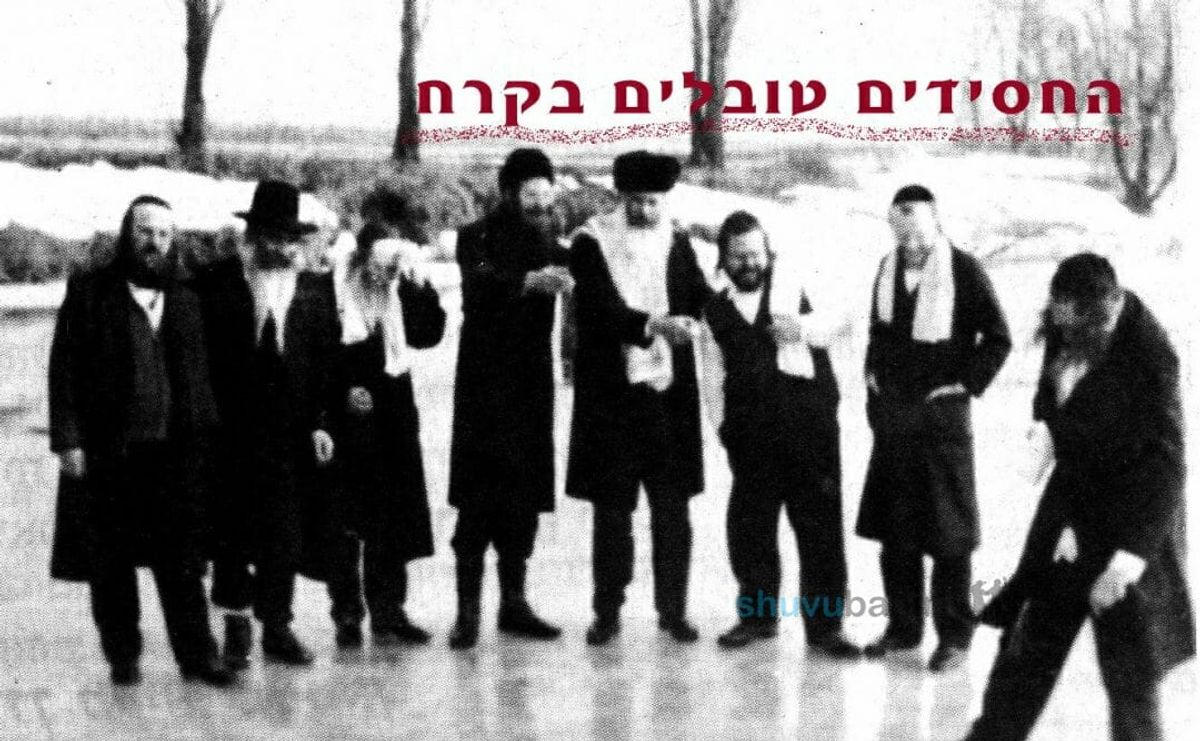
Rav Sofrin leads us to the advice so crucial for our generation: "Step by step, we advance toward the goal." While doing so, Rav Sofrin shares a private incident where the Chassidim of our teacher, the esteemed Rav Eliezer Berland shlit"a, were left in Kiev without a mikvah, and they performed self-sacrifice to immerse in the intense cold of minus 25 degrees and gale-force winds. Rav Sofrin testifies that for him personally, it was an almost impossible test. Did he eventually immerse...?
"And this is the aspect of all the ten plagues that Moses brought upon them. Moses our teacher entered before Pharaoh without any fear. Moses our teacher has no fear at all. Hashem told him: 'Take for yourself 70 of the elders of Israel and come to Pharaoh.' He took 70 elders and went to Pharaoh. Later it is written: 'And Moses and Aaron came to Pharaoh'—where are the 70 elders? They dropped off one by one."
"Rashi says: 'They dropped off'—they didn't run away; they found some excuse. One suddenly had a muscle cramp in his leg, another said, 'I forgot the food on the stove.' Each one found some excuse and said, 'I cannot.' They could not withstand the fear. It was a terrifying thing to go in there; they were going to provoke the wicked one, to provoke Pharaoh. There is no coming out of there alive; no one ever came out of there alive."
"That is exactly what was difficult. Suddenly, a man arrives, 5 meters tall, fat, and says that Hashem sent him. So okay, he started performing signs and said some slogans, so they went with him. But in actual practice, there wasn't yet faith—there was a weak kind of faith. They went to Pharaoh, they started to walk. I wouldn't have even started to walk, but they started to walk."
"We once had an incident in Kiev. We were there in some hotel; they didn't let us get to Uman, and in the morning there was no mikvah, because we couldn't travel to Uman, and there was no mikvah in the hotel, so there was a river not far away. The problem was that it was minus 25 degrees—and it is cooooold, it is cold, it is something terrible. But the Shuvu Banim don't care that it is cold; they went to the mikvah."
"All the friends went to the river to immerse, but I couldn't leave the room. I couldn't. Where? To immerse now in such cold? I can't immerse, I can't. So everyone went, and I remained alone in the room."
"I said to myself: 'I cannot immerse, but I can pray.' I looked for prayers in Likutey Tefillot about the mikvah—there are none, only for Shavuot, the prayers of Nun, Nun, the mikvah of Shavuot. I said, 'Okay, I will say the mikvah prayer of Shavuot.' I said the prayer, and a thought came to me: 'Okay, I won't immerse, but I will go to the river. To go out, I will go out; for hisbodedut (secluded prayer), I will go out. The problem is the immersion. I will go as far as the river, but I cannot immerse.'"
"I arrive at the river, and what do I see there? They are immersing in pairs, because the moment a person comes out of the water, he freezes. The hair freezes, the mustache freezes, the ears freeze, the fingers freeze. You cannot get dressed, you cannot close the buttons, you cannot move your fingers; you need someone to dress you. A person comes out of the water and his friend dresses him. It is cold..."
Is it impossible to close your hands, Rabbi Mordechai?
"Maybe a tiny bit, it freezes, it freezes—the hairs. You have to be careful that your beard doesn't break; it can break. It is ice, in a second, as soon as you come out. The water is 4 degrees; the water doesn't freeze. If it freezes at 0, until it freezes it is 4. Below, the water is flowing; below it is not cold. The problem is the wind—you go out into a wind of minus 25 degrees, it is like needles."
"So like that... they start to walk until they can't anymore. That is what happened with the elders. Some certainly didn't want to start walking, some started to walk, but by the time they got close... the closer you get, the more you see the fear, so you retreat backward. Only Moses and Aaron are the only ones who entered up to Pharaoh, and spoke to him, and accomplished everything."
"Our teacher, Rav Berland, was not in Kiev then. He was not with us. Maybe he immersed in another place, maybe he didn't go on this trip, I don't remember. He traveled, but he didn't always enter. No, he entered. On my trips, he always passed through, but I don't know... he didn't go with us to the river. Maybe he went to another place, I don't know, I didn't follow him."
Did you manage to immerse in the end, Rabbi Mordechai?
"Yes, thank God. The whole point is to do what you can. This is a thing you learn slowly, slowly, that even if you cannot do everything that needs to be done, but you can do half, do half. And then he sees that he can take another step forward, he takes another step forward, until in the end, he finishes everything."
"But here the elders couldn't; they didn't succeed. They started. It is not a simple thing. Moses says to them, 'Come to Pharaoh.' What, 'Come to Pharaoh'? Did you fall on your head? Are you crazy? It is not simple, the way to the palace... it is not that the palace stands on the street. It is an entire park around the palace; it is a long way from the entrance gate to the palace, and on the way, there are lions, there are tigers, there are gallows, where they hang all the criminals."
"They leave them there hanging, so that everyone who comes understands that if he just angers the king, either they will send him to the lions, or to the tigers, even if he has an appointment, if he says one wrong word..."
"There was a story with one of the Amoraim, I don't remember his name, he argued with the king and proved to him that he was wrong about something. They said to him, 'You are right, but for the fact that you proved the king is wrong, for that, you must be killed.'"
Subscribe to Our Newsletter
Receive Torah articles and inspiration directly in your inbox