
"If a person is within desire, he is a Canaanite slave"
Words of the esteemed tzaddik Rabbi Eliezer Berland shlit"a - Holy visions from the home gathering in Rechovot
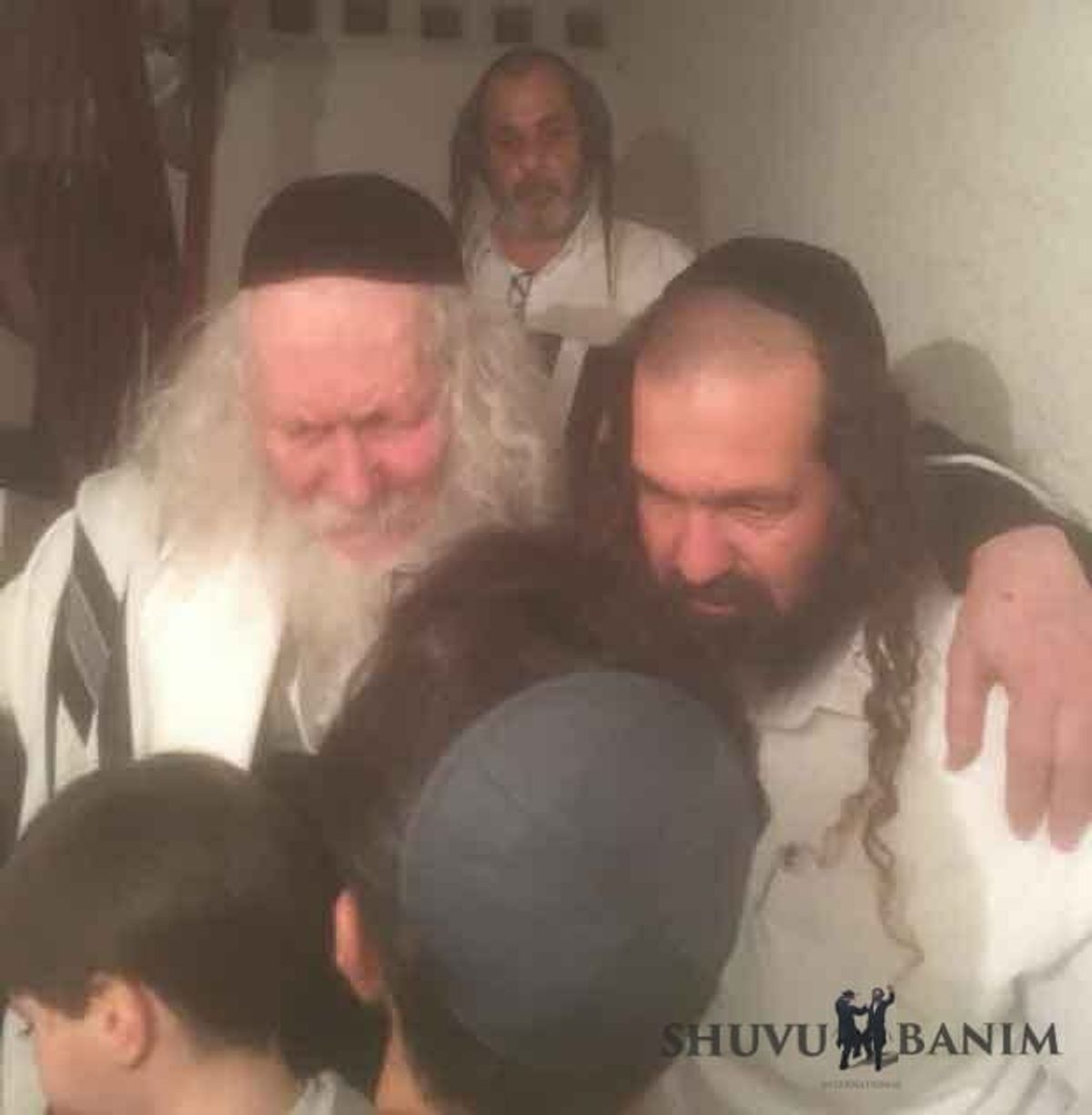
Yesterday, the night of Wednesday of Shabbat Shoftim 5778, August 15, 2018, the Gaon and Tzaddik, Rav Eliezer Berland shlit"a, arrived at a home gathering in Rehovot.
Words of the Gaon and Tzaddik, Rav Eliezer Berland shlit"a
"If a person is within desire, he is a Canaanite slave"
"We spoke about how a person turns from a slave into a free man, how a person turns from a gentile into a Jew. He was a Canaanite, he was in desire; if a person is within desire, he is a Canaanite slave. 'Cursed be Canaan; a slave of slaves shall he be to his brothers' (Genesis 9:25). 'Cursed be Canaan' means that he will always be in this terrible desire; he will never be able to free himself from it. The moment a person frees himself – he becomes a free man. He exits this desire; that is called becoming a free man, that he exits this desire. Therefore, a Canaanite slave is sold, in order to redeem him, and one must give a million dollars to the owner of the slave, and then he turns from a Canaanite slave into a free man. For in truth, the Canaanite slave has no hand; a Canaanite slave is like an ox or a donkey, he has no hand, he has nothing."
"One who finds money in synagogues and houses of study belongs to the finder"
"Like a courtyard that has no hand, a courtyard of Hekdesh (consecrated property) does not acquire. What is called a courtyard? Because there is a public domain and a private domain. Regarding a regular person, the street is a public domain and the courtyard and the house are a private domain, but Hashem fills the entire world with His glory. Hashem is the place of the world, we are not His place. If so, regarding Hashem, everything is called a private domain. If everything is a private domain, one does not need to say that Hekdesh has a hand. Therefore, the Gemara rules in Bava Metzia 21b that one who finds money in synagogues and houses of study belongs to the finder, because Hekdesh has no hand. The synagogue is not a hand for Hekdesh, and therefore, whoever found one hundred Euros there – one hundred dollars – if he merits it, he will find even six hundred, he will be able to fly to Uman, it is his."
"Deborah was twice as much as Moshe Rabbeinu"
"Deborah was twice as much as Moshe Rabbeinu. With Moshe, there were Clouds of Glory; they walked with Clouds of Glory, and when they crossed the Sea of Reeds, there were Clouds of Glory. But with Deborah, there were no Clouds of Glory, there were no Clouds of Glory at all. 'A shield if it be seen, or a spear among forty thousand in Israel' (Judges 5:8). And even so, they threw dust and it became swords, they threw straw and it became arrows, because 'When the leaders lead in Israel' (ibid. 2). Once, every woman knew how to perform circumcision, just as Tzipporah circumcised the son of Moshe, and Joshua circumcised all the men when they entered the Land because they did not circumcise in the desert. The women perform the circumcision; there is no choice, the women circumcise the children."
"In this generation, we are reincarnations of previous generations"
"A gentile who says he circumcised himself for the sake of Hashem, usually one does not believe him, but if we believe him, then the circumcision is a circumcision. Deborah came and innovated that 'priah' (uncovering) is required; no one knew that 'priah' was required. It is written in Joshua, 'And again circumcise the children of Israel a second time' (Joshua 5:2); that was 'priah'. Deborah said, 'Now, when you perform 'priah', it is possible to go out against Sisera.' Sisera twice is exactly Esther; Sisera (331 x 2 = 662), Esther is 661. What Queen Esther did was to subdue Sisera – Haman. 'The stars from their courses fought' (Judges 5:20). 'The stars from their courses fought' – the initials are Haman, because Sisera was Haman twice, and therefore Yael was reincarnated in Esther, because after Yael subdued Sisera, she had to come in a reincarnation to also subdue Haman, who was a reincarnation of Sisera. Because everything that happens in this generation is that we are reincarnations of previous generations, and therefore Rabbi Akiva had to rectify the spark of Zimri. Rabbi Akiva had to turn Sisera into a tzaddik, because in Sisera there was a spark of Rabbi Akiva."
"Hashem gives even to the greatest wicked person a spark of a tzaddik"
"Hashem gives even to the greatest wicked person a spark of a tzaddik, through which he can always return in teshuvah. Even Ahasuerus, who wore the garments of the High Priest, could have done teshuvah, to truly be the High Priest. In the end, Yael, even though she was a woman, became the High Priest, because every woman who is a righteous woman comes in a reincarnation and becomes the High Priest. If there is a Holy Temple, there is a High Priest. Therefore, Yael turned into Eli, and from Eli came Abaye, who was a priest. Therefore, the Halacha is like Abaye in 'Ya'al Kegam', because all the laws are drawn from Yael. Therefore, it is called 'Ya'al Kegam'; it comes from the soul of Yael that was impregnated in Abaye, and through this, when he innovated the laws, the Halacha is like him. For Rava was a spark from Lot. It is written, 'And they took Lot and his property, the son of his brother' (Genesis 14:12), the initials are Rava. Therefore, Rava would receive 'Shalom' from Heaven every Erev Yom Kippur, Shalom from Heaven literally – 'Shalom Aleichem Rava'. He merited to rectify the spark of Lot, but Abaye received Shalom every Erev Shabbat, because Abaye was a spark from Yael, which is higher."
"And therefore, 'Blessed above women in the tent shall she be' (Judges 5:24) – Yael merited to subdue Sisera. She merited to perform self-sacrifice, because if he – Sisera – had awakened for one second, he would have strangled her in that same second. If he had strangled her in that same second, no trace of her would have remained. It turns out that Yael sacrificed herself like the Akeidah (Binding of Isaac), that the merit of Yitzchak is the greatest merit. Even though the Geulah will be in the merit of Rachel, the greatest merit is the Akeidah. Whoever says the portion of the Akeidah will have no harm on that day, and therefore Rachel, who now sits at the crossroads – Rachel's Tomb is on the road literally – at the crossroads, so that she can cry literally on the road, to cry over the Geulah."
These are the words of the Gaon and Tzaddik, Rav Eliezer Berland shlit"a, as edited from the 'Shvivi Or' pamphlet from a lecture delivered on Motzaei Shabbat Ekev in Holon.
Subscribe to Our Newsletter
Receive Torah articles and inspiration directly in your inbox