
Instead of Hanging Esther, They Hung Haman — Rabbi Eliezer Berland shlit"a
6 Nissan
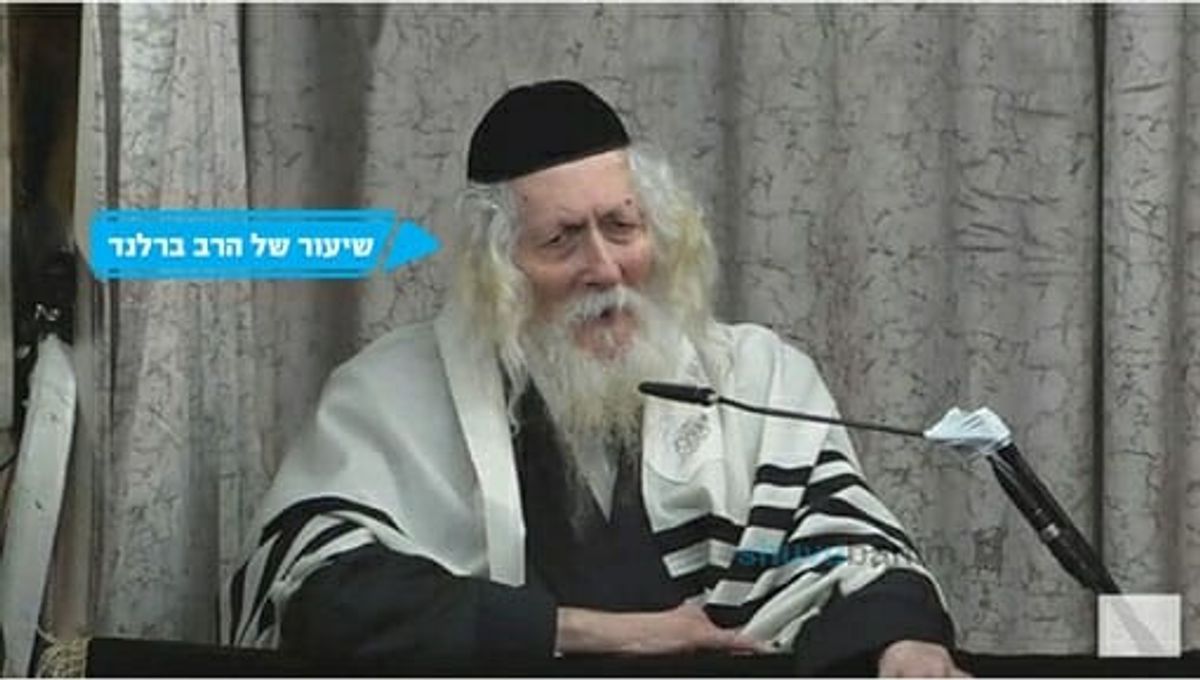
Holy words delivered by our teacher, the Gaon and Tzaddik Rav Berland shlit"a, on the 6th of Nissan 5782, the day of the Nasi Eliyasef ben De'uel:
The Parsha of the Nesi'im and Elijah the Prophet
Then there was Elitzur ben Shedeiur, who enters into the 'tzur' (rock). 'And you shall stand there for Me upon the rock,' and there is the cleft of the rock and the ceiling of the rock, and the entire service of man is to reach the ceiling of the rock, that he should always be at the ceiling of the rock. And then Moshe Rabbeinu fasted forty days and forty nights; after he fasted forty days and forty nights, he had already shed his entire body. Then Elijah the Prophet asked Hashem, and Hashem said to him, 'What are you doing here, Elijah?' What are you doing here, how did you enter here? What, without permission? He didn't have a visa, so Hashem said to him, 'What are you doing here?' 'What are you doing here,' how did you get here, 'what are you doing here.' So he said, what can I do, 'The Children of Israel have forsaken Your covenant.' They have forsaken Your covenant; now you will go to all the covenants, now you will have a punishment, you are obligated to participate even if there are ten covenants. It doesn't matter, a million covenants, he must be at a million covenants. In one day, in one second, at a million covenants. So they ask, what kind of punishment is this?! What, it is a merit to be at all the covenants. What kind of punishment is that!? If only we could be at all the covenants in the world, if only we would go to all the covenants. What is written here? 'And for the Jews there was light and gladness and joy and honor.' 'Gladness' is a brit milah, a brit milah. Because they issued a decree against the brit milah. Because Antiochus, he gave eight days; Antiochus was the greatest miser in the world, he did not agree that there should be twelve. A day like now, twelve days, Elitzur ben Shedeiur, Shlumiel ben Tzurishaddai. He said only eight, eight is enough. So now we are in a problem, how do we fit twelve into eight? I don't know, I didn't study math, how is this... but in Nissan we manage; Nissan is wonderful, we have twelve days, we make celebrations, and we sing and sing.
Queen Esther Did Not Give Up
But in the end, the king said to Queen Esther, 'Listen, it is all lost, they have already hanged Haman.' Because Shuvu Banim does everything backwards, everything they do is backwards, even... after all, they hanged Haman on Chol HaMoed. Esther said, 'I want to drink the four cups,' but he did not give them to her. He said, 'You will not drink four cups, I am warning you, you will not drink a drop.' 'Give me a sip...' 'No! Not even a sip!' 'A drop...' 'No!' So what will happen here, what will be the end? Suddenly she sees, then they said, 'They divide my garments among them,' there were already gala dresses, she had a thousand gala dresses, they had already divided everything. 'They divide my garments among them and for my clothing they cast lots,' they divided all the dresses. Suddenly they said, now they will hang her. At nine... the children didn't want to... small children, at eight in bed. I am warning you! All the little ones at eight in bed! Quickly go to sleep! The children didn't agree, they want to see how they hang Queen Esther. He said, 'Tonight they are hanging Queen Esther.' Suddenly, what do they see? Instead of hanging Esther, they hanged Haman. This is a terrible thing; Haman didn't do anything wrong, everything is... everything he asked the king. He didn't do things for no reason, everything he was disciplined, he was obedient, he did everything the king told him. He brought him ten thousand silver talents, 'I want to buy the Jews.' He said to him, 'Take it back, there is no need for the money, I am not prepared to kill the Jews, I don't have the strength.' He said, 'Look what happened to Sisera, what happened to Pharaoh, what happened to Sisera.'
The Story of Sisera and the Heroism of Yael
You know what happened to Sisera? Sisera is twice Haman. Why is Sisera twice Haman? 'From heaven they fought, the stars from their paths,' one must say 'from their paths' again, they fought, and that is twice Haman. There was twice Haman, he was. Nothing helped him, poor thing, in the end he drowned in the Kishon. Yael came and said the Ineffable Name, it is written 'b'lat' (stealthily), what is 'b'lat'? She 'walks stealthily,' that is exactly forty-two, 'b'lat' is bet-lamed, that is 32, aleph-bet is 10, so she said the 42-letter Name. 'And she peered,' Sisera's mother had a righteous mother, therefore one needs one hundred blasts to nullify the weeping of the mother. If a mother sheds a tear, woe and alas that no mother should dare to shed a tear. She shed one hundred tears, one hundred blasts came out. Every Rosh Hashanah, one hundred blasts. So for her one hundred tears, what's with the tears? A righteous, holy, pure mother, she went with five veils and five dresses. And therefore two Holy Temples were destroyed, and the third is on the way, now it will be built.
So Ahasuerus said to Esther, 'There is nothing to do, it is all lost, listen, 'seal it with the king's signet ring, and it cannot be revoked.' We do not change decrees here, not on the net, there is no government there, the government has fallen. With us, a government is a government! We made a decree, it is a decree, you will not revoke the decree for me, you will not interfere in my affairs, you want to, fine... my eyes, you are the eyes, the eyes, but you will not revoke any decree for me. I am telling you.' She said, 'And Esther added and spoke before the king, and fell before his feet, and wept, and pleaded with him, 'My G-d, my G-d, why have You forsaken me?''
Subscribe to Our Newsletter
Receive Torah articles and inspiration directly in your inbox