
It is Forbidden to Flatter the Wicked! Parshas Vayishev from the Gaon and
Tzaddik, Rabbi Eliezer Berland shlit"a
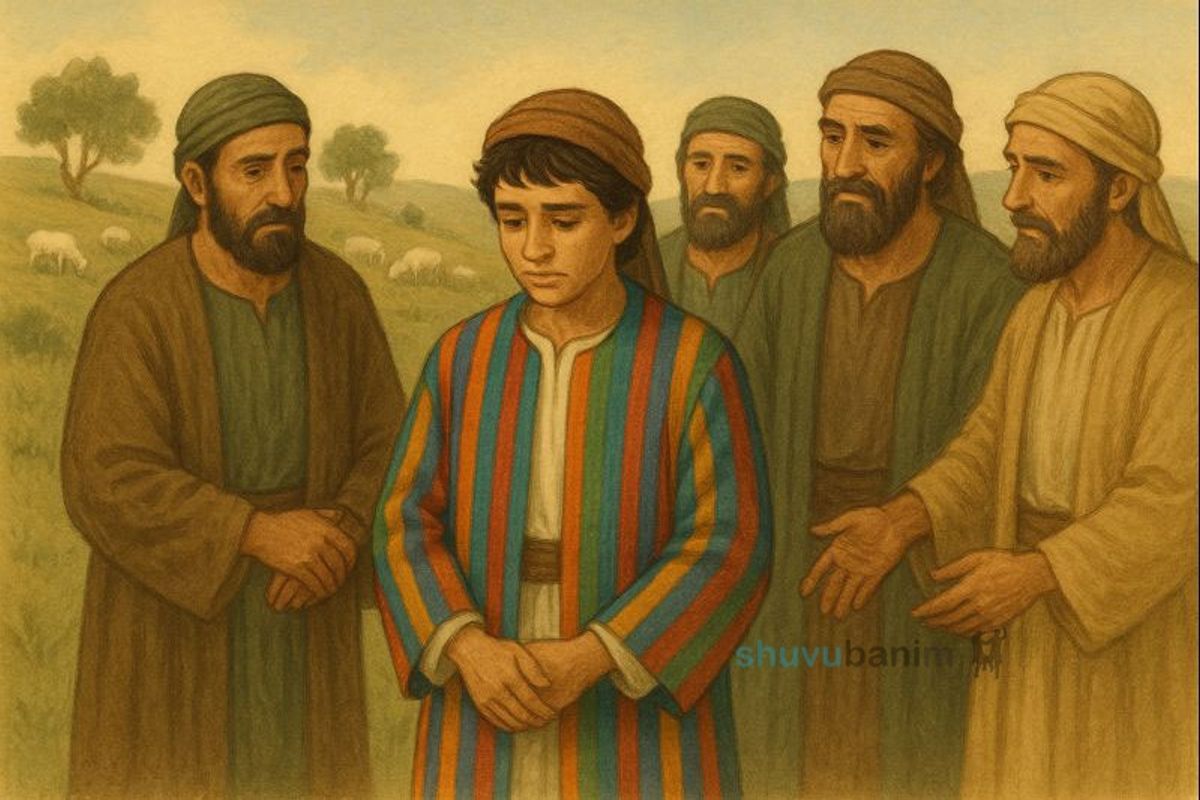
Wonderful holy words for Parshas Vayishev, full and overflowing with mussar (ethical teachings) and wisdom from the Gaon and Tzaddik, Rabbi Eliezer Berland shlit"a (may he live long and good days). The lesson was delivered on Thursday night of Parshas Vayishev, Teves 5779 (2018), after the Maariv (evening) prayer.
"And how could we steal silver and gold?" they asked Joseph. How is it possible? We returned to you all the money that was found in our sacks; how could we steal? How are these two things related? We returned more money than the goblet is worth, so would we specifically steal the goblet?
He says, yes, you want to perform sorcery. The goblet is not just silver; with the goblet, one can know where Joseph is living. By using the goblet, they know where Joseph is hiding. You took the goblet, not for the money, but to know where Joseph is, because the goblet tells everything. With the goblet, one can go from street to street until they reach the house where Joseph is located.
It is Forbidden to Flatter the Wicked!
King Agrippa, who should have been killed—Agrippa was the grandson of Herod. They said to him, "You are our brother, you are our brother." So now you will go into exile; it is forbidden to flatter the wicked! Even someone like Agrippa, who would lower the basket and bring Bikkurim (first fruits) and distribute Tzedakah (charity)—but to flatter him? His head should have been removed – the whole matter is Kanaus (holy zealotry); only one who is a Kanna (zealot for Hashem) has the right to live. If a person is not a Kanna, he has no right to live. A person must be a Kanna, and then he can live all one hundred and twenty years. Pinchas lives because he was a Kanna. Why does Pinchas live forever? Because he is a Kanna! Only one who is a Kanna has the right to live.
The Zealotry of Hashem of Hosts
We learn this from Parshas Vayishev. Yosef HaTzaddik (Joseph the Righteous) could have fled from them. He said, "I am going to them, even if they sell me." Joseph knew they would sell him; he was certain. But he said, "Even if they sell me, I am doing what my father told me. My father told me to go," so I go. For the question is, why did he continue going to Shechem?
Rather, whoever is a Kanna will triumph. Because Pinchas was zealous for Hashem, he lives forever; he did not die, he cannot die. If a person is zealous for Hashem, his entire body is transformed; he receives a new body from Gan Eden (Paradise) and he lives forever.
This is the meaning of "Shall we indeed come, I"—"I" refers to Yaakov (Jacob)—"and your mother"—this is Rachel—"and your brothers to prostrate ourselves to you to the ground?" (Genesis 37:10). The Midrash Rabbah says that Rachel lives forever; Rachel did not die. Rachel was merely included within Leah, "on the way to Ephras" (Genesis 48:7). What is "on the way to Ephras"? This is Leah. The entire work is how to include Rachel within Leah. Therefore, the Zohar says that Rachel did not pass away at all. Sarah also did not pass away, as it says, "And the life of Sarah was" (Genesis 23:1). Sarah lives forever. "And Yaakov lived" (Genesis 47:28)—Yaakov lives forever.
Only if a person is a Kanna can he truly live; then it atones for all his sins. If a person is a Kanna and fights for Hashem, then he will pass one hundred and twenty years without any doubt, because this purifies the body from the filth of the Serpent. Only Kanaus (holy zealotry) can purify the body. Only if a person is a Kanna will it purify his body; if he is not a Kanna, then his body decomposes. The whole matter of Rebbe Nachman is that he was a true Kanna; he was the ultimate true Kanna. Therefore, he lives forever. Therefore, his Chassidim live forever, and he merited that his continuation will be forever. No other Rebbe has a continuation like our holy Rebbe. Our holy Rebbe lives for all eternity; he cannot die, and even if they were to dig, he could move himself.
Like Chizkiyahu the son of Rabbi Yehuda. Rabbi Yehuda was a flame of fire; during the time of Yichud (marital intimacy), he was a flame of fire. We must teach children from the age of three that during the time of Yichud, fire should descend. If a person performs the Yichud without lust, then fire descends upon him. The whole point is that during the time of Yichud, a person should have no lust, no physical sensation, and then fire descends upon him. Like Rabbi Yehuda, fire descended upon him. A person must not have any physical sensation during the Yichud, and one must prepare for this already from the age of three. Therefore, it is written in the Pele Yoetz, to prepare children from the age of seven. And the children should "hit" their father for bringing them into the world in impurity. Because everything that happens to a child is because his father brought him in impurity; so let him "hit" the father—"Why did you bring me in impurity?" Through this, he removes the impurity.
"And it came to pass as they were emptying their sacks" (Genesis 42:35)
The Rebbe says to remove the impurity of birth, for a person is born in such terrible impurity—such impurity has not existed since the creation of the world. So how does he remove the impurity? Only through Kanaus (holy zealotry). Pinchas was zealous, and Pinchas lives forever. Some say perhaps it was a reincarnation, but the Arizal (Rabbi Isaac Luria zt"l) says that Pinchas is literally Eliyahu (Elijah). And after seven hundred years, Eliyahu the Prophet sits "under a broom tree" (I Kings 19:4), "coals of broom" (Psalms 120:4). He arrived in Beer Sheva, and after that, he traveled to Tzarfas. He traveled to Tzarfas, but not the France of today; rather, Tzarfas which is in Tzidon. This is "to Zarephath, which belongs to Zidon" (I Kings 17:9). So he can live forever, because there was a widow there, and she says "I have commanded" (ibid). What is "I have commanded"? Devorah says, "Hashem has commanded" (Judges 4:6). "Hashem has commanded", what, what, what is "Hashem has commanded"?
Rather, Hashem speaks with the soul. Hashem tells the soul everything that was and everything that will be. Before the soul descends to the world, they show it everything—all the paths. They show the soul that it needs to travel to Uman; they show it this before it descends to the world. They tell it, "Your Tikkun (rectification) must be that until one hundred and twenty, you shall travel to Uman." They tell it this, and it remembers this; suddenly, it awakens within it. In this merit, the person travels to Uman. The moment a person reaches Uman, he will already live until 120! A person's entire work is to reach Uman, and then he will already live until 120. A person comes to the world only to be in Uman—only! That is his entire purpose. To actually live there? That is a question, because one needs to establish Yeshivas (Torah academies), and pray at five in the morning, and not sleep at night.
If a person falls asleep at night, his entire work is not worth it. The Rambam (Maimonides) says in the Laws of Torah Study (Chapter 3, Law 13) that service of Hashem is only at night. He writes that a person should not lose any night to sleep or eating. A person needs to study the Ketzos HaChoshen (a classic work on Jewish civil law) 24 hours a day; only this captures the mind! If he learns Gemara (Talmud) without the Ketzos HaChoshen, he does not understand what he is learning! It doesn't connect for him. Only when he learns the Ketzos HaChoshen can he understand what he is learning!
For the Ketzos says that with one "slap" (legal transformation), a person is transformed from a donkey into a Jew. He asks, how can a Canaanite slave suddenly become a Jew? It is written about Tavi (the slave of Rabban Gamliel)—the Babylonian Talmud says he [Rabban Gamliel] took out his eye; the Jerusalem Talmud says he took out his tooth. "Eye" (Ayin) and "Tooth" (Shen) together have the numerical value of 480, the same as "Lillith" (a name for the forces of impurity). For every Canaanite slave is in the hands of the Lillith. When a person is not in the hands of the Tzaddik, he is in the hands of the Lillith! When a person goes with the Tzaddik, he can pass through Damascus Gate, even if they are throwing grenades and Molotov cocktails. All the Arabs move aside. On Simchas Torah, there were Zionists and Arabs there; they all moved aside, and they all become as nothing, like dust.
For the full lesson and more lessons on Parshas Vayishev click here
Subscribe to Our Newsletter
Receive Torah articles and inspiration directly in your inbox