Military Exemption
Who like Morinu HaRav (our teacher the Rav) respects and cherishes the soldiers of Israel, who demonstrate mesirus nefesh (self-sacrifice) to guard the borders of the Holy Land. Every soldier who sacrifices himself to guard the inhabitants of the Holy Land has tremendous merit. However, alongside the special love of the Rav shlit"a for every single Jew wherever he may be, Morinu HaRav teaches us that those who truly guard and protect the Jewish people everywhere—in the Land of Israel and across the entire world, providing both spiritual and physical protection—are the true tzaddikim (righteous ones) and the students of Torah. They are the masters of prayer and those who guard their eyes in holiness. "Not by military force and not by physical strength, but by My spirit, says Hashem." Indeed, in the Shuvu Banim yeshiva, Torah V'Daas, and the other yeshivas under the leadership of Morinu HaRav, one can see how the strengthening words of Morinu HaRav inspire in-depth Torah study with great power and mesirus nefesh.
Since Breslov chassidim have the custom every single year to travel outside the borders of the Land of Israel in order to merit being at the holy tziyun (gravesite) of Rebbe Nachman, the Flowing Brook, in Uman, they cannot afford to be labeled as "deserters." Therefore, they operate in full coordination with the law. Whoever can, obtains a complete exemption from military service, and whoever cannot, arranges his status as a yeshiva student and receives a deferment. Either way, many yeshiva students have received an official exemption from army service, and they "contribute to the nation and the state" by joining the legion of the army of Hashem, protecting us with their holy Torah study.
The editorial board of Pele Elyon received a fascinating story about an alumnus of the Succas Shalom yeshiva, a general Chassidic yeshiva, who tried many times to obtain an exemption from military service, but without success. He was even hospitalized for a week in a closed psychiatric ward for this purpose. Nevertheless, despite submitting his request for an exemption seven different times, he received a negative response all seven times, rejecting his application. Meanwhile, the month of Elul was rapidly approaching. The student desperately wanted to merit being at the tziyun of Rebbe Nachman of Breslov for Rosh Hashanah, but at that point, there seemed to be no reasonable chance of this happening—unless a miracle occurred.
And indeed, a miracle did occur. The young man, who was not counted among the students of Morinu HaRav, was speaking one day about his failed attempts with a fellow study partner. His friend gave him a piece of good advice and directed him to the prayer hall of Morinu HaRav. "Come to the tzaddik," he told him, "and with Hashem's help, you will succeed on the eighth try and receive an exemption."
As mentioned, this young man was not one of Morinu HaRav's students, but he realized he had nothing to lose and went to see Morinu HaRav. Morinu HaRav told him to go to the recruitment office once again. During his meeting with the mental health officer, he was instructed to say that he suffers from trauma following his involvement in a security incident a few years prior, and therefore, he is incapable of serving in the IDF. In addition, the young man received a blessing from the Rav, who blessed him that he would receive the exemption and merit to be in Uman for Rosh Hashanah by our holy Rebbe that very year.
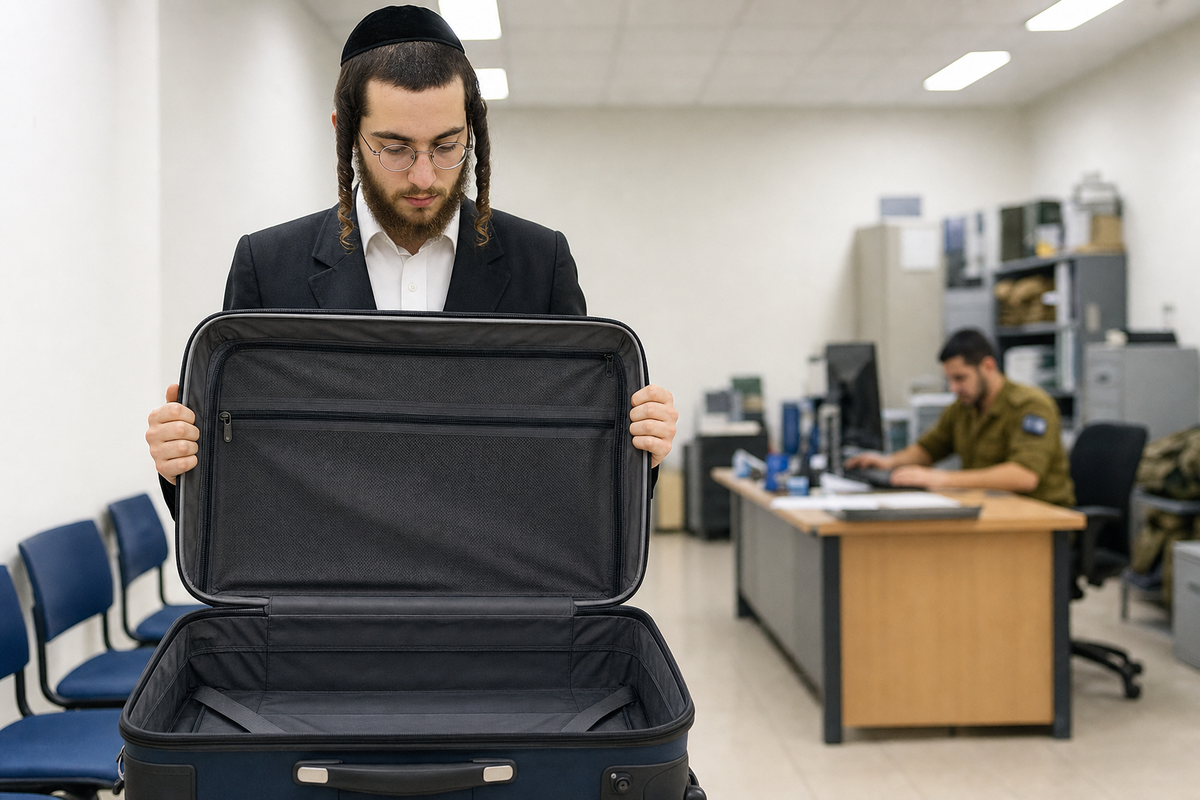
A few days later, the young man arrived at the recruitment office carrying an empty suitcase. He approached them and said he was coming to enlist, which is why he had brought a suitcase for his clothes. His plan was to innocently ask to meet with the mental health officer to try and obtain an exemption as a last resort. If, Heaven forbid, they would try to draft him on the spot and reject his request for an exemption, he would open the suitcase and show them that he had "forgotten" to pack his clothes, meaning he would have to return home... This way, he could safely go back home until his next attempt.
He entered the mental health officer's room, and before he was even asked to explain the reason for his visit, the officer asked him only two questions! The first question: "What is your name?" And the second question: "Where do you live?"
Immediately after these two questions, the officer told him, "You are unfit to serve in the IDF. Come with me right now, and we will arrange an exemption for you."
It was the middle of the month of Elul, 5778. On that very day, the young man received his exemption from military service and went straight to a travel agency, where he purchased a plane ticket to Uman for Rosh Hashanah. Indeed, in the merit of the tzaddik's blessing, he merited to be at the tziyun of Rebbe Nachman in Uman, Ukraine, for Rosh Hashanah 5779.
From the book *Pele Elyon Part 3*
Subscribe to Our Newsletter
Receive Torah articles and inspiration directly in your inbox