
Moving: The Eulogy of the Gaon and Tzaddik, Rabbi Eliezer Berland shlit"a
for the Chassid, Rabbi Moshe Tzanani zt"l
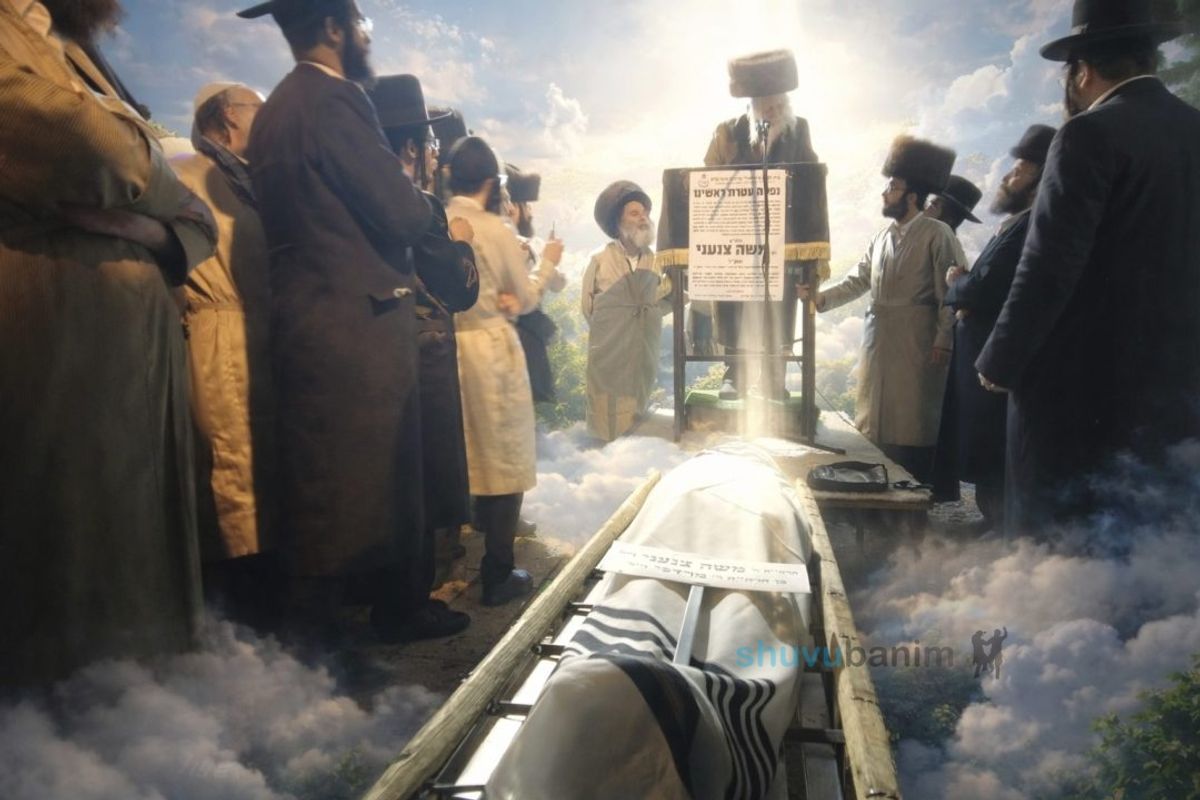
The passing of Rabbi Tzanani zt"l is the greatest loss for the Jewish People, it is the greatest loss!
He was the most elite at the university, number one, but he left the university in the middle. He left everything; he saw the light of the Torah. He went to Rabbi Ginzburg in Kfar Chabad, and then Moshe Shvili brought him to Shuvu Banim.
Since then, he guarded his eyes (shmiras einayim); he saw nothing, he did not open his eyes from the moment he arrived. He arrived in 5737 (1977), and on Simchas Torah in 5738 (1978) he entered my small room that was in the apartment of the Steipler (Rabbi Yisrael Yaakov Kanievsky zt"l). He entered the small room and would not budge; he said, 'I am not moving from here, I want a yeshiva (Torah academy) to be opened.'
Because I was against opening a yeshiva, I constantly told Rabbi Weisenfeld, I told everyone, to all who were with me, Rabbi Shimon Taichner, I am not ready to open a yeshiva; I want to learn. A yeshiva involves public affairs; it’s not for me. I want to sit in my corner and learn.
Rabbi Tzanani forced me. He said, 'I am not moving from this room.' Everyone knows the small room at 23 Rashbam Street (Bnei Brak); it became his room. Within a week, there were 20 young men inside that room. Then, after
two weeks, [Rabbi] Taichner arrived, took everyone to his home, and then his wife was blessed with a child (nifkeda) as soon as he took everyone into his home.
They were at Rabbi Taichner's for 3 months, after which we moved to Eilat Street in Neve HaChesed in Shikun Vav. We set up 4 rooms there, a dining room, a study hall, and two bedrooms for the students. After that, we moved to Pardes Katz.
From the moment Rabbi Tzanani drew close to Shuvu Banim, he was Rebbe Nachman himself; Rebbe Nachman was mystically attached (ibbur) within him. One could see that every movement of his and every thought of his was only dveykus (cleaving) to Rebbe Nachman.
He did not miss a single Rosh Hashanah (at Rebbe Nachman's grave) his entire life. Even during all the most dangerous trips (before the fall of the Iron Curtain) when they said they would send us to Siberia—they promised us, they committed to us that next time (we would be sent). Once, when I already came with an Israeli (passport), they told me, 'We don't believe you. You have 20 names; this is surely not you.' Convincing them was very difficult; the Russians are stubborn.
But Rabbi Tzanani withstood all the trials, all the controversies, and all the upheavals that Shuvu Banim went through. He passed through everything with heroism. Now he is an exemplary figure; he hasn't passed away at all.
It is written in the Gesher HaChaim (The Bridge of Life) that one must not say of a tzaddik that he has passed away – just as Rebbe Nachman is alive and enduring, so too is he alive and enduring. We are not 'toite' (dead) Chassidim; on the contrary, we are 'lebedig' (vibrant/alive) Chassidim. The other Chassidim are the 'toite' ones, because their Rebbe is 'toite'; they aren't alive at all. Rebbe Nachman is alive and enduring, and anyone who draws close to Rebbe Nachman is alive and enduring.
He merited, Rabbi Moshe Tzanani merited, Rabbi Moshe ben Yemima merited that he is alive and enduring. He hasn't passed away at all; one must not think so. He is here with us. It is written: "Warm the eulogy, for I am standing there" (Shabbos 153a). Rav said to Rav Shmuel bar Sheilas: 'Warm up the eulogy' (inspire the listeners), 'I am becoming an ibbur (mystical attachment) in you'; I am present, I am alive and enduring, I have not passed away.
Rabbi Tzanani goes before us. Right now, there is a decree of destruction (gezeiras shmad) against the Jewish People, and he sweetened (mittek - neutralized) everything. Now we will be able to live another 200 years in Jerusalem in peace—there were terrible decrees against the Jewish People; anyone who is informed knows this. They already wanted to wipe us out completely, to destroy us entirely. Even Trump is already moving to the side of the Arabs; he is already against us—in his merit (Rabbi Tzanani's), we will now be able to live in Jerusalem, the Holy City, for at least 200 years, until the end of the sixth millennium, when Mashiach ben David will come.
He was the soul of the Mashiach of the generation. The Chasam Sofer says (page 98b in Choshen Mishpat) that in every generation there is a Mashiach, only we are not worthy for him to be revealed. And he (Rabbi Tzanani) was Mashiach ben David, the soul of our Holy Rebbe; he was Rebbe Nachman himself.
He is alive and enduring and he continues to lead the yeshiva; he leads the entire yeshiva. I was his student. He led the yeshiva, he led everything, he led the young men and the married students (avreichim). Just by seeing him, a person would do teshuvah (repentance) at that very moment, just as it is written about Rabbi Aharon of Karlin who had 80,000 (people he brought back to the faith). When did he ever speak to 80,000? Rather, they just saw him—just by seeing him, everyone did teshuvah!
Anyone who saw him (Rabbi Tzanani) immediately did teshuvah. All the students in Shuvu Banim are in his merit. Today there are 10,000 students in Shuvu Banim; it is all in his merit, and he is alive and enduring—he has not passed away.
Everyone must take upon themselves absolute guarding of the eyes (shmiras einayim) and to learn 24 hours a day. This is the main thing. Now it is Shovavim (weeks of spiritual rectification); what does one do during Shovavim?
Learn – it's simple!
Rebbe Nachman is all about learning Gemara (Talmud). (Rebbe Nachman said), 'I want to pull the world toward action—that you should only learn Gemara 24 hours a day.' Walk with the Gemara in your hand wherever you are, whether standing in line for the bus or standing in line at the doctor's office. One can finish several tractates (masechtos) then; if a person stands in line for an hour, he can finish 10 tractates.
This was Rabbi Moshe Tzanani. He merited a 'vort' (Torah insight) on the entire Shas (Talmud) every year, just as Rebbe Nachman says (to finish every year) the Shulchan Aruch (Code of Jewish Law) and all the other works. Everything was fluent on his lips; he was unique in his generation, one of a kind.
The whole point is that we only need to follow in his footsteps, to know that he goes before us as a pillar of fire; he is alive and enduring. And let everyone take upon themselves now, during the days of Shovavim and afterward, to learn 24 hours a day.
One should doze over the Gemara, fall asleep over the Gemara. The tzaddikim did not get into bed at all. From the age of 13, they didn't get into bed; they would fall asleep over the Gemara and then continue learning further. Back then, they still learned with candles, so the Gemaras would get burned; all the Gemaras were scorched.
All the Gemaras from the era before the invention of electricity are scorched from them falling asleep over the Gemara with the candle in their hand. They would place the candle in their hand so they would wake up when the candle burned them, but in the meantime, the candle burned them and they didn't wake up. By the time they woke up, their fingers were already burned, the Gemara was burned, the Shulchan Aruch was burned—that is why you see everything scorched.
And this was him in our generation—he (Rabbi Tzanani) would learn 24 hours a day, and he never diverted his attention, never raised his eyes. He could walk upright while his eyes were hermetically sealed – let everyone take it upon themselves to close their eyes.
Now it is Shovavim, now is the Torah portion of the Geulah (Redemption). Within fifty days, they reached the Fiftieth Gate. Within fifty days, in Parshas Bo, the Geulah already begins. From Pesach to Pesach (the ten plagues occurred), and afterward from Pesach to Shavuos, another 50 days.
On Pesach, the 10 plagues began, and on the [following] Pesach was the final plague, the Plague of the Firstborn. After that, 50 days until they reached Mount Sinai, at which point they already reached the Resurrection of the Dead – now we are in the time of the Resurrection of the Dead.
Rabbi Tzanani has not passed away; G-d forbid (chas v'shalom), one must not think for a single moment that he passed away. He can now resurrect the dead. On the contrary, he has now risen in level; "Tzaddikim are greater in their death than in their lives." He can now revive us all, resurrect the dead, and heal the sick.
Anyone who mentions his merit, anyone who is present now at this funeral (levaya) will be healed from all illnesses.
He and his offspring and his offspring's offspring, forever.
Subscribe to Our Newsletter
Receive Torah articles and inspiration directly in your inbox