
"On the Eighth Day Moses Offered"
Only the Tzaddik of the Generation Can Offer During the Days of Inauguration • Parshat Shemini from the Gaon and Tzaddik Rabbi Eliezer Berland shlit"a
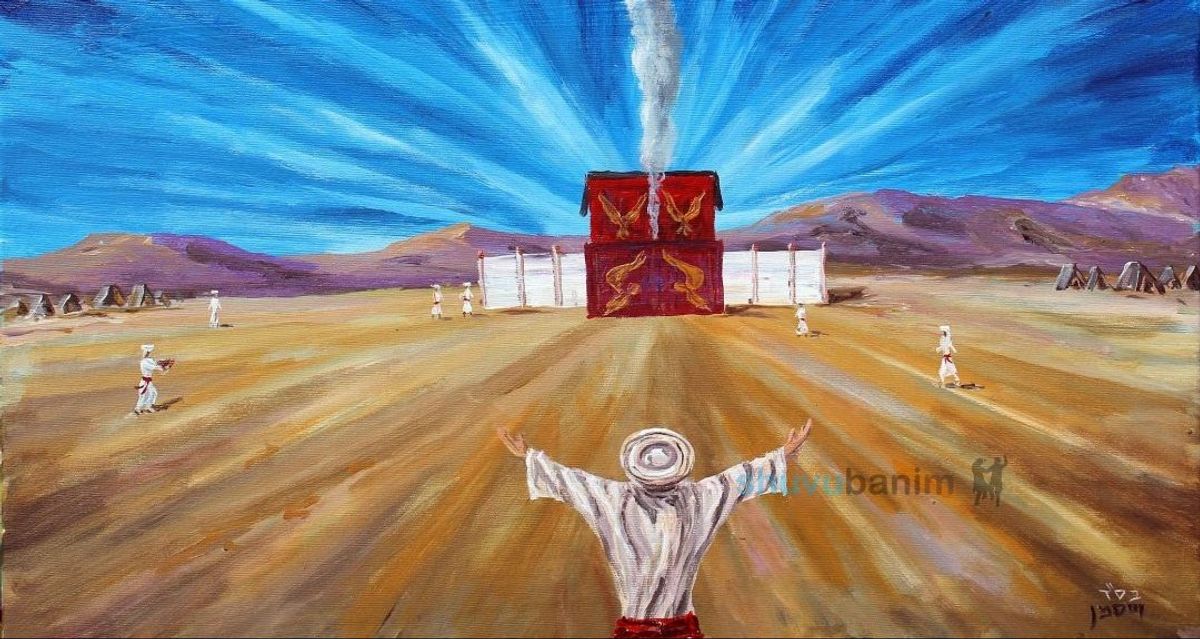
Why specifically did Moshe Rabbeinu (Moses our teacher) offer on the eighth day? What is the meaning behind Nadav and Avihu wanting to nullify the attribute of Elokim (Judgment)? And the secret of why Moshe told Aharon (Aaron) that they are greater than me and you. Insights and pearls for the weekly Torah portion of Shemini from the Gaon and Tzaddik Rabbi Eliezer Berland shlit"a (may he live long and good days).
"Moshe is the Tzaddik of the generation, for only he can offer the sacrifices during the days of the Miluim (Inauguration)":
Because now it is the eighth day, which is the 1st of Nissan. The day called "the eighth day" is the 1st of Nissan; it begins on the 23rd of Adar, during these days when we build the Mishkan (Tabernacle). Moshe establishes the Mishkan; "on the eighth day Moshe offered." Moshe is the Tzaddik of the generation, for only he can offer the sacrifices during the days of the Miluim (Inauguration). Therefore, on the eighth day, only Moshe offers. He used a garment without a hem, the garments of Yom Kippur (Day of Atonement). He used the garments of the Kohen Gadol (High Priest) on Yom Kippur, because the Parah Adumah (Red Heifer) is performed in white garments. Therefore, the eighth day also coincides with the Parah Adumah, where white garments are used. The Kohen Gadol performed the Parah Adumah in white garments. This is why the Kohen Gadol—Aharon—must perform the Parah Adumah, even though Elazar his son, who was then the deputy priest, was also fit. But the whole matter of the Parah Adumah is that it rectifies the Sin of the Calf. For the Sin of the Calf is "and on the day I visit, I will visit" (punish), "and the king appointed officials (pekidim)" in the Megillah of Esther, because truly the decree was only deferred until the year 5700 (1940). Parshandatha has a small 'Taf', Parmashta has a small 'Shin', "and she shall write" which is 'Taf' 'Shin'—it was deferred to 5700. The entire decree of Haman was deferred to 5700. After that, it is written that twenty-eight years before the end of the sixth millennium, there will be the war of Gog and Magog in Cheshvan. It is written in Parshat Balak in the Zohar Chadash that in Cheshvan the Third Temple will be built after Gog and Magog begins in Cheshvan and ends in Cheshvan, and then the Third Temple will be finished speedily in our days, Amen.
"Nadav and Avihu wanted to nullify every judgment in the world":
We read in Parshat Shemini, "Today Hashem appeared to you." Nadav and Avihu wanted to nullify the name Elokim (representing Judgment). "You shall have no other gods (elokim) before Me," for it is forbidden for there to be anything in the name of Elokim, which is judgment, only Havayah (the Tetragrammaton), which is mercy. For it is forbidden for there to be any judgment at all. After the Calf, there was no judgment—meaning they were not punished for the Calf as they deserved, but rather "on the day I visit, I will visit." "Take for yourself a young calf for a sin offering"—the calf that Aharon offered on the eighth day came to atone for the Sin of the Calf. The entire Holocaust, everything that happens, the firing of missiles—this comes to atone for the Sin of the Calf. The entire service of Nadav and Avihu was "for today Hashem appeared to you," that there should only be the name Havayah in the world. Nadav and Avihu wanted to nullify the name Elokim because it is written, "You shall have no other Elokim before Me." Every second that the name Elokim exists in the world, it is judgment. We must nullify all judgments through the Tzaddik. It is possible to nullify all judgments the moment one reaches the true Tzaddik and knows of the true Tzaddik. It is possible to nullify all the judgments in the world; there is no judgment that is not nullified through the true Tzaddik—barren women are blessed with children (nifkadot), marriage matches (shidduchim). Regarding shidduchim, a person needs to decide; 90 percent find it hard to decide, it's difficult for them to decide. They have a hundred suggestions, and it takes them a hundred years to clarify those hundred suggestions. Every year they clarify one suggestion—at least by age 120 they will reach a decision, then it will also be good... But the work of Nadav and Avihu was to nullify every judgment in the world, so that there would be no judgment, no pain, and no screens over the mind. The main thing is "Today Hashem appeared to you," that there should be no screens over the mind, so that whatever a person learns today—Gemara (Talmud), Ktzot HaChoshen (a legal work)—he will understand everything automatically, as if he were reading a story. All of Ktzot HaChoshen is like a story; there is no problem there. Every page he repeats a hundred times and clarifies and explains a hundred times. (Third Meal, Parshat Shemini 5779).
"Nadav and Avihu—their entire desire was to be consumed for the sake of Hashem":
Nadav and Avihu were the souls of Adam HaRishon (the first man). Regarding those who tended to them, it is said, "defiled by the soul of a man (nefesh adam)." The intention, as written in Sha'ar HaPesukim, is that they were the soul of Adam HaRishon. They were the Sefiros (Divine emanations) of Netzach and Hod. Yaakov Avinu (Jacob our father), who was also the soul of Adam HaRishon—and what is written, "and he touched the hollow of Yaakov's thigh," the Zohar says this refers to Nadav and Avihu. The angel, the ministering spirit of Esau, struck him in the hollow of the thigh—these were the souls of Nadav and Avihu, who are the aspect of the Sefiros Netzach and Hod, which are the aspect of the legs: Netzach is the right and Hod is the left.
Nadav and Avihu passed away "in their drawing near before Hashem." For they only wanted to draw close to Hashem, they only wanted to be consumed for the sake of Hashem. Their entire desire was to be consumed, and therefore Moshe said, "This is what Hashem spoke, saying: 'Through those near to Me I will be sanctified.'" Moshe tells Aharon that Nadav and Avihu are greater than me and you. The Arizal (Rabbi Isaac Luria) says they were greater than Moshe and Aharon in itgalya (revealed state). Moshe and Aharon were in itkasya (hidden state). The desire of Nadav and Avihu was a flaming fire; it broke through all boundaries. Moshe's desire for Hashem was hidden; no one saw it. Moshe and Aharon were in itkasya and they were in itgalya. "All the House of Israel shall bewail the burning." The people of Israel thought in their simplicity that they were greater; their flaming fire conquered all boundaries, it was visible to the eye. All their love for Hashem, may He be blessed, crossed all boundaries. Therefore, they were reincarnated (ibbur) into Eliyahu HaNavi (Elijah the Prophet), who ascended in a whirlwind to heaven.(Melaveh Malkah, Saturday night Parshat Shemini 5777)
The lesson has undergone editing, and if any error has occurred, it should not be attributed, Heaven forbid, to our teacher the Rav shlit"a, but to the writer, "and with us let our error lodge."
Painting courtesy of the artist R' Yehoshua Wiseman. For purchase: www.yehoshuawiseman.com
The Shuvu Banim website system wishes you, the readers and followers,
a Shabbat Shalom and a blessed one!!!
Subscribe to Our Newsletter
Receive Torah articles and inspiration directly in your inbox