
One Hundred Years Since the Passing of Maran the Chafetz Chaim zy"a • Lines to
His Portrait and a Prayer from the Holy Tzaddik Rabbi Eliezer Berland shlit"a
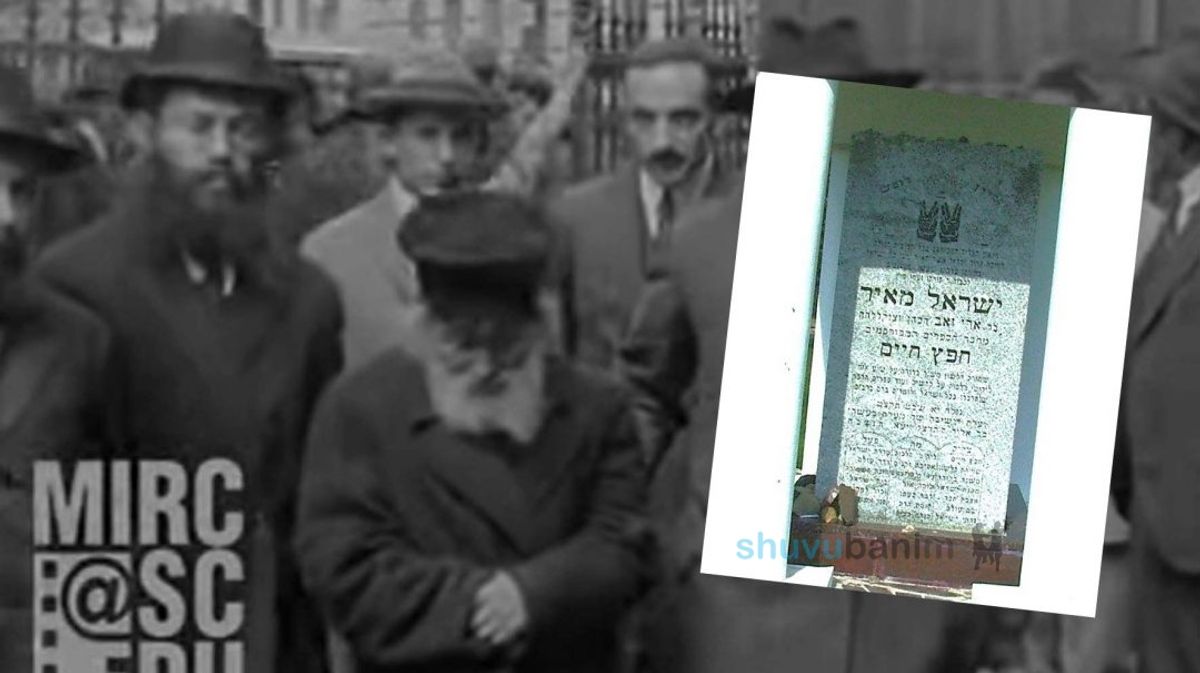
Today, the 24th of Elul 5783, marks one hundred years since the passing of the Kohen Gadol, Maran Rabbi Yisrael Meir HaKohen of Radin, author of the Mishnah Berurah and the Chafetz Chaim.
His Life Story:
Rabbi Yisrael Meir was born to his father, Rabbi Aryeh Zev, and his mother, the Rebbetzin Dovorosha, on the 11th of Shevat 5599 (1839), though some claim he was born in the years close to that date. From a young age his extraordinary talent was already evident, and at only ten years old he went out on his own to learn in the “Parnas Kloiz” in Vilna, where he drew his Torah from his great teacher Rabbi Chaim of Volozhin zy"a. At the age of fourteen he was orphaned from his father, and after his mother remarried, at the request of his stepfather he married his stepsister at the age of seventeen. After his marriage he moved to the city of Radin. In the year 5629 (1869) he founded the Radin Yeshivah, led it, and personally ensured all its needs were provided for.
In the year 5663 (1903) his first wife passed away, and he married a second time—Mrs. Miriam Freida, daughter of the great gaon Rabbi Hillel of Lapis zt"l.
In the year 5633 (1873) he published the first edition of the sefer “Chafetz Chaim,” dealing with the halachos of guarding one’s speech. One year later he published the first section of his great work, Mishnah Berurah, on the Shulchan Aruch. Rabbi Yisrael Meir published more than twenty sefarim, which today are foundational stones in the Jewish library. These works encompass the hidden treasures of the holy Torah—whether in halachah, mussar, aggadah—and even the subject of the Beis HaMikdash never left his mind.
Maran the Chafetz Chaim was known for his tremendous activity on behalf of the Jewish people before the Holocaust. He worked tirelessly to spread and preserve authentic Judaism, so that the winds of the maskilim should not penetrate the camp. He also supported the establishment of “Beis Yaakov” for girls, and he participated in the various conferences of Agudas Yisrael.
On Wednesday, the 24th of Elul in the year 5663 (1903), the world of Torah was darkened with his ascent to the Heavenly heights. Thousands accompanied him on his final journey, and he was buried in the town of Radin. By open miracles during the Holocaust, his grave survived the bombings of the Germans and the Allies.
Before you is a prayer written by the holy Tzaddik Rabbi Eliezer Berland shlit"a for guarding one’s speech, and for the merit to be like the Chafetz Chaim:
To merit never to speak lashon hara—ever—and that all my words should be weighed and measured, as on a scale of gold, precious stones, and pearls; and through this, to draw close to the Tzaddik who atones for our sins
Master of the world, Who is all-powerful: Grant me the merit never to speak lashon hara—ever. And may I merit to be like “the Chafetz Chaim,” who from the day he came to full understanding never stumbled in any forbidden speech of lashon hara. Through this he merited to be included within Adam Kadmon of Adam Kadmon—because all his words were weighed and measured on a scale of gold, precious stones, and pearls.
For lashon hara is more severe than the three most severe transgressions: idolatry, forbidden relations, and bloodshed. Because when a person speaks lashon hara, he transgresses “bloodshed”—and he turns himself into idolatry, “I am, and there is nothing besides me,” as everyone comes to listen with longing and yearning, and they honor him for it. And it is also “forbidden relations,” because he exposes the other person’s disgrace and shame; this is like exposing nakedness, which is disgrace and shame for the one being spoken about.
And since he is arrogant and speaks lashon hara, therefore Hashem brings upon him a malignant tzara’as on the skin of his flesh, deeper than the skin—just as he “goes deep” to find deficiencies in another, so Hashem “goes deep” for him with the affliction, so that he will be forced to come to the Kohen, who is in the aspect of the true Tzaddik. For the Kohen is, for us, in the aspect of the true Tzaddik—who atones for all our sins—who offers korbanos and atones for our sins.
For we bring upon the mizbe’ach the animal spirit within us, which causes us to do animal-like deeds. And that is why there are so many acts of slaughtering korbanos in the Beis HaMikdash: because an animal can never speak lashon hara, and it will always remain pure and clean—for it never spoke lashon hara, nor even the slightest trace of it.
Subscribe to Our Newsletter
Receive Torah articles and inspiration directly in your inbox