Only When He Studies Ketzos HaChoshen Can He Understand What He’s Learning! •
For the Yahrtzeit of the Author of Ketzos HaChoshen
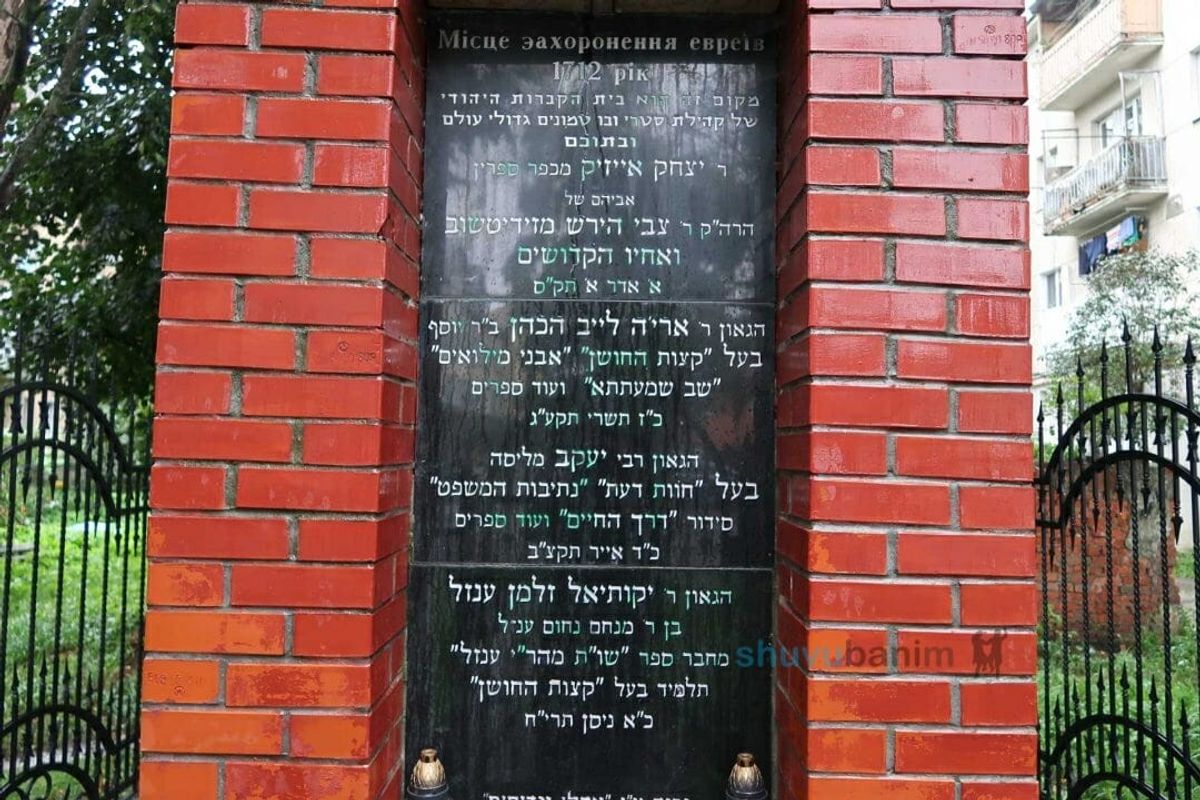
Today, the 19th of Teves, is the yahrtzeit of the gaon, the author of Ketzos HaChoshen—Rabbi Aryeh Leib ben Rabbi Yosef HaKohen Heller zy"a, who is buried in the city of Stryi in Ukraine.
Before you are several excerpts from shiurim in which The Rav, Rabbi Eliezer Berland shlit"a, speaks about the greatness of the author of Ketzos HaChoshen and about the exalted value of learning his profound sefer;
In his lifetime, the Ketzos HaChoshen did not sleep, and he did not eat throughout his life. He would eat at his parents’ home, while she [his wife] would eat at her parents’ home. The one who arranged this match was Rabbi Shlomo Zalman of Brod—Rabbi Shlomo Kluger of Brod. And there was no money, there was no food, they had no home—there was nothing. So all his life he ate at his parents, and all her life she ate at her parents. In their lifetime they did not have food—he did not see food in his life.
In his lifetime he did not sleep in a proper bed. He had some flimsy, broken bed and a torn feather blanket. In the winter he would sit under the feather blanket and write his chiddushim beneath the blanket—and the ink would freeze from the intense cold, minus thirty. All the windows were covered with frost; rain would come inside and turn to ice; the whole house was sheets of ice—and that is how he wrote all his chiddushim. And not with pens like ours, but with quills; each time he had to sharpen the quill, and each time the quill would break. And the ink would freeze—it would become a block of ice. And inside the room it was minus thirty. He had to put the ink under his armpit, press it to his chest—maybe, just maybe, it would melt. And so he did not sleep and did not eat in his lifetime. In his lifetime he did not eat—even on Shabbos they could not eat together; each one ate only at their parents’ home. (Shiur delivered on the yahrtzeit of the Ketzos HaChoshen, 5777).
***
The Ketzos HaChoshen was literally the soul of Rebbe Nachman. Since Rebbe Nachman did not say chiddushim on the Gemara, Rebbe Nachman came again in the Ketzos, and in this way he wrote chiddushim on the Gemara. He passed away together with Rebbe Nachman—because Rebbe Nachman passed away in 5571 and he in 5573—but he was truly the soul of Rebbe Nachman, which came down to the world in order to show that one must learn Gemara.
Because all of Breslov, in general, do not know that one must learn Gemara. In Breslov they don’t know—they never saw the Rebbe learning Gemara even once. The Rebbe, already at the age of seven, finished Shas a hundred times, a thousand times, with the Eitz Chaim, with everything. The rest were already attainments—attainments we no longer have.
The Rebbe said: “All my Torah is only one out of myriads upon myriads of times of what I truly grasp; I only bring it down in the language of children, in the language spoken in kindergarten.” But these are attainments that do not exist in the world.
And the first thing is to merit seichel. The Rebbe says a person was given seichel so that he will learn Gemara with seichel. Instead of learning Gemara, he looks at iPhones, he looks at the internet—just for the seichel—to show that there is seichel in everything. The Rebbe is only seichel; the Rebbe is only pure seichel.
As it is written in the Rambam, that for Moshe Rabbeinu only seichel remained—this is the Rambam’s wording in Sanhedrin (Commentary to the Mishnah, the 13 Principles): that Moshe remained seichel alone; he did not have a body at all, and he did not have any form of a body, and he had nothing. That it’s only the imaginations of Shuvu Banim—that he had a body. Only the crazy Shuvu Banim think he had a body. According to the Rambam, and according to Moshe Rabbeinu, they had no body at all. The Rambam says that only seichel alone remained. (Shiur delivered on the yahrtzeit of the Ketzos HaChoshen, 5780)
***
Because the main thing is learning Gemara. The Rebbe says, “Arise, sing out in the night” — this is learning Gemara. All of Chanukah is learning Gemara. All of Chanukah is only learning Gemara—learning Ketzos HaChoshen.
A person cannot connect sugyos. Every daf of Gemara is twenty sugyos, forty sugyos—it’s impossible to connect them without Ketzos HaChoshen. If a person does not learn Ketzos HaChoshen, nothing connects, and he forgets everything. He’ll come to a wedding without remembering anything.
***
A person comes into the world only in order to learn Ketzos HaChoshen. That is what he must learn day and night—now it’s 7:30—until 7:30 to finish Ketzos HaChoshen. A person can finish the entire Ketzos HaChoshen; there is no problem at all—if a person takes Ketzos HaChoshen now, from 7:30 until 7:30.
There are 100 young men here. Whoever was awake at night should sleep another 12 [hours]—5 hours; that’s for 50 years. Whoever already slept can learn from 7:20 until 7:30, Ma’ariv, and then go back to sleep another 4 hours.
The night was created only for girsa. A person must clear out all his days, all his hours—clear everything—eat nothing, only Torah and Torah and Torah.
And to give shiurim from 7:30 until 7:30—twelve shiurim—each shiur an hour, another shiur in Ketzos HaChoshen. Only Ketzos HaChoshen—this is what explains the Gemara.
A person can learn the entire Shas and still know nothing. He doesn’t understand a word. He doesn’t know how to connect the sugyos—how they connect.
***
Yosef HaTzaddik—Moshiach ben Yosef—who is holy, the holiest of the holy, Shmiras HaBris—he can stand 12 years in prison, and another year in the house of Potiphar, and another 9 years in Pharaoh’s house; to stand in tests that no “son of death” can stand in. And it is all in the merit of the dances, in the merit of the songs, in the merit of the fact that he was sewing shoes—he only worked on how to sew shoes. That is the entire avodah of a person: to sew shoes for the Shechinah.
- And this he can do only through dancing. He can learn Gemara, learn Ketzos HaChoshen. And without Ketzos HaChoshen, the Rebbe says: “Upon the instrument of meditation with a harp” (Tehillim 92:4). A person cannot sing when he does not learn Ketzos HaChoshen.
Why was there no Geulah? Why did they make the Golden Calf? Because they did not learn Gemara—it did not help them. Because only when a person learns Shas, the six orders, only then can he stand against the yetzer hara. Without the six orders—without learning Gemara—even if a person dances all day, it won’t help him.
Only learning Gemara. The Rebbe says: three partitions of the mind—there are “telat chalalei galgalta d’mocha”—three chambers in the brain. But only if a person learns Gemara can he push away the foreign thoughts.
***
If a person falls asleep at night, all his avodah is not worth anything. The Rambam says: avodas Hashem is only at night. The Rambam, in Hilchos Talmud Torah (chapter 3, halachah 13), writes that a person should not lose even a single night to sleep, and not to eating.
A person must learn Ketzos HaChoshen 24 hours—only this grips the mind! If he learns Gemara without Ketzos HaChoshen, he does not understand what he is learning! It doesn’t connect for him. Only when he learns Ketzos HaChoshen can he understand what he is learning!.
A number of years ago, The Rav, Rabbi Eliezer Berland shlit"a, wrote a tefillah for his yahrtzeit, which is today, the 19th of Teves:
Here is the complete tefillah for reading and download:
Yahrtzeit of Ketzos HaChoshen, Rabbi Aryeh HaKohen Heller zt"l
With siyata d’Shmaya, for the sake of the Name, for the sake of the Shechinah, may it be an eternal merit—on Rosh Hashanah he passed away, 19 Teves 5573
Ketzos HaChoshen, whose entire avodah all the days of his life was only and solely to raise the Shechinah back to her root and to bring near the end of the Geulah—for his soul was emanated from the Kesser of Atzilus, from Arich Anpin, the Kesser of Atzilus, in the secret of “Vanity of vanities,” said Koheles, “vanity—everything is vanity.” For all the days of his life he was surrounded by a chariot of fire and horses of fire, like Yehonasan ben Uziel, who whenever he learned Torah was surrounded by the supernal fire.
For to emanate a soul from the Kesser of Atzilus—which is Arich Anpin of Atzilus—belongs only to one whose soul is encompassed 24 hours by the supernal fire. For to emanate a soul from Arich Anpin of Atzilus—where the soul of Arich Anpin of Atzilus is from the sefirah of Chochmah of the Name Mah (Yud–Kei–Vav–Kei), where lies the root of all the ten Sefiros, in the secret of “With me from Lebanon, bride; with me from Lebanon you shall come”—which is said about the month of Teves, when all the ten Sefiros of Chochmah shine, in the secret of Hillel who was in the aspect of three cubits of snow, which is the measure of a mikveh.
For all the days of Ketzos HaChoshen he never knew what warmth was, and he was always surrounded in the months of Teves and Shevat by rivers of freezing ice, when the ink would freeze at the time of writing, and he would warm it in his bosom. This is the sefirah of Binah, which reaches to the navel and clothes itself into Gevurah of Atik, which is entirely chasadim.
And therefore the soul of Ketzos HaChoshen, which was emanated from Chochmah of Mah of Atzilus— which is the root of all wisdoms and understandings—in the secret of “With me from Lebanon, bride; with me from Lebanon you shall come,” which is said about the month of Teves {With me = 411}—and this Partzuf of Abba, which is …… for the soul of Ketzos HaChoshen, whose Name is Yud–Kei–Vav–Kei.
For with thirty-two paths of Chochmah He poured forth and formed and engraved the Rock of the worlds—the souls of all the Tzaddikim and all the wise and understanding Chassidim. For Abba reaches until the navel of Arich Anpin, and Yisrael Saba until the edge of the Tiferes of Arich Anpin, where is the Yesod that bestows all wisdoms and understandings.
And therefore, all the days of Ketzos HaChoshen he never ate in his own home, for he was in the aspect of Eliyahu HaNavi, who did not eat and did not drink forty days and forty nights. And through this, Ketzos HaChoshen merited ….. to him the Torah was given, which accompanies us every day and every hour through the awesome Name “Ehyeh Asher Ehyeh,” for he was in the aspect of the eyes of the congregation for all generations; for his soul was comprised of ten Havayos times … and his soul was the soul of Adam HaRishon, which came and descended to the later generations to rectify and prepare everything for the coming of Moshiach.
Subscribe to Our Newsletter
Receive Torah articles and inspiration directly in your inbox