
Parashat Chayei Sarah - The Secret of the Good Eye and the Burning Jewish Spark
Escaping the Klippah of Efron: The Secret of the Good Eye
Efron had a great treasure in his courtyard (the Cave of Machpelah). He had Adam and Eve, who illuminated from one end of the world to the other, but for him, the Cave of Machpelah was darkness and gloom. Complete darkness, because Adam and Eve were buried in the cave, so Hashem arranged for there to be such terrible fears, such illusions that demons and spirits were there. There was a terrible fear to approach there; it was a remote place on the mountainside. No one wanted to buy this place until Efron was certain he was tricking Avraham Avinu in selling the cave.
Reb Noson explains that the holiest place, the holiest tzaddik, wherever there is great holiness, it always appears as a place of darkness and gloom, surrounded by demons and spirits. As it is written:
"Whoever is holier than his fellow is more desolate than his fellow"
"Efron" (עפרן) in gematria is 400, which equals "Ra Ayin" (רע עין - evil eye, 400), the opposite of a good eye. Therefore, he saw only darkness and gloom in the Cave of Machpelah. But King David had a good eye, as it is beautifully written:
"Beautiful eyes and goodly to look upon"
He saw only the light in every Jew, the good point in every Jew, the holy spark in every Jew.
A person sees his own light, but does not see the light of the other, whether between friends or at home. Sometimes a man sees light in his wife, while the wife does not see light in her husband, or vice versa, the wife sees light in her husband but he does not see light in his wife. In truth, everyone must see the light in the other, because it is forbidden for a person to see a flaw in the other, a defect in the other.
The essence of the evil eye is that one cannot bear that his friend is better than him, that he looks narrowly at his friend's elevation, at his friend's success. He sees that his friend learns more, prays more. Why should you care that he prays better? Learns better? Every person has an evil eye and no one is willing for the other to be greater than him. If a person were willing for the other to be greater than him, he could live forever; he could bring tikkun (rectification) to the entire world. But a good eye is something else entirely. A good eye means that you support the other, love the other, rejoice in his elevation, and rejoice in his successes.
The Burning Jewish Spark: The Story of Yosi Meshita
Every person has treasures; one only needs to remove the dust that covers them. One must escape the klippah (husk) of Efron, from the evil eye. In every son, in every daughter, and in every Jewish soul, there are infinite treasures. A Jewish soul blazes for Hashem and burns for Hashem; every soul of a Jew wants to do teshuvah (repentance)!
Every Jew has a heart burning for Hashem, blessed be He, a burning heart that could burn up the whole world. Every Jew is a flaming fire. In the inner essence of every Jew, a fire blazes:
"A constant fire shall burn upon the altar; it shall not be extinguished"
Every single Jew can bring the whole world back in teshuvah (repentance). Even the greatest wicked person can do teshuvah (repentance), because the more wicked he is, the more power he has; he has a greater soul.
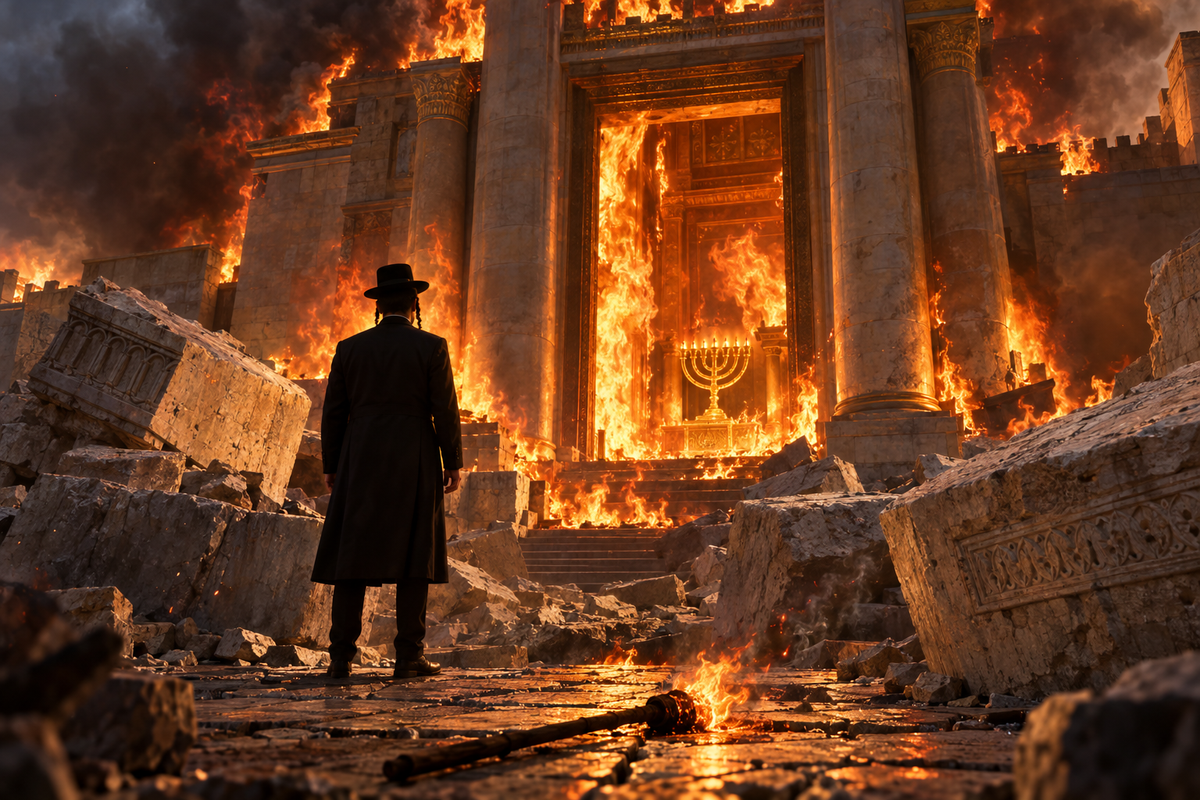
As told in the Midrash about Yosi Meshita, who denied Hashem, denied everything, and joined the Romans. Whoever kept Shabbat, whoever circumcised children at that time, was crucified. He saw that the people of Israel were lost, wiped off the face of the earth. He fell into despair and said, "Why do I need to be a Jew? I will be a Roman." He went with them to burn the Holy Temple, throwing torches with them. Before the Temple was completely burned, the Romans said to him: "Wait a minute! Who will enter the Sanctuary to bring out the Menorah?" They told him, "You go in and take something." Everyone knew that whoever entered the Sanctuary would be burned; whoever entered the Holy of Holies would be burned. Everyone was afraid to enter, so they told him, "Whatever you bring out first will be yours."
Yosi Meshita went in, grabbed a golden Menorah, and came out with it. They said to him, "Give us that Menorah! You cannot take it, it is too precious! Take a goblet, a spoon, but not the Menorah!" At that moment, the Jewish spark ignited within him; suddenly, his spark was lit. The Menorah kindled the spark for him. He saw that the Menorah was entirely light, and then he held the Menorah tightly and said, "You are not getting the Menorah; you will not get the Menorah."
They said to him, "What do you mean we won't get the Menorah? We will slaughter you, beat you, cut you into pieces." He said to them, "I am not giving you the Menorah. You will not take the Menorah from my hand; I will die with the Menorah." They told him, "It doesn't belong to you! It belongs to the king! We must bring the Menorah to Titus."
He said to them, "You will absolutely not get the Menorah; I will die together with it." And then he became entirely a flaming fire, entirely a fire burning for Hashem. "I am returning to Judaism! I am starting to be a Jew! Cut me into pieces." They said, "Fine." They grabbed him, put him in a carpenter's workbench where they saw wood, and began to cut him, sawing him into pieces.
The moment he began to suffer, he felt such delight; with every saw cut, he experienced pleasure. He was entirely gripped by joy, entirely enthusiastic, saying: "I take upon myself teshuvah (repentance). I accept the tortures with love. Master of the Universe, it is good that they are sawing me, good that they are cutting me. Forgive me for all my sins. How could I have joined the Romans who murdered millions of Jews? How did I not know that the people of Israel are eternal! A Jew is eternal. Thank Hashem they are sawing these rotten bones, these poisoned bones that caused me to sin and dragged me to where they dragged me."
And Yosi Meshita was entirely singing to Hashem, entirely joyous. While they were sawing him, he continued to sing. He felt no pain; he sang songs, singing, "My soul is sick with love for You." They were sawing him, and he was lovesick for Hashem. He only felt Hashem; he felt nothing except Hashem.
In the Light of the King's Face is Life: The Power of Inner Work
Because without inner work, a person remains with all his nonsense: he feels deprived, he complains, he gets angry, he is sad, he is worried, he blames himself and others, he is arrogant, he is jealous, he eats too much, he looks too much. Everything he does is for his own success, for the honor they will give him.
A person who does inner work grows, he develops, he changes. He draws closer to Hashem. He is constantly introspecting, asking himself, 'Where am I in the world?' Am I connected or not connected? What am I connected to? And what will become of me, Father? What will be my end? When will I start thinking about You and not about myself and my honor?
Thought has tremendous power. Everything is clarified in thought. That is where the soul resides. That is where the will is found. A person reflects a little on himself, on his life, sees where he is holding, and then he moves from thought to speech: "Hashem, help me eat less. Look what a belly has grown on me. It distances me from You. It is impossible to cleave to You; the belly gets in the way. Hashem, help me rejoice in what You give me and stop being jealous of others who suddenly learn without stopping, who suddenly smile all the time."
"Help me to rejoice in my friend's success with true joy, that I won't avoid meeting him because I don't want to give him the pleasure of seeing him in his success." And from speech, one moves to action. Slowly, one merits to change. And then life is truly wonderful. How much pity there is on someone who remains with all his nonsense until the end, and he is already old but is essentially still a child. For him, this is called the Void (Chalal Panui). Hashem is not there, Heaven forbid.
Magen Avraham: Finding Hashem Within the Void
And then one thinks a good thought, prays with intention, learns something, and all these fill the Void. Hashem says to each of us: Go to this place that is full of Hashem, to your inner essence, to the place where Hashem is always present, and then you will be able to awaken constantly from this point and not fall or become confused.
Even though Hashem created the world with a Void (Chalal Panui), and there are always troubles, and all sorts of things we don't understand, and we are constantly getting insulted, and we fall, and everything goes backwards for us, and everything is not good for us, and everything is bad for us—nevertheless, even when things are bad for us, we must remember that Hashem is everywhere. We are "Ivrim" (Hebrews/passersby). We pass over to the place where Hashem is, open our hearts, and find Hashem within the heart. We find that protected point that connects us to Hashem.
Avraham Avinu made for us "Magen Avraham" (the Shield of Avraham), which is greater than the Resurrection of the Dead. "The first is yours." We begin the Shemoneh Esrei prayer with the blessing of Magen Avraham. Only afterwards is there the Resurrection of the Dead. First, we need protection. "Your blessing is greater than My blessing," Hashem says to Avraham. "You are first, I am afterwards; I revive the dead, which is the second stage."
Avraham Avinu protects this point, which is the silver (kesef), which is a palace of silver, which is "the wings of a dove covered with silver." Yearning (kisufim) and love for Hashem, which is the true joy. And in its merit and by its power, one can overcome all troubles. The entire people of Israel is sustained by this point.
People sinned, failed, ruined, and transgressed, and afterwards their children returned, and sometimes they themselves returned. Everything is in the merit of this point, a point that is enduring and exists until the end of all generations. Just as a baby wants its mother, constantly running to its mother, so too the whole world wants Hashem. The entire people of Israel stands on this point. It stands on Avraham Avinu (In the Light of the King's Face is Life).
Torah Tidbits: The Secret of Eliezer's Miraculous Journey
"And I came this day to the spring" (Genesis 24:42)
From the wording of the verse "And I came this day," Rashi deduces that Eliezer said to Rivka's family: "Today I set out and today I arrived" – from here we learn that the earth contracted for him (Kefitzat HaDerech).
The Sages of Israel ask a question on Rashi: How does the verse – "And I came this day to the spring" – prove that the journey contracted for Eliezer, the servant of Avraham? Perhaps he set out a few days earlier, and only when he reached the spring did he say, "And I came this day to the spring"?
The holy Rabbi of Apta says that in the books of Kabbalah, the holy Name through which one can perform Kefitzat HaDerech (contracting the journey) is "A-H-V-H" (אהו"ה), and it emerges from the acronym of the verse:
"Et HaShamayim V'et HaAretz" (The heavens and the earth)
Behold, the acronym of the verse "Va'avo Hayom El Ha'ayin" (And I came this day to the spring) is also "A-H-V-H" (אהו"ה). Based on this, the holy Rashi relied in his commentary: "Today I set out and today I arrived – from here we learn that the earth contracted for him."
Yet we still need an explanation: Where do we find that Avraham Avinu transmitted to his servant Eliezer the holy Name "A-H-V-H," which is the Name capable of contracting the journey? It can be said that this matter is hinted at the beginning of Eliezer's mission:
"And Avraham said to his servant... and I will make you swear by Hashem, the God of heaven and the God of earth"
Avraham hinted to his servant through the acronym – "Elokei Hashamayim V'elokei Ha'aretz" (God of heaven and God of earth) – to the holy Name "A-H-V-H," which is capable of contracting the journey. And this is what is stated there:
"And the servant took... and he went, and all the good of his master was in his hand"
That he went with the Name of Kefitzat HaDerech in his hand – "A-H-V-H," whose numerical value in gematria is "Tov" (good, 17).
Did You Set Times for Torah? The Desire to be Included in Hashem
When a person arrives in Heaven, this is the first question they ask him. There are two levels in a person who sets times for Torah. One level is – "I will learn and thereby merit the Garden of Eden and the World to Come," which is also a tremendous virtue when he learns with this intention and not for the sake of arrogance or to provoke, Heaven forbid.
But there is a higher virtue than this: "I am learning because I want to do the will of Hashem and nothing else; I want to be included in Hashem" – absolute nullification, like a 3-year-old child who comes to his father, not because of a specific interest, but simply because this is the only reality he has.
The tzaddik understood that there is nothing in this world besides Hashem, and therefore he wants to be included only in Him. This is our work in the world – to reach this ultimate goal. And this is achieved by being included in the tzaddikim who merited this level, and who always remembered that Hashem is God – there is none else.
A Story for the Parashah: The Modest Garments of Rivka Imeinu
"And the servant brought out vessels of silver, and vessels of gold, and garments, and gave them to Rivka" (Genesis 24:53)
The tzaddik Rabbi Shalom Rokeach of Belz was exceedingly strict regarding the clothing of his thousands of chassidim, and at every opportunity, he would warn them to wear modest garments, as has been customary in Israel for generations. When chassidim came to him to receive his blessing regarding a shidduch (marriage match), he warned them to write explicitly in the "Tena'im" (engagement contract) that the garments for the bride would be provided according to a modest and simple Jewish standard, as is customary in distinguished chassidic homes.
The Admor Rabbi Shalom based this matter on the following verse: "And the servant brought out vessels of silver, and vessels of gold, and garments, and gave them to Rivka." The question is asked: For what purpose did Eliezer take special garments with him from the house of Avraham for the bride designated for Yitzchak? Could one imagine that the honorable and wealthy family of Nachor would send the bride from her father and mother's house without proper garments?
Rather, Avraham Avinu intentionally ensured that his servant Eliezer would take with him garments for the bride designated for his son Yitzchak, according to the standard customary in his home – so that this bride, who was destined to enter his home, would no longer wear the fashionable and ostentatious garments worn by the girls in the idolatrous "City of Nachor"...
"A Precious Stone Hung from Avraham's Neck"
The daughter of the Admor Rabbi Aharon of Karlin, author of "Beis Aharon," once fell ill with a severe disease, and the doctors almost despaired of her life. It happened that the tzaddik Rabbi Moshe of Kobrin visited the home of the "Beis Aharon." Rabbi Aharon invited him, according to his holy custom, to dine at his table.
During the meal, Rabbi Aharon mentioned to the guest tzaddik his sick daughter, who was in need of Heavenly mercy. Rabbi Moshe replied to his host: We learned in Tractate Bava Batra (16b):
"A precious stone hung from Avraham's neck, and any sick person who looked at it was immediately healed."
And the question is asked: What is the nature of this precious stone, in the merit of which Avraham Avinu healed all the illnesses in the world? Rather, the intention is not a physical "precious stone" that one can touch with their hands, but a spiritual precious stone – the good and special trait with which Avraham Avinu was endowed, which is the mitzvah of Hachnasat Orchim (welcoming guests), and it is the proven remedy for complete healing of every illness and malady.
"At this hour," continued the tzaddik of Kobrin, "His Honor Rabbi Aharon, the father of the sick daughter, is hosting us, and the precious stone, which is the trait of welcoming guests, is now hanging on your neck! Let the sick girl therefore look at her father, at you, and with Hashem's help, she will be healed." Rabbi Aharon did as his distinguished guest instructed, and miraculously, that very day there was a change for the better in his daughter's condition, and not many days passed until she was completely healed from her illness.
Subscribe to Our Newsletter
Receive Torah articles and inspiration directly in your inbox