
Parashat Shmini - So That My Soul May Sing to You: The Power of Song and the Sweetening of Judgments
"And Aharon Was Silent" - The Virtue of Silence vs. The Virtue of Song
"And Aharon was silent" (Vayikra 10:3)
Every person needs to study mussar (ethical) books, to know the book "Mesillat Yesharim," to know the book "Shaarei Teshuvah," to know the book "Orchot Tzaddikim," to read the chapter on anger in the book "Orchot Tzaddikim," to learn not to get angry, to know how to be in a state of joy in every situation, and to know that everything is for the best.
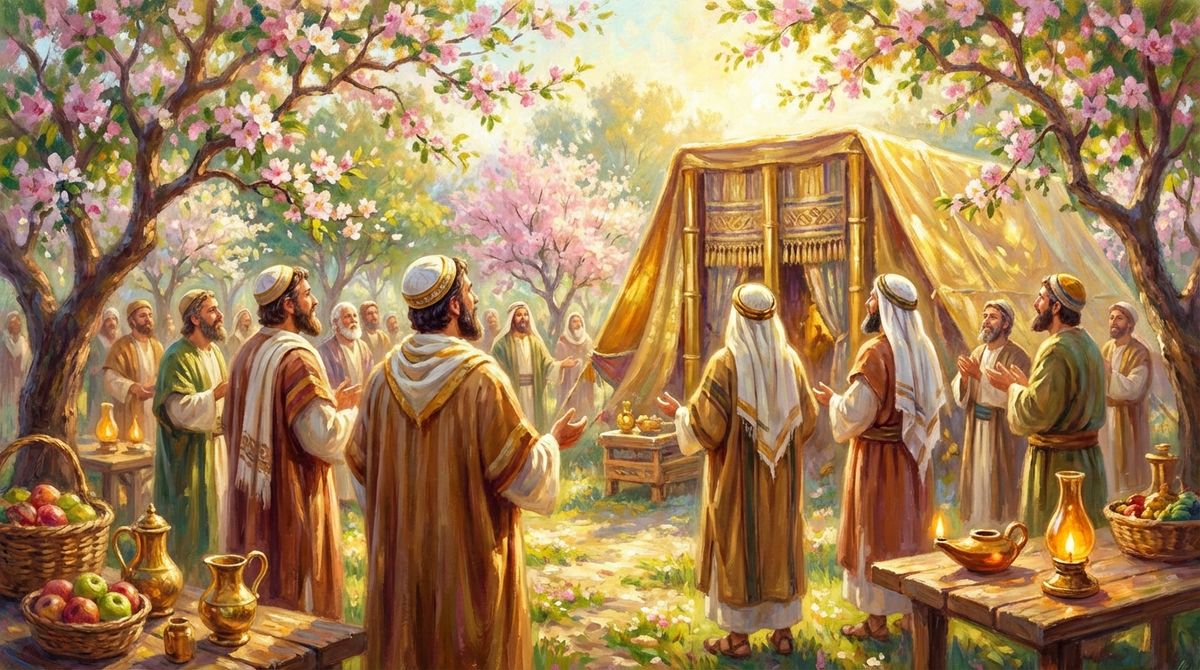
As it is written about Aharon, "And Aharon was silent" - Aharon saw the greatest, most terrible tragedy of his life; his two sons, Nadav and Avihu, who were equal to Adam HaRishon, were killed, slaughtered before his very eyes. He does not fall into despair, he continues onward in his service, "And Aharon was silent" - he was not confused by anything.
Dancing Inside the Fiery Furnace
There is a higher level than "And Aharon was silent" - which is called "So that my soul may sing to You and not be silent." Just as there are stories from the Holocaust about Jews who would dance and sing inside the furnaces, inside the gas chambers. It is told that once the Nazis put 50 Vizhnitzer bachurim (young men) into one of the gas chambers on the night of Simchat Torah. Instead of falling into terrible despair, they began to dance and sing:
"For out of Zion shall go forth the Torah, and the word of Hashem from Jerusalem."
They had such joy, such enthusiasm, as if they were dancing right now in Jerusalem, singing and dancing there at the Western Wall. When the Nazis saw them dancing, they said: What is this here! What is this dancing? What are these songs? This is heresy! They wanted to hear Jews crying, to hear weeping. What is this, a dance hall in Auschwitz?! The Nazis burst through the doors and shouted: Stop the dancing, stop this joy, this is not a theater!
But the Chassidim continued to dance and rejoice. The Nazis told them: If this is how you behave, you are mocking us. Get out, and tomorrow at 9 in the morning we will cut you to pieces with all kinds of torture, not a quick death with gas; tomorrow we will see how you dance.
The next morning, a message arrived that a thousand workers needed to be transferred immediately to another camp, and they were missing exactly 50 workers. One of them said: "Look, there are exactly 50 young men in the barracks over there who know how to work well, let's take them," and they immediately loaded them onto a truck and disappeared from there. In the merit of the songs and dances they performed, they merited to stay alive, and this is the meaning of "On the altar's pyre we will go out in a dance." A Jew does not lose faith for a single moment, not for a single second; he only dances and sings even in the most difficult situations in life.
Sweetening the Judgments Through Melody
When a person is in some trouble, has some problem, some difficulty in life, and he does not fall into despair and does not lose faith for a single moment, but rather strengthens himself with songs, dances, and joy - then he is not on the level of "And Aharon was silent" where he accepts it in silence, but rather he is on the higher level of "and not be silent." He sings, dances, and rejoices amidst the trouble, amidst the suffering; he sings to Hashem and thanks Hashem for every single breath.
What does it matter what you are going through? You must always thank Hashem for every single breath, as it is written about King David:
"For the conductor, with instrumental music, a Maskil of David. When the Ziphites came and said to Saul, 'Is not David hiding with us?'"
Saul is chasing him, everyone is informing on him. When he was in Keilah, the people of Keilah informed on him, and the only way David managed to escape from them was through songs, as he would rise at midnight and play music until morning. When the Philistines captured him in Gath, he said "For the conductor" and began to sing and play music. When Saul entered the cave to catch him, he began to sing and play music. When he saw that they were already besieging his house and soon everything would be surrounded by soldiers with arrows and spears, the first thing David did was begin to sing and play music. Whenever David was in trouble, he would constantly recite a song of victory, a melody, and thus he was saved from all troubles.
The Spiritual Power of Gratitude and Joy
When a person feels that he is going through such troubles, such suffering, the minimum is to wake up at dawn and sing the songs and the zemirot (hymns), and through this to sweeten the judgments. All judgments and troubles are sweetened through joyous song, singing, and melody.
"Let them sing for joy and be glad, those who desire my vindication."
King David said: All those who desire my vindication (tzidki) will sing and rejoice. What is "tzidki"? These are judgments. Through song and joy, the judgments will be sweetened. The Zohar in Parashat Vayishlach says that King David would sing all night, he would strengthen himself with songs and praises until the morning rose. A person must always praise Hashem, and whoever knows how to praise Hashem "constantly as is fitting," then Hashem accepts his prayers and saves him from all accusations and disasters.
When people do not dance, do not sing, are not joyful, and walk around broken - then they also break everything. A broken person breaks the entire system; he breaks all of creation. Why are you broken? Is it the Holocaust right now? Sing, dance, recite a chapter of Tehillim, say "For the conductor, with instrumental music, a psalm, a song" 7 times. This brings all the salvations, shidduchim (marriage matches), healings, it brings everything.
It is written in the Arizal: Whoever says "Lamnatzeach" (For the conductor) 7 times is guaranteed salvations, children, healings, etc. Songs and melodies are the way to sweeten all the judgments. Hashem is angry with one who does not awaken himself to sing, play music, and chant. There is no way to sweeten judgments other than through joy and dancing. The word "Jew" (Yehudi) comes from the word "Hodayah" (gratitude); he always gives thanks, always sings, whatever Hashem does is good, Hashem is always with us.
In the Light of the King's Face: The Tzaddik and the Ba'al Teshuvah
A person has a lot of intellect, and a lot of advice to give everyone, and a lot of wisdom, and a lot of sermons, but to actually see what is happening with him, with himself, where he stands within this picture, how the mind enters the heart, meaning how his entire being becomes a vessel for the service of Hashem - that is already much more difficult. And this, the tzaddik is able to do.
Rashbi said, "I am merely a sign in the world." I do not exist, I am nothing, I am only a sign. What am I a sign for? I am a sign for Godliness. And this is because he purified himself until he had no connection to any sense of self-entity, and his entire existence in the world was only to be a sign. People see him, and he reminds them of Hashem. Whoever looks at him is reminded of Hashem.
A person needs to see Hashem in every minute, in every moment, and in every hour; everything he sees, he needs to see that it is Hashem; everything that happens to him, he needs to know that it is all Hashem. In every movement, in everything, he sees the Divine Providence of Hashem. He believes that Hashem is guiding him and Hashem is leading him, and in everything he is connected to Hashem, in every single step. True, this is the level of the tzaddik, but what about us, who are we? We are the people of the tzaddik. The tzaddik is our guide; he does not give up on us, on any of us, and we also do not give up on him.
Even though he is the tzaddik, there is an aspect where the ba'al teshuvah reaches something that is greater than the tzaddik. How much Hashem loves the ba'al teshuvah! Out of so much love and longing, he skipped over everything, he broke everything; no one forces him, he does everything out of love, from his own free will. Therefore, at that moment, all of his intentional sins are transformed into merits.
The moment he begins to do teshuvah (repentance) out of love, it is then revealed to him that this point was inside him the entire time, it just had not come out into the open. And then, in essence, even in all the sins he committed, his wonderful spirit was beating, the spirit that essentially loves Hashem all the time, only that it had not come out into the open.
The Secret of the Priestly Blessing: Connecting Action to Knowledge
"And Aharon lifted his hands toward the people and blessed them" (Vayikra 9:22)
And this is the aspect of the Priestly Blessing (Birkat Kohanim). For the Kohen is the aspect of Da'at (Knowledge), the aspect of guarding the Covenant, in the aspect of "For the lips of a Kohen should guard knowledge, and they should seek Torah from his mouth" (Malachi 2:7), and all the more so "They shall teach Your ordinances to Yaakov, and Your Torah to Yisrael" (Devarim 33:10). And therefore, all the blessings are in their hands.
And the essence of the blessing is through the lifting of the hands, the aspect of "Lift your hands in holiness and bless Hashem," meaning that one must lift the aspect of the hands, which are the aspect of action, the aspect of money drawn through the work of his hands; one must lift this aspect of the hands to Da'at. And then, when he connects the action, meaning the money, to Da'at, from there all the blessings are drawn, the aspect of "And He will bless you in all that you do."
And this is "And Aharon lifted his hands," and then specifically "and blessed them" - the Priestly Blessing. "May Hashem bless you" - with money, "and protect you" - from harmful forces. Because then money of holiness is drawn, which is the aspect of blessing, which is protected from the harmful forces and the Sitra Achra (the Other Side), which are the aspect of darkened faces. Because the money is connected to Da'at, from which blessing is drawn, the aspect of illuminated faces, the aspect of "In the light of the King's face is life," and this is "May Hashem illuminate His face toward you" - the aspect of illuminated faces, for this is the essence of the blessing. (Likutey Halachot, Laws of Theft 2:13)
The Humility of Aharon HaKohen
"And it came to pass on the eighth day, that Moshe called Aharon and his sons, and the elders of Israel" (Vayikra 9:1)
Our Sages of blessed memory said in Tractate Megillah (10b): "Wherever it says 'Vayehi' (And it came to pass) - it is nothing other than an expression of sorrow." The question is asked: What was the sorrow that befell Aharon on the eighth day of the Miluim (the inauguration of Aharon and his sons to the duties of the priesthood)?
According to the simple meaning (pshat), one can answer - and indeed this is how the Gemara answers - that on this day a great tragedy came upon Aharon, with the sudden death of his two great sons, Nadav and Avihu. And according to a Chassidic explanation, the very honorable role of the Kohen Gadol (High Priest) in the Mishkan was in the aspect of "sorrow" for the modest and humble Aharon, who said over and over again: Who am I and what am I, that I have been appointed to this exalted and important position?
The tzaddik Rabbi Uri of Strelisk, known as "The Saraf," would say about this: It is better for a person to throw himself into a fiery furnace than to be a great and famous tzaddik in Israel.
And Moshe Heard and It Was Good in His Eyes - The Power of Torah to Heal
"And Moshe heard, and it was good in his eyes" (Vayikra 10:20)
It is told of the "Holy Jew" of Peshischa, of righteous memory, that in his youth he was a melamed (teacher) in a village for a certain homeowner. Over time, when the "Jew" had already become famous as a great tzaddik, the son of that homeowner became ill in his eyes, and that homeowner sought out doctors, but it did not help at all, and his son had already gone completely blind.
Then he heard that the very person who used to teach his son, Moshe, had been revealed as a holy Rebbe. He immediately traveled to him with his sick son, so that he would bless him with a blessing for a complete healing. When he arrived there, the Holy Jew began to speak with the homeowner's son in words of Torah, and asked him: Moshe! Do you hear? And the son answered: "Yes, I hear."
The Holy Jew of Peshischa said to him: It is written in our holy Torah, "And Moshe heard, and it was good in his eyes..." And behold the wonder - immediately the son began to see with his eyes, and was healed.
He Does Not Chew the Cud - Charity Precedes Going to the Beit Midrash
"And the pig, because it has a cloven hoof that is completely split, but will not chew the cud; it is unclean for you" (Vayikra 11:10)
The tzaddik Rabbi Meir'l of Premishlan used to go around himself to the doors of philanthropists, to raise money from them for the poor and needy. Once, Rabbi Meir'l arrived at the home of a certain wealthy man, who was a Torah scholar and meticulous in mitzvot, but his hand was tightly closed to anything involving charity.
When the man saw Rabbi Meir'l standing at the door of his house, he understood that he had come to ask for a donation for a mitzvah, and he immediately began to apologize with feigned words of piety: "Does my master not see that my time is not free right now! I am hurrying to the Beit Midrash for my regular Torah class and for communal prayer!" And while he was speaking, the man took his hat and coat from his hand, and began walking hastily out the door of the house.
Rabbi Meir'l hurried after him, and said to him: About you and those like you the Torah has already said: "Because it has a cloven hoof... but will not chew the cud (gerah)" (this verse is said about the pig), and the explanation of the verse is: What advantage is there to the hooves of a person's steps, in his walking to a place of Torah and prayer - if "he does not chew the gerah" - if he does not donate the "gerah" to the poor (gerah being a term for a coin, as it is written: "Twenty gerah is the shekel").
A Prayer to Merit Complete Joy
Master of the Universe, grant me the merit of all the exalted levels that the tzaddikim and righteous women merited in the merit of their immense joy in You, a joy that had no end or limit. Grant me the merit to be like Yosef the tzaddik, about whom it is said "a successful man," for he was always cheerful and joyous, jumping and dancing even in prison, even in the pit of the underworld where he did not see a ray of light, because You were an eternal light for him, because he never diverted his mind from You and saw nothing besides You.
Master of the Universe, "Who chooses songs and praises," please grant us the merit to draw upon ourselves the spirit of the prayer and song of the "Sweet Singer of Israel," the holiness of his joy and the grace of his humility of "David is the smallest\
Subscribe to Our Newsletter
Receive Torah articles and inspiration directly in your inbox