Parashat Vayeshev - The Secret of Guarding the Eyes and the Light of Chanukah
The Holiness of Yosef HaTzaddik and Guarding the Eyes
Yosef the tzaddik was holy, Yosef the tzaddik guarded his eyes! He never opened his eyes [to look at forbidden things], and through this, he sanctified the entire space of the world. He went through terrible suffering and difficult tests, one year in Potiphar's house, and another 12 years in prison.
The Midrash says that three times a day Potiphar's wife would come to incite him to sin, to tempt him with endless temptations. Three times a day she would change clothes: morning, afternoon, and evening.
"His soul came into iron" - all day long she would come and pierce him with pins and needles, with iron combs!
She said to him: "We will blind your eyes! I will gouge out your eyes!" He said to her: > "Hashem opens the eyes of the blind" - I will walk with closed eyes and Hashem will open my eyes! She stuck pins under his neck and he never opened his eyes. She said to him: "I will bend you! I will humiliate you!" He said to her: > "Hashem straightens the bent." She said to him: "You will be here in prison for life! You will never get out of here!" He said to her: > "Hashem frees the bound."
The Secret of the Shoes and the Holiness of the Land of Israel
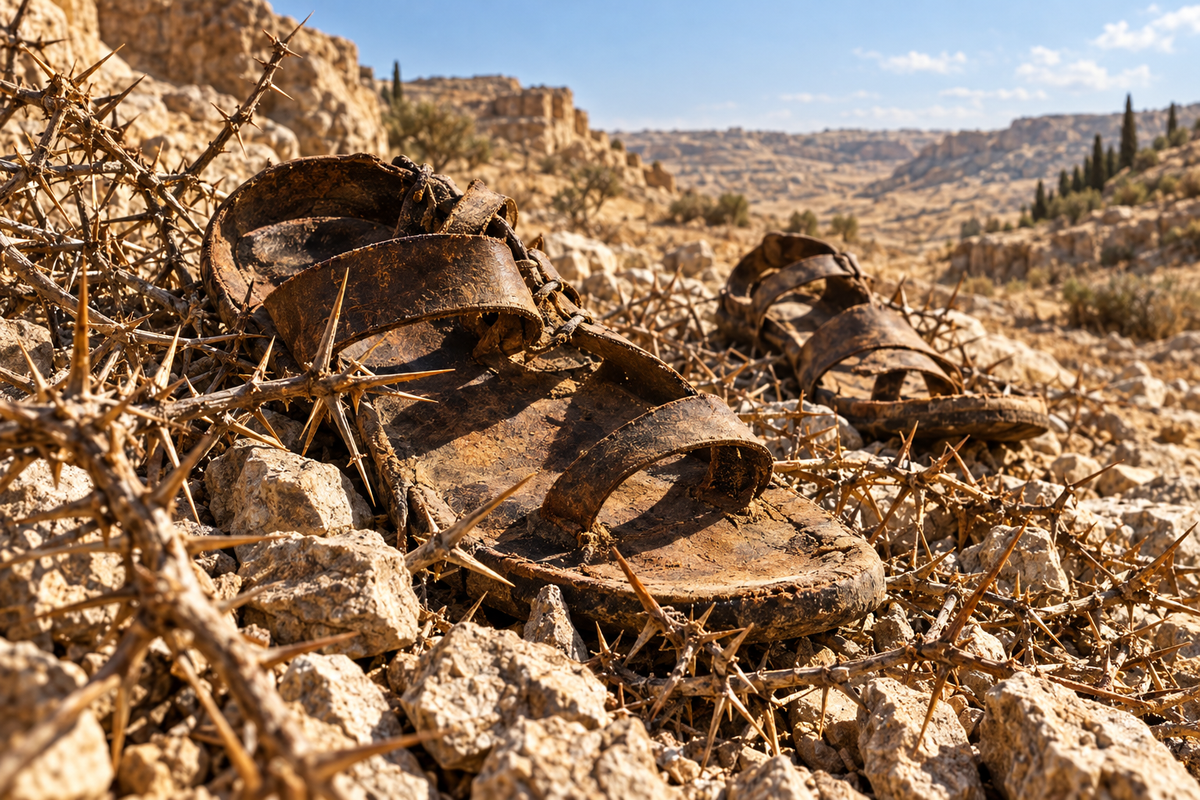
Yosef's holiness sanctified the entire world! When Yosef was alive, even the earth was sanctified. The Midrash says the brothers sold Yosef > "for a pair of shoes." What does it mean for shoes? No one sells a brother for shoes! Where do you hear such a thing, selling a brother for shoes? What, did they not have shoes?
The "Pelach HaRimon" explains: In the time of Yosef the tzaddik, who had absolute guarding of the eyes and never opened his eyes in his life, through this he sanctified the entire space of the world and the entire Land of Israel. The entire Land of Israel was sanctified with the holiness of the Holy Temple, and therefore everyone could walk throughout the Land of Israel without shoes, just as in the Holy Temple one walks without shoes due to the holiness.
There was such holiness that with every single step, they did not feel the pricks of thorns or the sharpness of stones. As long as they believed in Yosef, believed in the tzaddik and did not think of selling him, then nothing pricked them; the thorns were holy and everything was holy.
The brothers did not know who the tzaddik was in the merit of whom the land was filled with holiness; each one thought perhaps it was his own merit. The moment they sold Yosef, everything stopped! Suddenly they did not feel the holiness of the land, the earth became like ordinary earth, suddenly they felt that everything pricks, everything hurts, and immediately they needed "shoes."
The Danger of Looking and Elevating Sparks
The Jerusalem Talmud in Peah brings that Yosef rebuked his brothers for looking at the daughters of the land. He said to them: "Why are you looking?" They said to him: "It doesn't harm us." But Yosef argued that even if a person is holy and pure and looking does not harm him - it is forbidden to look! Because the very act of seeing is harmful.
Reb Noson explains that such strong lights, such wondrous lights, emanate from the eyes. All of a person's vitality passes through the eyes. A person transfers all his vitality, his entire soul, his entire spirit, he transfers everything to those he looks at. Because the very act of looking transfers powers, for a person is full of Torah, full of prayer, full of Godliness. When one looks at the kelipot (forces of impurity), at the wicked, then one transfers vitality and power to them.
And this is what Yosef rebuked the brothers for: "It is true that seeing does not harm you, you are the tribes of God, the supernal holy ones, but by the very act of looking itself you are transferring powers to the Sitra Achra (the Other Side), powers to impurity, and therefore you are forbidden to look."
The Tur, Part I, says: > "Be swift as an eagle" - this corresponds to guarding the eyes! That you should close your eyes swiftly like an eagle, this is how the Tur begins! A person opens his eyes, walks with open eyes, all the Torah he learns goes to the kelipot, to the enemies, to the wicked. He gives them life! He gives them the power! Because their vitality comes from what you learned. If you learned for 10 hours and said six hundred thousand letters, and because of this you looked and saw forbidden things, you gave life to all the kelipot!
But if a person goes out into the street guarding his eyes in holiness, he will elevate all the sparks that are in the kelipot! A person closed his eye - he burned all the kelipot! In every kelipah there is a holy spark. The moment a person walked down the street guarding his eyes, the spark was freed.
The "Heichal HaBracha" brings: Since the creation of the world, holy sparks have been lying in the streets and marketplaces waiting for someone to elevate them, for someone to give them a tikkun (rectification), and only with closed eyes can they be elevated. The Divine spark is everywhere, but it is not seen, it is hidden. The holy spark inside the kelipah is in prison and cries out to you: "My brother, have mercy on me! Do not look at me, free me! With one time that you do not look, you bring down the infinite walls and the infinite kelipot that surround me."
One must know, if an angel were to walk down the street he would not accomplish any tikkun (rectification)! He would not elevate any spark! Because he does not have the evil inclination to look. But human beings who are flesh and blood need tremendous self-sacrifice to guard their eyes, and by guarding their eyes they elevate and rectify all the sparks.
The Light of Chanukah and Self-Sacrifice
On Chanukah, a blazing fire breaks forth that cannot be stopped, a blazing fire that descends from Heaven through the Chanukah candles. The Rebbe [Rebbe Nachman] brings in Torah 249: > "Suddenly a spirit of courage clothes a person," and then he can do a deed of heroism because "the essence of courage is in the heart." One whose heart is strong is not afraid of any person in the world, he has only "There is none besides Him," only Hashem!
And this spirit can be received on Chanukah, just as Chana merited. "Chanukah" is Chana-K"V (26), Chana-Havayah (the Tetragrammaton), Chana to Hashem. > "And Chana prayed to Hashem" - she only sees Hashem! She only cleaves to Hashem! Reb Noson explains in Choshen Mishpat that all of Chanukah is from the lights of Chana, from the soul of Chana.
Chana does not abandon her prayers and her faith in any way in the world! From age 10 she began to pray that she would merit a tzaddik son, and at age 130 she was blessed with a child. For 120 years she only prayed to Hashem and succeeded in bringing down the soul of Shmuel, who is equal to Moshe and Aharon. Shmuel anointed Shaul and David, and the main thing is David, which is Mashiach, as it is written > "I have prepared a lamp for My anointed (Mashiach)," which is the light of Chanukah.
When a person decides to hand himself over to Hashem, he receives a spirit of strength and courage, and then he can defeat all the wicked and the Hellenists and bring the Geulah (Redemption). Today, self-sacrifice is simply to sit and learn! Today, self-sacrifice is not to wage war with anyone, but simply to immerse one's head in the holy Torah, in the holy Gemara.
The Secret of Yearning for Hashem (Ohr Pnei Melech Chaim)
It is impossible to live down here without desires and longings, without searching and yearning. If one does not connect to the inner essence of things, one very quickly reaches boredom, to performing mitzvot by rote. We must remember that there is an infinite love of Hashem for us and His desire to draw us upward, to Him, above time.
All of life is a game of hide-and-seek. Hashem hides and we search for Him. > "Your way was in the sea, and Your path in the great waters, and Your footsteps were not known." This power to search, to yearn, to have self-sacrifice in order to draw close to Hashem, we receive only from the Torah of the hidden (Kabbalah). Without this power of the Torah of the hidden, the entire world is an aspect of an empty vessel.
In the merit of this power, we emerge from the exile of the soul. We need air, we need life, we need to feel good, to be joyful, to feel the soul that is in everything. Parents need to be joyful in the service of Hashem, and children need to feel that their parents already know the secret. And when the soul rejoices and is glad, it passes on to the children even without words.
We must learn from the tzaddik who is constantly yearning, without pause! And when we yearn, then Hashem says: "They yearn for Me so much, so I give My infinite light." And the infinite light of Hashem is our life, it is our health, it is our joys and our miracles.
Torah Tidbits: Vayeshev Yaakov
On the verse > "And Yaakov settled in the land of his father's sojournings" (Genesis 37:1), the Sages expound: > "Yaakov sought to settle in tranquility, and the agitation of Yosef sprang upon him. The righteous seek to settle in tranquility, Hashem says to them: Is it not enough for the righteous what is prepared for them in the World to Come, that they also seek to settle in tranquility in this world?!"
The expounders of hints found support for the words of this Midrash based on the notarikon (acronym) of the opening of the parashah: "VaYeSheV YaaKoV" (וישב יעקב) – VaYevakesh Yaakov Shevet Beshalva, Yosef Alav Kafatz Berogzo (Yaakov sought to sit in tranquility, Yosef sprang upon him in agitation).
The Sages of Israel add to this: The verse emphasizes here "in the land of his father's sojournings" – in order to give a tikkun (rectification) for the mitzvah of honoring one's father, which Yaakov had blemished by being distant from his father for twenty-two years. Regarding this we learned in Tractate Megillah (17a), that Yosef was separated from his father for exactly twenty-two years, just as Yaakov was separated in his time from his father Yitzchak. Measure for measure.
Stories for the Parashah: The Power of Faith
"The chief warden of the prison did not look at anything in his hand, because Hashem was with him."
In the days of the Vilna Gaon zt"l, there was a man who showed and did wondrous things and foretold the future. They came and asked the Gaon about him. The Gaon told them to observe him - if he holds an object or something similar in his hand, then it is nothing but sorcery, as it is said regarding the elders of Midian: > "and charms in their hands." They checked the man and found that he held a stick in his hand. They took the stick from him, and he could no longer do anything.
According to this event, one can explain the verse: For in Egypt too they were experts in acts of sorcery and charms, and therefore the chief warden of the prison thought that Yosef was a sorcerer. But when he saw that there was "not anything in his hand," that he had no object or sorcery in his hand, he understood that "Hashem was with him" and He is the One giving him the power to do wondrous things.
"But remember me with yourself when it goes well with you, and please do kindness with me, and mention me to Pharaoh."
One of the chassidim of the Admor Rabbi Dovid'l of Tolna once complained to his Rebbe about his difficult financial situation. "I am truly suffering from the disgrace of hunger," the chassid cried out with emotion, "If I had parnassah (livelihood) in abundance, I would serve Hashem with a broad mind without worries. Why does Hashem not trust me? Let Him test me by giving me parnassah (livelihood) in abundance, and He will see the extent of my piety!"
Rabbi Dovid'l replied to that chassid: "At the end of Parashat Vayeshev, Rashi says that Yosef was punished with an additional two years of sitting in prison, because he did not reveal his full trust in Hashem but rather cast his hope on the chief cupbearer, who is flesh and blood. And if so, and a mortal cannot and is not permitted to trust in another human being, you want the Master of the Universe to trust in you - a human being?!"
Deep Waters: The Secret of the Chanukah Candles
"These candles are holy and we have no permission to make use of them"
The meaning of these words: First of all, we must rejoice greatly that we are going to merit to light the Chanukah candle, and it is a great joy that the light of Chanukah descends and reaches all the way to me, to reveal to me that Hashem is with me, Hashem is by my side. But on the other hand, they tell you that it is forbidden to make use of the light – and the intention is that I should know that I am very, very far from this light, and it does not confuse me that I am still far; I am happy that right now I merit to light the Chanukah candle.
The greatest joy is when a person thanks Hashem when he knows he is far, and this is the essence of closeness. And nevertheless, the days of Chanukah come to shout one phrase to me: > "There is no despair in the world at all." The main thing is the battle and not the success, for as long as I am fighting against this world, I am certainly winning the battle.
And this is actually what our Rebbe [Rebbe Nachman] wanted to convey to us in two Torahs: Torah 282 ("Azamra") – I am a Jew and I am very happy in my Judaism. And in Torah 12 ("Ayeh") – but I am still far from You. This knowledge gives me the true yearning for Hashem. On one hand, one must feel that I have lost, and on the other hand, not to blame myself too much, and to rejoice in everything I have merited to snatch here in this world.
Subscribe to Our Newsletter
Receive Torah articles and inspiration directly in your inbox