
"Purim is the Day When the Snake Can Be Subdued" • The lesson before the
Megillah reading last night from the Gaon and Tzaddik Rabbi Eliezer Berland shlit"a
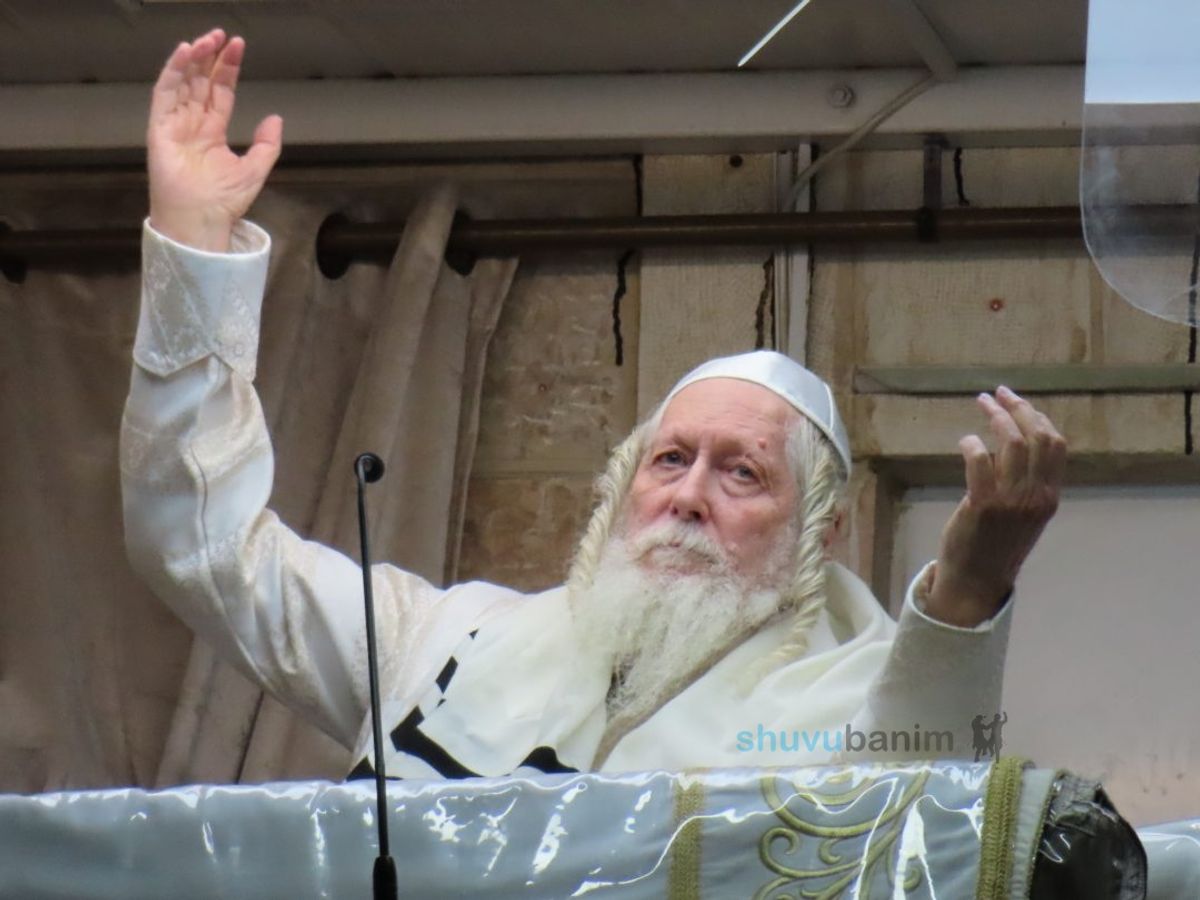
Presented before you is the lesson delivered by the Gaon and Tzaddik Rabbi Eliezer Berland shlit"a (may he live long and good days) last night, Sunday, the night of Purim de-Mukafim (Purim celebrated in walled cities) 5784, before the reading of the Megillah:
[Hashem said to Adam] HaRishon (the first man), He said to him, "What do you choose for yourself? Choose something: burning, stoning, killing, or strangulation—you brought death to the world." All the disasters, the entire Holocaust, all the destructions—Adam HaRishon is to blame for everything. He is to blame until the end of generations; it has already been six thousand years, two destructions, the Holocaust, six million Jews. Adam HaRishon brought it all. Hashem asked him, "What do you choose for yourself?" He said, "I choose hanging—on the tree." He [Hashem] says, "So when shall I hang you? When do you think it is appropriate to hang you? Choose the date." Adam HaRishon said—all this is said by the Da'as Zekenim from the Ba'alei HaTosafos (medieval commentators)—"Yes, I see Haman, a good fellow, a nice fellow actually; he will be my atonement, he will be my substitute, he will be my replacement. We will hang him on the tree in my place." He will be hung on the tree; Haman is the Nachash (snake) itself. Haman was the Nachash itself. And everyone has a Nachash; everyone must contend with the Nachash until one hundred and twenty years. And if he lives until [the age of] five hundred, then five hundred years. Enosh began to serve avodah zarah (idolatry) at the age of six hundred and ninety-five. That was considered young, that was considered a small child. In the past, they lived until nine hundred and sixty-nine, so that is two-thirds of a life. Like a person [today whose death is] at age seventy, then two-thirds is at age fifty. So six hundred and ninety-five is not [old], it is a very young age. He merited—he said the grandfather passed away [Adam HaRishon], no one knows who this grandfather is, who created him. He [Enosh] said, "I created the grandfather, I did everything, I created everything. I created the world, I created the sun, I created the moon, I created the stars." Everyone believed him [because after all, he was] the "Heinkel" (grandson)—he was a real Heinkel, the grandson of the Chief Admor (Chassidic leader). Adam HaRishon was the first Rebbe in the world, the first Admor in the world. His Heinkel says—he was a holy Heinkel. For six hundred and ninety-five [years] he was holy. One day he announces, "I created the world, I created the earth, I created the sun, I created the moon, I created the stars." The Asarah Ma'amaros (Ten Utterances) by the Rama mi-Fano says: he [Enosh] held this view for eight years; he knew he was lying, he knew he was a liar, he knew he was a fraud, but the Nachash (snake) within him burned in him! There was a Nachash inside him!
So the Nachash is Haman, "whom the king elevated." Mordechai, Master of the World [-] higher than Hashem, higher than Achashverosh, he "merited" to be higher than everyone, he merited... "whom the king elevated above all the ministers." Achashverosh said, "I am afraid to touch them [the Jews]. [Look] what happened to poor Sisera..." Sisera was a "righteous" man. "From heaven the stars fought, from their courses they fought." "From heaven the stars fought, from their courses" (Min Shamayim Nilchamu HaKochavim Mi-mesilotam) is [the acronym for] Haman. He [Sisera] was Haman; Haman was impregnated within him. And after that, "the stars from their courses fought" again [acronym] Haman. Twice Haman, he was a double Haman. For twenty years he ruled, for twenty years he ruled. The whole story of Haman is three days; the entire Megillah is three days.
"In the twelfth year of his reign on the 13th..." Shuvu Banim is accustomed to celebrating Purim in Adar II; this is a custom of Shuvu Banim. But in truth, it [the miracle of Purim] was in Nisan, it was on the night of the Seder. "And fast for me for three days"—"And Mordechai passed (Vaya'avor)"—what is the [meaning of] "Vaya'avor"? [That Mordechai] transgressed the law, [because] it is forbidden to fast on Pesach (Passover). Shuvu Banim are capable of anything; he knew that in Shuvu Banim they would agree to anything. "And Mordechai passed"—Esther said, "Now we do not eat, we do not eat on Pesach, we do not do—not the four cups, not the matzos."
Rabbi Avraham Elimelech of Karlin said—Rabbi Avraham Karliner had a hundred yeshivas, maybe two hundred. He said if they had fasted for three days, they would have cancelled the decree [of the Holocaust]. Even one day, if they had fasted! Afterward, they had to fast for six years [during the terrible years of the Holocaust]; there was no food, they received a slice of bread a day. Had they fasted for three days, as Queen Esther did, who said to fast for three days, the decree would have been cancelled. For seven years he [Hitler] spoke about how he would destroy all the Jews from young to old, children and women in one day. Only this decree was postponed, it was not cancelled; the decree of Haman was not cancelled. Therefore, "And Esther wrote (Vatiksov)"—this is a large Tav. And Parmashta—this is a small Shin. [Together it equals] 700 (Tash). This [the decree to destroy, kill, and annihilate] was postponed to the year 5700 (1940), it was postponed by two thousand five hundred years. From the year 3408, when the Temple was built, two years before that was the story of the Megillah.
The Gemara says in Megillah page 14b that two years prior—before the building of the Beis HaMikdash (Holy Temple), the entire story of the Megillah took place. Haman knew that now they were going to build a Beis HaMikdash, and then it would be the end of the world—the Jews would rule over the world. There would be no Persian kingdom, there would be no kingdom in the world.
So therefore he made a tree fifty cubits high, to cancel the fifty days of Sefiras HaOmer (Counting of the Omer). For when did they hang Haman? On the first day of the Sefirah (counting), according to the Mishnah Berurah, then [they hung Haman] on the first day of the Sefirah. "And Haman rested on the morrow of the Omer"—this is already hinted at in the verse, that Haman was hung immediately after the Sefiras HaOmer. They finished counting the Omer, went out to the city square, made a tree fifty cubits high [and hung Haman].
And why specifically fifty? Because it is forbidden to hang a father and son together; this is against the Torah: "It and its son you shall not slaughter on one day," all the more so if ten children with the father, it is certainly forbidden, it is a Torah prohibition "you shall not slaughter on one day." So therefore Haman—therefore he made a tree fifty cubits high. So that there would be a gap of a cubit between child and child; every person is three cubits, Haman is three cubits, the sons are three cubits, a gap of a cubit makes four cubits, times eleven is forty-four, three [gap from] above and three [gap from] below—that [comes to] fifty [cubits]. So therefore they needed to make a separation of a cubit. Because "it and its son you shall not slaughter on one day," it is forbidden to slaughter a father and son together, there is no such thing. We must keep this Halacha (law).
But it was on the 13th—that they slaughtered Haman—this was before the Mishnah Berurah on the 16th, that is another thirty days from today, it is the 16th, then we will make a feast and a great Hillula (celebration of a Tzaddik's passing). Therefore everyone [all the Tannaim, as he will explain] traveled to Bnei Brak, for the sake of the Hillula. Because on the 16th they already perform the Hillula, so when there is a Hillula on Saturday night, then they travel to Meron already on Friday. So they already—they already needed to be in Bnei Brak on the eve of Pesach, for the sake of the Hillula. Because the Hillula is held in Bnei Brak. From the descendants of Haman, they studied Torah in Bnei Brak, so all the sons of Haman always held the Hillula on the night after Pesach, the Hillula in honor of their father. But Rabbi Akiva studied Torah in Bnei Brak.
For in truth there is a terrible question: why on earth travel to Bnei Brak? What do we have to do with Bnei Brak? It is written: follow Rabbi Yehoshua to Peki'in, follow Rabbi Eliezer to Lod. If you want to travel to Uman, you travel to Lod, not to Bnei Brak. So follow Rabbi Eliezer to Lod—why to Lod? Because through Lod one can reach Uman, and the whole goal is to reach Uman. This is the whole of Purim, to reach Uman, so that we can do Purim next year in Uman. So therefore Rabbi Eliezer lived in Lod, because he set Uman in motion, he brought the planes to Uman. Therefore he lived in Lod, so they needed to travel to Lod. For who was the teacher and who was the student? The teacher was Rabbi Eliezer and Rabbi Yehoshua, they were the teachers of Rabbi Akiva. So we should follow Rabbi Akiva? Follow Rabbi Eliezer and Rabbi Yehoshua! [To Rabbi Eliezer in Lod], or to Peki'in [the seat of Rabbi Yehoshua]. One can travel to Peki'in, it is closer. Peki'in is right here after Jerusalem, that is Peki'in... one can travel to Peki'in to the cave of Rashbi (Rabbi Shimon bar Yochai), to do Purim there, the Seder night. So either we follow Rabbi Yehoshua to Peki'in, or we follow Rabbi Eliezer to Lod. But why on earth Bnei Brak? Rather, Bnei Brak is the gematria (numerical value) of Satan; we must subdue the Satan.
Nachash (snake) plus one is Satan; Satan is the Nachash itself. Everyone has a Nachash! And therefore Purim comes to remove the Nachash! The whole matter of Purim is that we gather—a time of assembly for all. "And he assembled..." "Go, gather the Jews," Mordechai assembled all the Jews. It is impossible to subdue the Nachash except through [the gathering of] all the Jews. Therefore Mashiach (Messiah) will come only when all the Jews are in unity, then Mashiach can come. Because Mashiach is also the gematria of Nachash. So Mashiach—three hundred and fifty-eight, Nachash—three hundred and fifty-eight. So only Mashiach can subdue the Nachash! And therefore Purim is the only day in the year that one can subdue the Nachash. This is the only day that a person can leave his Yetzer Hara (evil inclination), his Nachash! For the Yetzer Hara accompanies a person all one hundred and twenty years, all one hundred and twenty years the Nachash accompanies the person. And therefore we say, "And remove the Satan from before us and from behind us."
The Shuvu Banim website wishes all our followers, the students of the Tzaddik, on Purim de-Mukafim, and all of the House of Israel wherever they may be, a blessing of
HAPPY PURIM - A FREILICHEN PURIM!!!
Subscribe to Our Newsletter
Receive Torah articles and inspiration directly in your inbox