
Rabbi Tzanani and Rabbi Succot in Powerful
Strengthening Words Accompanied by Guitar Melodies
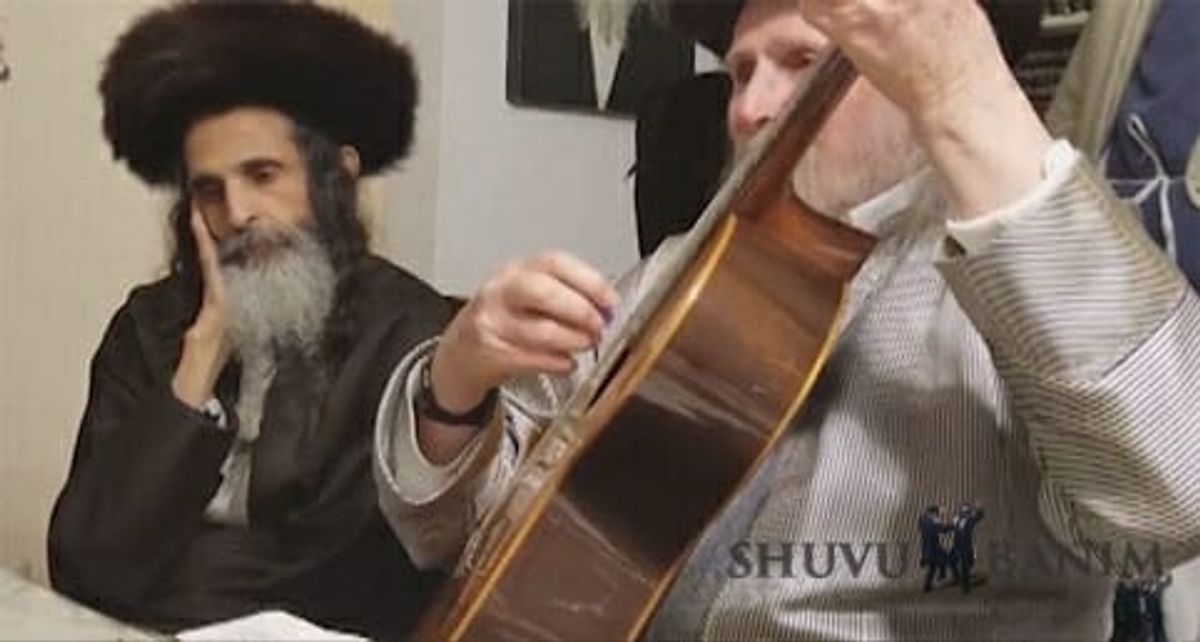
Rabbi Eliyahu Succot and Rabbi Moshe Tzanani, students of our teacher, the holy Gaon and Tzaddik Rabbi Eliezer Berland shlit"a (may he live long and good days), in strengthening and necessary words of emunah (faith) and bitachon (trust) according to the tradition of Breslov Chassidus throughout the generations and following the path of our teacher, the Rav shlit"a.
Rabbi Succot accompanies the talk with his holy niggunim (melodies) and stirring guitar sounds, just as our teacher Rabbi Berland shlit"a told him many years ago—to go out with the guitar and bring the Jewish people closer to Hashem (God).
Don't miss it!
Selected highlights from the strengthening talk
Rabbi Tzanani: "One must ask in prayer to merit an 'ayin tova' (a good eye), both to escape the lust of adultery and to see one's friends with a good eye. Whoever understands knows that these things are interconnected. Everything that our teacher Rabbi Berland shlit"a merited was because he had infinite Ahavas Yisrael (love for the Jewish people). Rabbi Succot can tell you endless stories about the Rav's Ahavas Yisrael."
"There is no doubt that our teacher Rabbi Berland could serve Hashem alone, but he always sought to take more friends with him—to the field for prayer, to study, etc. Why did he need more friends with him? After all, he was always a mighty servant of Hashem! Rather, it was the endless love for friends that he possessed."
Rabbi Succot: "I have a friend, one of the descendants of Rebbe Nachman, who told me that he could never oppose our teacher Rabbi Berland shlit"a. He told me he has great 'hakaras hatov' (gratitude) to the Rav, because once, when he was studying at the Breslov Yeshiva in Bnei Brak, in order to wake up for Chatzos (the midnight lamentation), he would tie a rope to his leg and lower it out the window. Before midnight, Rabbi Berland shlit"a would arrive, pull the rope, and wake him up—this was long before the era of cell phones. The Rav used to fill vans with people he would wake up to go out and pray in the field at Chatzos."
"Someone once asked the Rav if it is better to arrive at the field after making an effort to bring more people with him, or if it is better to arrive as quickly as possible. Our teacher Rabbi Berland answered, 'It is impossible to describe the difference; it is infinitely better to come with more people.' The Rav didn't just say this; he did it all the time."
Rabbi Tzanani: "The Rav is infinite love and help for others. We see it today—in his place, I couldn't stand for ten minutes where the Rav stands during prayer. With all his illness and weakness, everyone crowds around him, and the Rav is in a state of 'bittul' (self-nullification) toward every single person. This is called 'shimush tzaddikim' (observing and learning from the righteous)—both to be with him in prayer and to see how he behaves. What love he has! The Rav is the essence of refinement; he would never hurt another person in any way."
"Someone once came to the Rav with a pidyon (redemption offering). The Rav pounced on him and shouted at him. The person was startled and fled—after all, he only wanted to make a request. The Rav sent the gabbai (attendant) to bring him back. When he entered, our teacher Rabbi Berland said to him, 'I saw the Samael (the Accuser/Satan) upon you.' The Rav is the height of gentleness; he would never hurt a person in any way, but sometimes there is a tikkun (rectification) for a person and the Tzaddik saves him. Apparently, there was a din (judgment) upon the person, and by showing a face of anger, the Rav was actually saying to the Heavenly Court, 'Leave him alone, I will deal with him myself.'"
Subscribe to Our Newsletter
Receive Torah articles and inspiration directly in your inbox