
Rebroadcast from South Africa! A Class in Honor of the Hilula of Moharanat zt"l
10th of Teves 5776, by the Gaon and Tzaddik, Rabbi Eliezer Berland shlit"a
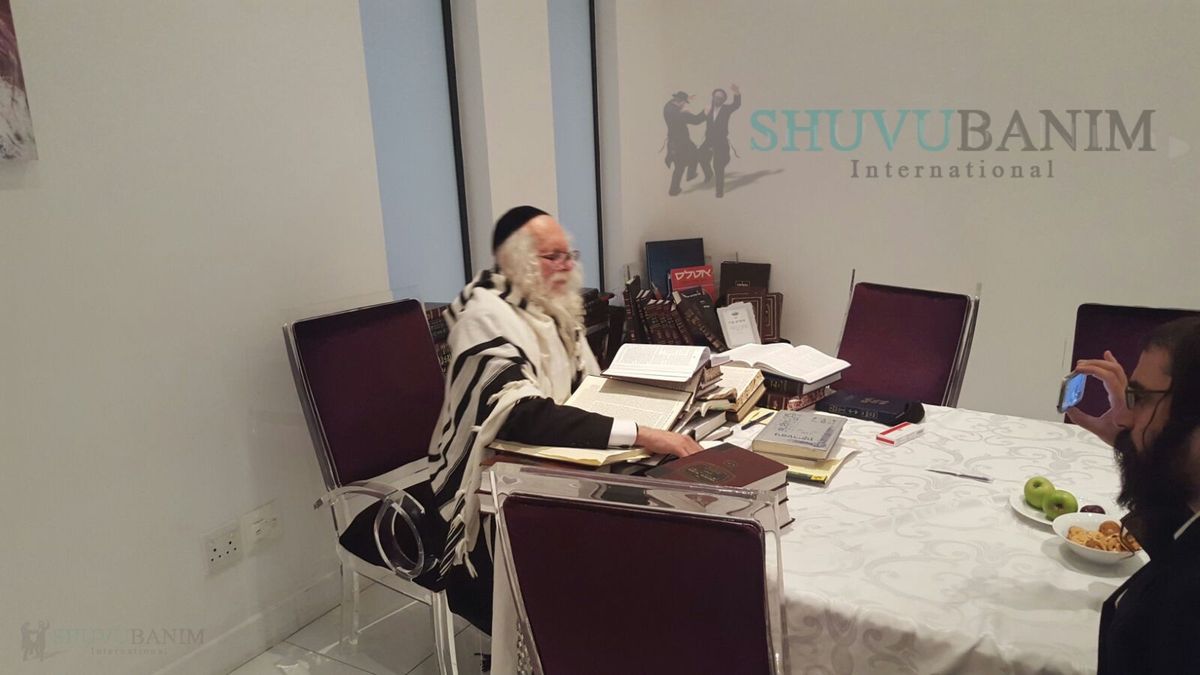
A moment before the entrance of Morinu, the holy Gaon and Tzaddik, Rabbi Eliezer Berland shlit"a, into the hall in Talpiot for the Hilula (anniversary of passing) of Reb Nosson of Breslov zy"a, 5780, we are sending an important reminder from the days when Morinu, Rabbi Berland shlit"a, was in exile (galut).
Back then, we had to hear and see the Rav via satellite—how pleasant it is to remember, now that Morinu, Rabbi Berland shlit"a, is here with us.
Baruch Hashem, on Monday, the eve of the 10th of Teves at 18:00, Rabbi Eliezer Berland shlit"a delivered a live broadcast class in honor of the Hilula of Moharanat of Breslov, the student of our holy master, Rebbe Nachman of Breslov zy"a.
The broadcast could be viewed here on the site.
Follow us for more live broadcasts.
Please donate generously to the Live Broadcast Fund Click Here
Transcript of the Class
Yahrtzeit of Reb Nosson, 5776
(Unedited)
If a person wants to be close to Rebbe Nachman, he must study the Jerusalem Talmud (Yerushalmi).
For the Tzaddik did not know he was a Tzaddik. Yishai did not know he was a Tzaddik; he thought he was a Moabite.
For the entire dispute between the brothers was based on the method of the Rambam, who rules in the Laws of Inheritances—that even if a man is the greatest Tzaddik in the world, like Jacob our Patriarch, until he shows a certificate of release [emancipation for a slave], he is not believed. Jacob asked him, "Who are these to you?" So he brought him a marriage contract and a Ketubah. Jacob did not believe Joseph, even though Joseph was the greatest Tzaddik in the generation—Joseph the Tzaddik. He did not believe him: "Bring a deed of emancipation, bring a marriage contract, a Ketubah." In the same way, the brothers said, "It is impossible to believe even Jacob, because the presumption of being a maidservant is not annulled by a presumption of fitness (kashrut)." Even if the man is the greatest Tzaddik in the world, like Jacob our Patriarch—"Give truth to Jacob"—all the disputes between the brothers and Joseph were regarding the absolute foundations of the world, concerning the Rambam, the Rif, and Rav Natronai Gaon on page 5a in Yevamot.
If we go according to Rav Natronai Gaon, then Joseph was right. For how do we know who was right, Joseph or the brothers? For all the brothers were Tzaddikim, foundations of the world. Joseph is the angel Metatron. Joseph is the angel Metatron, and that is why the brothers sold him. For why did He say to create the world? Joseph the Tzaddik is the angel Metatron, and Joseph told them that it is forbidden to look [at women], even if there is no sinful thought. It is forbidden to look, because "you see fields and she sees demons," and they connect and create chaos, an intifada.
For Joseph said that Father married Bilhah, the handmaid, with proper marriage, with a marriage deed, with a Ketubah. But the brothers said that until they are shown a marriage deed and a Ketubah, then Bilhah and Zilpah have the status of maidservants, and Naftali, Dan and Naftali, Gad and Asher can be sold. Therefore, they thought Joseph came to prevent the sale [of the brothers], so they sold him. The Kli Yakar and other commentators explain: Why did they sell him as a slave? Because he suspected them of wanting to sell Dan, Naftali, Gad, and Asher as slaves. And Gad is... the sons of the handmaids. Therefore, he is found in the South: Reuben, Shimon, Gad. For Reuben and Shimon are from the World of Atzilus; they are much higher than Judah. Therefore, he cursed them. Just as the curses in [Parashat] Ki Tavo are actually blessings—"Every illness that I placed upon Egypt I will not place upon you, for I am Hashem your Healer"—He will hide all the illnesses. So when the Tzaddik curses, these are the greatest blessings. Since Reuben and Shimon were in the World of Atzilus, they received only curses, only curses. "Reuben, my firstborn, you are my might and the beginning of my strength... Unstable as water, you shall not excel, because you went up to your father's bed; then you defiled it—he went up to my couch." Reuben picks mandrakes (duda'im). Mandrakes are not cyclamens, they are not anemones that anyone can pick. It is something rare, rare, rare, not found at all. The Zohar says these were the Cherubim. For if it were a regular thing, Rachel could have sent someone to pick some mandrakes for her as well. Rather, it was something that only Reuben [could get], since he was in the World of Atzilus. He was the firstborn, "excess of dignity and excess of power," worthy of the priesthood, worthy of kingship; everything should have come from Reuben. But "unstable (pachaz) as water"—for a person must not make a single move without an hour of Hisbodedus. If he had done an hour of Hisbodedus, he would not have stumbled, even though it was for the sake of Heaven. For a person does not know what is a mitzvah and what is a sin, only the true Tzaddik knows. "That which you were stringent about, I was lenient; that which you were lenient about, I was stringent."
For the holy Ohr HaChaim brings that Laban made a condition with Jacob that he would not free them—Bilhah and Zilpah—because that was the way, like Adah and Zillah, for the sake of children. They would give a second wife as handmaids so the sons would serve the sons of the mistress. So he gave Bilhah and Zilpah, for they were all Laban's daughters, but this one came from the handmaid and that one from the mistress. Dan and Naftali from the handmaid; Reuben, Shimon, Levi, Judah, Issachar, and Zebulun from the mistress. And they were intended to serve the sons of the mistress. He made a contract, a condition with him, that he would never free them. But the moment they decide to convert, to become Jewish women, the condition is annulled automatically. But the brothers said that since the grandfather, since Laban the grandfather made a condition that they are not to be freed, then there is a presumption of servitude here until we see a deed of emancipation.
"And he was a youth with the sons of Bilhah and with the sons of Zilpah, his father's wives." What is meant by "his father's wives"? He told them: Bilhah and Zilpah are wives, they are mistresses, they are Matriarchs. There are 6 Matriarchs; they are counted among the Matriarchs. That is why he called them "his father's wives."
The Maharal of Prague brings that the brothers had the legal status of Noahides (Bnei Noach), while Joseph thought they had the status of Israelites. For only Abraham and Isaac were strict even about Eruv Tavshilin and Eruv Techumin, but the brothers were exempt. And Joseph, who was included in the Patriarchs, being Joseph the Tzaddik who was head and shoulders above them—"And he recognized them, but they did not recognize him." The Heichal HaBeracha says he was 236,000 parasangs above the brothers, and they did not recognize him. This is 236 (RaL"V)—Joseph was included in the Shechinah. Therefore, it is brought in Midrash Pli'ah that the brothers asked, "How will we cross the Red Sea? How will the sea split?" The brothers saw with Ruach HaKodesh (Divine Spirit) that only through the coffin of Joseph would it split. So they said, "There is no choice." If we want to leave Egypt—"and they shall serve them, and they shall afflict them four hundred years," for "your seed shall be a stranger in a land that is not theirs, and they shall serve them, and they shall afflict them four hundred years"—so after 400 years from the birth of Isaac... But how will they leave? Who will draw down the Clouds of Glory? Since they reached the Jordan, Moses told them, "The story is over, gentlemen. The story is over. You think you will have Clouds of Glory? You will have nothing. You will have nothing. You are crossing the Jordan to come and dispossess these nations. Know this: go only with simple faith (Emunah). Until now you had Clouds of Glory, Manna from Heaven. Now you will plow and sow the fields. Miriam's Well? Now you will dig wells. All those stories are finished. Now, simple faith for the rain of the heavens. Lift your eyes to the heavens so you will have rain. Lift your eyes to the heavens so your seed will grow. You won't even have Clouds of Glory." I remember when I was there, I was in shock. I became paralyzed; I couldn't cross the Jordan. What will we do without Clouds of Glory? How will we cross? How will we fight? How will we fight them? What does the Gemara say in Sotah 36a? That the moment they crossed the Jordan, they started flying in the air. I, the fool, didn't understand this. I remained with my own intellect. In the end, they dragged me on some stretcher. I don't remember, a vein burst in my leg, I don't remember exactly what happened. I couldn't cross the Jordan out of sheer fear. But the Gemara says in Sotah 36a—now they studied the Daf Yomi, no one knows this is written in Sotah at all; they learn and don't understand what they are learning on [page] 36. The Gemara says on side A: They traveled 60 mil on that day. The Yerushalmi says 120 mil. From Gilgal to Shechem is 120 mil, and they flew in the air. I, the fool, asked, "What will we do without Clouds of Glory?" I asked Moses on the 7th of Adar before his passing, "Moses, how are you leaving us?" Moses didn't even answer me, didn't look at me with a single glance. "What will we do without Clouds of Glory?" I had endless questions about the Tzaddik. So what will we do without Manna? What will we do without Miriam's Well? I had billions of questions about Moses our Teacher. In the end, they dragged me with a stretcher; they carried me across the Jordan on a stretcher out of fear. What can I do? I've been a coward from the day I was born. Without Clouds of Glory, is it possible to cross? Is it possible to defeat all seven Canaanite nations? How is it possible? I had billions of questions about Moses. But still, they dragged me on a stretcher. Suddenly I see everyone flying in the air. I was still on the stretcher, a vein burst in my leg from fear, I was paralyzed in all limbs. Suddenly, they are flying in the air—not like you primitives flying in airplanes—flying in the air literally. 60 mil. The Yerushalmi says 120 mil, doubling it. It is written that Saul ran 180 mil in one day. 180 mil from the battlefront in the land of the Philistines, from the battlefield to Shiloh is 60 mil. He heard the Tablets were captured, the Tablets were in Goliath's hand. In a split second, he returned to the battlefield, another 60 mil, and pounced on Goliath, took the Tablets from him. And with the Tablets, which weigh a ton, several tons of sapphire stone—with the Tablets, he ran with the Tablets in hand another 60 mil. A marathon, 42 km, everyone needs a million ambulances, all the people are dying here. We are talking about 180 km, 180 mil! How did he do it? But the moment he became jealous of David, his strength left him. A person is jealous of the Tzaddik. David is the true Tzaddik. Even though Saul is head and shoulders above—"In the morning he shall devour the prey, and at evening he shall divide the spoil," Benjamin is a ravenous wolf—"In the morning he shall devour the prey," that is King Saul. But you are jealous of David, the true Tzaddik. You cannot tolerate that there is such a Tzaddik who fights Goliath. The moment you were jealous of the Tzaddik and didn't listen to the voice of Samuel to wait another second... The Tzaddik arrived at 12:00 noon. At 11:59 and thirty seconds, he offers the burnt offering. Doeg told him, "Enough, everyone has left you, you remain last on the battlefield." Another 30 seconds... and Samuel arrives. "You have acted foolishly." Because of 30 seconds, you lost an eternal kingdom. "For now Hashem would have established your kingdom," an eternal kingdom, a kingdom of the world. Saul should have been the king of the world, he and his sons in all generations. David is the true Tzaddik; he doesn't need to be revealed at all. No one needs to know about him. He can be in the innermost chambers, in a cave under the earth, playing his harp. With his harp, he can bring salvations. "Our feet were standing within your gates, O Jerusalem." How were our feet standing in the battles, in the wars with the Philistines, Ammonites, Moabites? Suddenly Ammon and Moab arrive. We told everyone to study 2 Chronicles Chapter 20; one must read it 7 times. Ammon arrives, Moab arrives, millions of soldiers. And in Judah, there is no bow, shield, or spear. "Was there a shield or spear seen among forty thousand in Israel?" It is written in 1 Samuel Chapter 13 that there wasn't even a kitchen knife, only wooden knives. The Philistines did not allow them to hold any knife, any metal tool. They had to sharpen and polish the plowshares in the land of the Philistines. A shield, if seen, and a spear among forty thousand in Israel? When Deborah and Yael went out to war, there was no shield, no spear. There were also no Clouds of Glory. When Moses was there, there were still Clouds of Glory. Here, there weren't even Clouds of Glory. No spear, no shield. Also, there was no one to say "Sun, stand still at Gibeon, and Moon in the Valley of Aijalon." That didn't exist either. Therefore, the Song of Deborah is greater than the Song of the Sea. The Zohar says... side B, that the Song of Deborah and the Prayer of Hannah are greater than the Song of the Sea. Because at the Song of the Sea, they still had Clouds of Glory. On the 15th, the Clouds of Glory began; they crossed the sea on the 21st. But here there was nothing. "A shield if seen, and a spear among forty thousand in Israel." The Baal HaTurim says: If there is one Jew who keeps Shabbat among forty thousand, he can protect all forty thousand. If there is one synagogue in some Kibbutz and there is a Minyan there, even on Shabbat, the synagogue protects the entire Kibbutz so that missiles won't fall there, there won't be stabbings there. So one in forty thousand can protect, can protect all forty thousand, even if they are not Shabbat observers and he is a Shabbat observer. Because through his power, everyone will keep Shabbat. If there is one true Shabbat observer in forty thousand who makes the Shabbat a delight—Shabbat is not a prison for him, he feels delight and doesn't wait for Shabbat to leave, he waits to extend it—then he can illuminate all forty thousand so that everyone will do Teshuvah (repent). Rabbi Akiva said, "If I were in the Sanhedrin, no man would ever have been executed." Rabbi Elazar ben Azariah says once in seven years; Rabbi Tarfon says once in 70 years. The Rabbis say once in 70 years. Rabbi Tarfon and Rabbi Akiva say, "If we were in the Sanhedrin, it would never have executed a man." So how would there be fear and dread? How would there be "so that they shall hear and fear"? After all, you are spilling blood in Israel! But if Rabbi Akiva were sitting in the Sanhedrin, if the Tzaddik sits in the Sanhedrin, all the murderers do Teshuvah. There is no murderer who does not do Teshuvah. A Jewish murderer also needs to say "Who has not made me a gentile"; he is obligated in all the Morning Blessings. Even if he murdered a thousand people, he must do Teshuvah. Manasseh murdered a thousand people every day. Not once a thousand people—every day! For 22 years, this was his daily bread, a regular thing. This is brought in Sanhedrin 109b, 103b. Every day a thousand people. Let's calculate: 22 years. 365 times 20 is 7300, plus 730 is 8030. Times a thousand people a day is 8 million, 30 thousand. More than Hitler, may his name be obliterated. And he does Teshuvah! Because a Jew always does Teshuvah. A Jew... Rabbi Akiva says, "If we were in the Sanhedrin, anyone who comes to the Sanhedrin and sees the Tzaddik immediately does Teshuvah." Anyone who reads Likutey Halachos immediately does Teshuvah. Anyone who comes to the Zion [Rebbe Nachman's grave] immediately does Teshuvah. Because this is the Rav and the Disciple whom we have been looking to since the creation of the world. This is the Rav and the Disciple for whom we have been waiting 5700 years. We are waiting for the Rav and the Disciple. Because in 5760—forty seah which is 5760—then the light of Mashiach begins, the light of the Resurrection of the Dead. As brought in Heichal HaBeracha, that in... there will be the Resurrection of the Dead. What is the Resurrection of the Dead? That everyone does Teshuvah. When they read the Likutey Halachos of Reb Nosson, everyone does Teshuvah. When Rabbi Akiva is in the Sanhedrin, everyone does Teshuvah. There is no need, no need to punish. We only punish lest he kill again. But if he sees Rabbi Akiva, he will not murder anymore. Even if he worships idols, he will do Teshuvah, he will stop worshipping idols like Manasseh. And this was the intention of Nachshon ben Aminadav. That is why the word "Nasi" (Prince/Leader) is not written regarding Nachshon ben Aminadav. "Nasi" is not written. He is the only one for whom "Nasi" is not written. We read the Portion of the Nesi'im; no one notices this. He is the only one. Because of the humility of Nachshon ben Aminadav, Hashem knew that if "Nasi" were written, he would faint, he would die. Hashem knew that the word "Nasi" could not be written in the Torah because he would die. If "Nasi" were written, he would say, "This is a lie, I am not a Nasi, I am only a servant, a servant of the People of Israel." Reb Nosson was the servant of all the People of Israel. What Reb Nosson went through—extraditions, humiliations, prisons—no mortal has ever gone through in the world. So said Rabbi Shabtai Yudelevitz, that every time he reads the stories about Reb Nosson, such a thing never happened. Even King David did not go through what Reb Nosson went through. There was no such thing. Moshe Chinkis says, "This man will not enter Breslov. I will not allow it under any circumstances. Not as long as I am alive; he will not enter." See all this in Siach Sarfei Kodesh Part 6. He went to the governor and told the governor, "Listen, this man does not enter here under any circumstances." At that very moment, he expired. At that very moment, his soul went up to Gehennom, to Gan Eden, I don't know exactly what. The Rebbe said he would rectify him; the Rebbe promised he would rectify him. Whatever the case, the governor... a man collapses in his office, in the magnificent office with the magnificent armchairs on the magnificent red carpet. He collapses on the carpet, all bleeding, blood pouring from his throat. Soon they will accuse him of a blood libel. "Get him out of here! Go take him out!" There are no wagons outside, no carriages. Back then there were no cars, no airplanes either. How will we fly him? Where to? "I don't care, take him out now on the first wagon you find." They found a wagon full of filth, garbage, fragrant odors, pleasant smells—like Joseph the Tzaddik, lehavdil. And immediately they put him on the wagon and brought him home. He was already dead. Just as he said. Moshe Chinkis was a prophet, a true prophet. He said, "Reb Nosson will not enter the city while I am alive," and that is exactly what happened. Someone who is a prophet is a prophet all the way. That was Moshe Chinkis. And like Moshe Chinkis, there were many others like him. Every corner Reb Nosson went, they informed on him that he was a sorcerer, that he was Mashiach. Because the law in all the nations of the world until 50 years ago was that anyone who says he is Mashiach is immediately hanged. That's how it was in the Land of Israel with "that man." The moment he said he was Mashiach—even though he didn't say "Mashiach" literally, he was silent, he said "You say so"—they immediately hanged him. Because anyone who says he is Mashiach will eventually rebel against the Sultan. Like Sabbatai Zevi, may his name be obliterated, who said he was Mashiach. So the... arrived. The priest said, "If so, put him in the fire, let's see." Like Rebbe Zira. Let's put him in the fire. Rebbe Zira was a true Jew. Let's put him in the fire. What does it mean to put in the fire? Every second Jew, you put him in the fire. A ship left the exile of Jerusalem and arrived in some land in Africa. The Bishop apparently came out there and said, "Who are you? Passports? Visas?" Everyone had black visas, of course. So what will happen today? Anyone who has a black visa is put in prison. So what will happen to you? What are you, ISIS? Al-Qaeda? Who are you? They see long beards like Al-Qaeda. "Who are you?" "We are Jews." "Jews? What is the proof?" "We are circumcised." "Al-Qaeda are also circumcised, ISIS are also circumcised. What good does it do if you are circumcised?" You know what the Bishop said? "I have an idea, an original, original, original, original idea. I once read the Bible," the Bishop tells them. "I read about Chananiah, Mishael, and Azariah. You know what? If you are true Jews, purebred Aryans, let's put one in the fire. Let's see. If he burns, it's a sign you are not Jews, you are Al-Qaeda. If he doesn't burn, it's a sign you are Jews." Fear and dread fell upon them. Master of the World! What trials! We fled the exile of Jerusalem, we fled the Romans, out of the frying pan into the fire. This one wants to put us in the fire now. What will be? They said, "Give us 30 days." "Fine, take 30 days. But if he burns, know that I will know you are not Jews. A Jew does not burn. Put him in the fire, he won't burn. There is no such thing as a Jew burning." After 30 days, they recounted their dreams on the last day. One says, "I dreamt two 'Ki' (for/when) and three 'Lo' (no)." They say, "Two 'Ki' is... 'Ki le'olam chasdo' (For His kindness is eternal), 'Ki b'shem kodsho batachnu' (For in His holy Name we trusted). Two 'Ki', I have good. Two 'Ki', excellent." He was an ignoramus; he only knew how to say Psalms all day. Immediately they said, "You will enter the fire. Because two 'Ki' and three 'Lo' is: 'Ki (When) you pass through the waters, I am with you; and through the rivers, they shall not (lo) overflow you. Ki (When) you walk through the fire, you shall not (lo) be scorched; nor (lo) shall the flame kindle upon you.'" And then three old men arrived—it was either Abraham, Isaac, and Jacob, or it was Chananiah, Mishael, and Azariah—and they said the entire "Vehu Rachum" (And He is merciful). And this is the "Vehu Rachum" that we say every Monday and Thursday. And the Bartenura says that the custom of Jerusalem was to say it every day. That's how it was 200 years ago; the custom of Jerusalem was to say it every day. So a Jew can enter the fire like Rebbe Zira. Every 30 days he would enter the fire. Rabbah said, "That is not enough." The Baal HaHafla'ah says this wasn't just a story there on page 7b [of Bava Metzia/Shabbat? - likely referring to Bava Metzia 85a regarding Rebbe Zira]. It wasn't just a story; it was all because they needed to clarify the Halacha. Rebbe Zira said, quoting Shmuel—it is written in Chullin 8a—Rebbe Zira said in the name of Shmuel: "One who slaughters with a white-hot knife..." Which comes first, sharpening it or whitening (heating) it? Or whitening it then sharpening it? Here is a tremendous hint. Because anyone who comes to Breslov dances on the tables, jumps, and in the end drinks whiskey or vodka. Why? Because there is no "sharpening." He doesn't sharpen the mind. He comes straight with enthusiasm, with "whitening" (heat). The Rebbe wants you to learn Yerushalmi, learn Ketzot HaChoshen, learn Netivot HaMishpat. A person without Shas (Talmud), without sharpening the intellect... The Rebbe says in Torah 62, then there is no "Know what to answer an Epicurean." Because a person is full of bad thoughts from the day he was born, and he cannot purify them except through study in depth (Iyun). There are "three hollows of the brain," and it cannot [be purified] unless it is filled with Torah and prayer, with Torah, with Gemara, with study in depth. A person can defeat the bad thoughts. He can travel to the Zion a billion times, he can bang his head on the wall a million trillion times, he cannot purify his brain except through study in depth. The Rebbe says in Torah 101, 105, 62, and other Torahs. A person thinks that if he becomes a Breslover, he is exempt from studying Gemara. Today is the greatest Yahrtzeit, like Yom Kippur. "On this very day (B'etzem hayom hazeh), the King of Babylon laid support/siege." What is "on this very day"? The Ya'arot Dvash asks: What happened here? What is special about this day of all days, that Hashem chose specifically this day? Why not the 1st of Shevat? Why not the 1st of Adar, or 20th of Adar, or 10th of Adar? Why specifically this day? Rather, this was the day when there was a Hilula, like Methuselah. There was a Hilula. Rashbi (Rabbi Shimon bar Yochai), we make a Hilula to this day. And the 7th of Adar is a Hilula to this day. There was a Hilula because the seven days of [mourning for] Abel ended. According to Midrash Rabbah Parashah 22 Part 1, on Chanukah, Zot Chanukah, Abel was murdered. The seven days ended on the Tenth of Teves. And then they made a Hilula in honor of all the generations. And Adam HaRishon made Chanukah twice. And this is what Joseph asks: "Av o Ach?" (Father or Brother?). Because it was exactly on Wednesday. On Wednesday, they don't know if it is Beit Shammai or Beit Hillel, because then everyone lights four candles. Therefore he asks, according to which method do you light? Av or Ach? Av or Ach? All this Ben Sasson said, that it was exactly Wednesday. Because on Chanukah they arrive. Therefore on Chanukah we read Miketz. "And they became drunk"—this was Purim. The second time was "And they became drunk." "And they drank and became drunk with him." They drank. They drank because Joseph had not drunk wine for 22 years, and they had not drunk wine. But they see the Tzaddik, they see the Tzaddik, suddenly everything stopped pricking them. Until today everything pricked them regarding "For three transgressions of Israel, and for four, I will not revoke the punishment; because they have sold the righteous for silver, and the needy for a pair of shoes." A person sells the Tzaddik for two pennies. "Chad Gadya, Chad Gadya, d'zabin abba bitrei zuzei" (One kid, one kid, that father bought for two zuz). Here they sell the Tzaddik for a shoe that is worth... shoes that are worth a hundred dollars. They sell the Tzaddik. So the Pelach HaRimon asks: Did they not have shoes? Or did they not have a sheep to slaughter? After all, they have, "And the man broke forth (prospered) exceedingly"—they have the greatest flocks in the world, hundreds of thousands of goats, hundreds of thousands of sheep, hundreds of thousands of calves. Why suddenly do they need to sell the Tzaddik so they can have shoes? And Reuben is already 23 years old and walking without shoes? Nothing pricks him? He meets angels. What are the mandrakes? They were angels. Reuben's curses are blessings. They are the greatest blessings, more than Judah, more than everyone. Dan, who is the gatherer for all the camps, he is the snake. "Dan shall be a serpent by the way, an adder in the path, that bites the horse's heels, so that his rider shall fall backward." The Zohar says in Balak 194: Who is "Dan shall be a serpent by the way and an adder in the path"? The snake is Tzalyah. Tzalyah, Tzalyah... Tzalyah. Who was Tzalyah? He was the armor-bearer of Pinchas. And when Pinchas wanted to bring down Balaam after he flew in the air, and he aimed a knife at him, he [Balaam] hid behind the stars, behind some star. So he sent Tzalyah and taught him the Ineffable Name, and he revealed behind which star he was hiding and brought him down. And then he tried to cut, to cut him again with the sword of the Name Havayah. He told Moses, "Cut me with the sword of the Name Havayah so I will have a Tikkun (rectification)." But Moses cut him with a sword upon which a snake was engraved. So Tzalyah is the one who succeeded in bringing down Balaam, revealed behind which star Balaam was hiding, and succeeded in bringing him down. "Dan shall be a serpent by the way"—a flying serpent, a flying fiery serpent. "An adder in the path"—this will be Tzalyah who will come with Mashiach ben Ephraim. The holy Zohar says: when learning the Parashah, one must learn it with the Zohar. Who is the adder (shefifon)? It is Tzalyah. Because Samson was Adam HaRishon in his own glory and essence. He should have been Mashiach ben David, as brought in 164, 168 Yoreh Deah Part 1. But the moment he said, "She is right in my eyes," his eyes were gouged out. There is no "right in my eyes." Even if you are Mashiach ben David, even if you are the soul of Adam HaRishon, you can never say "She is right in my eyes." You cannot do what is right in your own eyes, whatever you feel like, whatever you want. The entire Torah is obligations. The moment we reach the Tenth of Teves, which is the day a Temple of Fire could have descended... "On this very day, in the ninth year, in the tenth month, on the tenth of the month, on this very day, the King of Babylon laid support/siege." Nebuchadnezzar was the size of a pitcher (kad), barking like a pitcher, like a pitcher that makes sounds. That's how Nebuchadnezzar was; he was only the height of a pitcher. Pharaoh was a bit taller, he was already the height of a cubit (amah). But Og King of Bashan—when I saw Og King of Bashan, I remember I was completely paralyzed. I said, "Moses, here you won't be able. You can handle Pharaoh, the size of a cubit. Here it is impossible, the size of a mountain." He uprooted a mountain, grabbed it, and threw it on the camp of Israel. He wanted to throw it. I always had questions about Moses: How will we cross the Jordan? How will it be without Manna? How will it be without this? How will it be without that? How will we manage? Where will we sleep? Where will we eat? I always had questions about Moses. Suddenly it comes... The Gemara says in Sotah 36a: Suddenly everyone is flying in the air! The entire camp of Israel is flying in the air. Anyone who doesn't believe, look in 36a. Everyone is flying in the air. "The princes of Judah stoned them." When they jumped into the Red Sea, "The princes of Judah stoned them"—they stoned them with stones. Rabbi Meir says that Benjamin... only Benjamin jumped into the sea. But Rabbi Yehuda says no, they simply stole the turn. "A thief, son of a thief." This thief who stole the goblet, he is stealing the turn. This is Rabbi Yehuda's opinion. It is written in Sotah 36a. You don't notice; you learn Daf Yomi, you don't know what you are reading at all. Simply thieves. Rachel steals the Teraphim, Benjamin steals the goblet, and now, after 210 years, they are stealing the turn again. Judah wants to jump first. Rabbi Yehuda says: Judah is "he went down" (rad) with "God" (El). He wants to jump, he wants to go down. Why are you stealing our turn? Benjamin are thieves. Why are they stealing the turn? Therefore it is written "Avidan ben Gidoni." They were a tribe of suicide commandos. They were told immediately "And they shall journey"—they didn't think for a second. Without thinking, straight jumping into the sea. The Tzaddik says a word, immediately jumping into the sea. While Judah is thinking—to jump, not to jump, maybe we'll make rafts, make ships, make boats—they are already inside the sea. "Water reached the soul." Therefore it is Avidan ben Gidoni. The Gidonim are the suicide commandos. The Gidonim are those who commit suicide [for the cause]. 300 go against a million soldiers, like the sand of the sea, like the sand of the sea. 32,000 volunteers arrived. "Don't need them, get out of here." Good, ten thousand return, "the fearful and soft-hearted." 22 remained. He says, "No, I don't want. 300 men are enough for me. Take them down to the stream. Whoever laps with his hand, whoever takes in his hand and licks from the hand—choose him. And those who put their head in the water—lust for eating, lust for drinking—throw them out of here." 300 men remained. "And with these I will give the salvation." And then a cake of barley bread turns over in the camp. He tells the dream. One says, "I saw a cake of barley." It was the night of the Counting of the Omer, the first day of the counting... of the Omer. So the entire dispute of the Rambam with Rav Natronai Gaon, what the Rif brings on page 5a—because one must learn everything with the Rif, with Rav Natronai Gaon, with the Ketzot, with the Netivot, with "Takfo Cohen" (If the Cohen seized). If the Cohen seizes someone, you cannot take it out of his hand. The Rashba says we need to pledge our souls. After all, the Rambam rules the opposite of the entire Sugya. But in truth, says the Rashba, what Rabbah says to Rav Hamnuna is only by way of "Ipcha Mistabra" (the opposite is logical). But the Halacha remains "Takfo Cohen." Now the Cohen is the Tzaddik, Matityahu and his sons. The High Priest, his flask is sealed with a seal. We are now exactly seven days, seven days from Zot Chanukah, from the seal within a seal that Ben Azzai speaks of in Chapter 3 of Shekalim. Ben Azzai says we need... Ben Azzai says five seals. The first seal is the night of Rosh Hashanah, when the Rebbe passes everyone through. The second seal is Yom Kippur, when they pass all the intermediate ones. Hoshana Rabbah is the third seal. The fourth seal is already... when doing Hakafot Shniyot until the morning, that is a seal, that a person must dance until the morning. And then he tears all the notes, all the decrees. Because sometimes a person... it could be, but he doesn't know that they are shortening. He reduces from his 120 another ten and another ten and another ten... even... but he can reach 160. Especially in our days, many reach 120. A person can... 70 years is easy. But a person doesn't know that every Rosh Hashanah they reduce for him. If he doesn't know who the Tzaddik is and goes to other places, then they reduce for him every year—once ten, once five—until he passes away at age 80, at age 70, at age 60. And he doesn't know why, he was such a Tzaddik. But to know who is the Rav and the Disciple whom we look to from the creation of the world... that even the brothers didn't know. The brothers, the Tribes of Yah. Suddenly everything started to prick them. Reuben, Shimon, and Levi, who are cursed entirely. Why? Because their blessings are such blessings—it is Adam Kadmon and it is the Name "Av" (72). For Reb Nosson knew the Name Av. The soul of Reb Nosson was drawn from the Name Av. "HaNoten" (The Giver). Therefore it is written twice "HaNoten, HaNoten." Reb Nosson is Nathan, for he gives to us. "And He did not let our foot slip." So "HaNoten, HaNoten Imrei Shefer" (He who gives words of beauty). And "HaNoten, HaNoten"... Because a person thinks his wisdom, his genius, his luck... It is not your luck, and not the genius, and not your schemes. It is all "Naftali is a hind let loose." "HaNoten Imrei Shefer." The Zohar says in Mishpatim: "Gad, a troop shall troop upon him" (Gad gedud yegudenu). Gad is the ankle. Gad is the ankle of the right [leg]. "Naftali is a hind let loose"—these are the thighs and the calves. "Naftali is a hind let loose." "Out of Asher his bread shall be fat, and he shall yield royal dainties." "Let him be acceptable to his brothers." Because Asher, whose daughter revealed the terrible secret... For if, Heaven forbid, Jacob had heard that Joseph was alive, then immediately in that second all the brothers would have died like Rabbi Yochanan. Rabbi Yochanan—everyone holds Rabbi Yochanan in high esteem—regarding Reish Lakish, he simply murdered two people. That Rabbi Yochanan whom you hold in such high esteem, who composed the entire Gemara and the entire Yerushalmi, simply murdered two people: Reish Lakish and Rav Kahana. No one pays attention to this at all. In 84a he murdered Lakish, and in 117a he murdered Rav Kahana. With Rav Kahana, he revived him, compromised with him, told him... "You already murdered me once, I'm sick of it, I don't have the strength to die twice. Make a contract with me, come to a lawyer, that you won't kill me anymore." Simply murdered people just like that in the middle of the day. In the middle of the day! Rabbi Yochanan—it is impossible to understand this at all. Rav Kahana, he sees some person... approaches him, boom, gives him a blow on the neck. One blow of Rav Kahana laid him on the ground. The Rav tells him, "Listen, Rav Kahana, it's not like that. That's not how you do a Tikkun for a person. You want to bring him into Gan Eden? Ask permission... Even if he is an informer... Go out to seven years of exile." Good, he arrives. Reish Lakish repeats Rabbi Yochanan's lecture. Immediately he answers all their questions, whatever they didn't understand. Reish Lakish comes running to Rabbi Yochanan—he was married to his sister—he tells him, "Listen, a lion has come up from Babylon. He answered all our questions in a split second." When Reish Lakish would ask a question, there were 24 answers. Not 24 answers for 24 questions; for every question, 24 answers. Good, Rabbi Yochanan got scared. He immediately started reviewing the lesson. He didn't sleep all night, repeated it a hundred times, 101. In the morning he arrives. Rav Kahana doesn't open his mouth. Mute. "What are you? Why don't you open your mouth? Speak! What are you ashamed of?" He seated him in the first row. "Fly back another row, second row." Good, he waits for him to ask some question. He is silent, doesn't answer, doesn't speak. "What is this here? Fly another row, third row." Good, maybe now he will open his mouth, maybe he will ask a question. He says the lesson for half an hour; he doesn't answer. Fourth row. "Fly to the fifth. Fly to the sixth. Fly to the seventh." What disgrace! What shame! A person receives shame. He says, "Every shame I received corresponds to a year." 7 shames, 7 rows, 7 years. A person doesn't know what shame is. I learned now with the Rebbetzin: "What a fool is he who loses what is given to him." What is "the loser"? Everyone... that he loses the "Mah" (the "What"/Humility). You receive humiliations, they throw you from all the rows, throw you from city to city like Reb Nosson. Like King David hid from cave to cave, and they inform on him in every cave, in every place... in the wilderness of Ziph, everywhere they hand him over. He goes to Keilah—they hand him over. How are you such a fool to lose the "Mah"? Everyone humiliates you, shames you, talks about him. Accept it with joy! Dance on every disgrace! Dance, dance, dance on every humiliation. Reb Nosson dances on all the humiliations they humiliate him with. There was no man in the world whom they humiliated like Reb Nosson. Prisons with murderers, they put him... may Hashem have mercy. There was no such man. He only went through humiliations until the last day. But in the end, he passed away on Friday eve... after the immersion... He said, "We all knew that when the Rebbe said in Torah 7 'For Moses laid his hands upon him,' he meant you." We said that this must be said in life, not after passing away. In life! After the Arizal, everyone accepted him; there were already the decrees of 1648 and 1649 (Tach v'Tat). After the passing of the Baal Shem Tov, everyone accepted him; there were already decrees... 1768. Then there were the decrees of Uman and everything. But to admit the Tzaddik in life! This is what it says... regarding the faith of Esau. The faith of Esau in the Tzaddik—there is no such faith in the world. I wish I would merit that once. "And he cried a great and very bitter cry." What is "And Esau hated the blessing"? What happened? You received Champagne, you received France, Germany, Austria... even Italy. The blessings of Jacob have not been received at all yet. Nothing. "From the dew of the heavens, from the fatness of the earth... Nations shall serve you and peoples bow down to you." There is no "Nations shall serve you and peoples bow down to you." Maybe in the time of David and Solomon, some short period. The blessings of Esau are being fulfilled with ease. His whole world, his whole globe. We received a tithe of the assets. I wish we would receive a tithe of the assets from 70 nations. We received the land of the seven Canaanites. So only in the time of David and Solomon. Because immediately came Cushan-Rishathaim, and they came to war, and Sisera, and every moment someone else rules over us. Even in the Second Temple, it is written that the Greeks ruled here for 170 years, the Persians 94, and after that the Kingdom of Herod was under the Romans. So when was Jacob's blessing fulfilled? Esau, Baruch Hashem, rules over the whole world, over all 127 countries, all 252... But besides that, Esau rules over... The kingship is only with Esau, not with us at all. So what is "And Esau hated"? Why "And he hated"? Why are you jealous like that? You received the whole globe, the whole world. France, Champagne, Hungary—it's yours. Champagne is yours. Everything is yours. England is yours. What happened? We received "Shem" (name/reputation), we received a small desert. "For the rain of the heavens you shall drink water." What did we receive already? We didn't receive. "And you watered it with your foot like a vegetable garden"—the Nile waters them. Here, nothing. The Land of Israel is a desert, 90 percent desert. What did we receive already? What is "And he hated"? Why "And he hated"? "And he cried a great and very bitter cry"—Why? "He cheated me!" What did he cheat you of? Everything is yours. Already 3300 years from the blessing, and everything is yours. What did they do to you? What are you, a one-year-old baby? What, what, what are you crying for? And all of Hebron gathers. "And he cried a great and very bitter cry." And he screams and shrieks, and everyone gathers. All of Hebron. Surely there is some murder in Isaac's house. They see Esau, the great murderer who murdered Nimrod, sitting on the ground and crying like a baby. I wish we had faith in Rebbe Nachman like Esau had faith in Isaac. But the test is to believe in Jacob. To believe in Isaac... he is already 123, already completely blind, he doesn't see what you are doing. To believe in a person who sees what you are doing. Let Esau say to you, "Why don't you pray? Why don't you pray with a Minyan?" Let Esau say to you, "Why do you open your eyes? Why don't you have guarding of the eyes?" Isaac doesn't rebuke him. Isaac sees nothing. To believe in a Tzaddik who has already passed away, in a Tzaddik who is already 123—it is as if he passed away. "A blind man is considered as dead." Believe, says Rashi, believe in Jacob. That is the test. True, he is your twin. True, the Heichal HaBeracha says your light is a thousand times the light of Jacob. But you are Gevurot (Severities), you have no guarding of the eyes, no holiness. Believe in a holy man, "a wholesome man, dwelling in tents." And then you will be a thousand times Jacob. The Heichal HaBeracha says, "For he was ruddy (admoni)." So Reb Nosson explains in Matana 5, 62: There are only two "ruddy ones" in the Torah. Whoever finds another "ruddy" will get a million dollars. There are no more "ruddy ones." One ruddy one is Esau and David. So Isaac thought that Esau was David, and Samuel thought that David was Esau. But in truth, who merits to be ruddy? Who merits to be ruddy "with beautiful eyes"? As the Midrash says: What is the difference between David and Esau? This one kills on his own accord. Both killed, both made wars. But this one makes wars on his own accord, for his own pleasure. He kills Nimrod for his own pleasure. He didn't kill Nimrod to save Abraham's honor. And Abraham knows, and Abraham dies a minute before he kills Nimrod. Abraham doesn't want to see it. Even though the world thought he wanted to avenge the grandfather. But that's not how you avenge the grandfather. There are billions of Nimrods. Every Arab is Nimrod, every ISIS is Nimrod, every Al-Qaeda is Nimrod, every second Arab is Nimrod. Rather, the true Nimrod—remove him from your heart. This Nimrod that does not nullify himself to Hashem. That now is the Tenth of Teves, when a Temple of Fire can descend. If we merited on the Tenth of Teves, we would see now the Temple in its glory. And the Zohar says in Ra'aya Meheimna that the Temple was not burnt; it stands in its place. The Temple stands in its place. And there is an ointment called "Puch." If we knew this ointment, we would put it on our eyes and we would see the Temple surrounded by flames of fire. And now, the Tenth of Teves is the moment when faith in the Tzaddik is renewed. Everyone receives an Ibbur (impregnation of soul) from the Tzaddik, a spark from Reb Nosson, a spark from Reb Nachman. Everyone can receive on this day some spark, that with this spark a Temple of Fire will descend, and we will merit the complete Redemption speedily in our days, Amen.
Subscribe to Our Newsletter
Receive Torah articles and inspiration directly in your inbox