
Sending a Messenger to Save You from Death
The Daily Chizuk from the Gaon and Tzaddik, Rabbi Eliezer Berland shlit"a
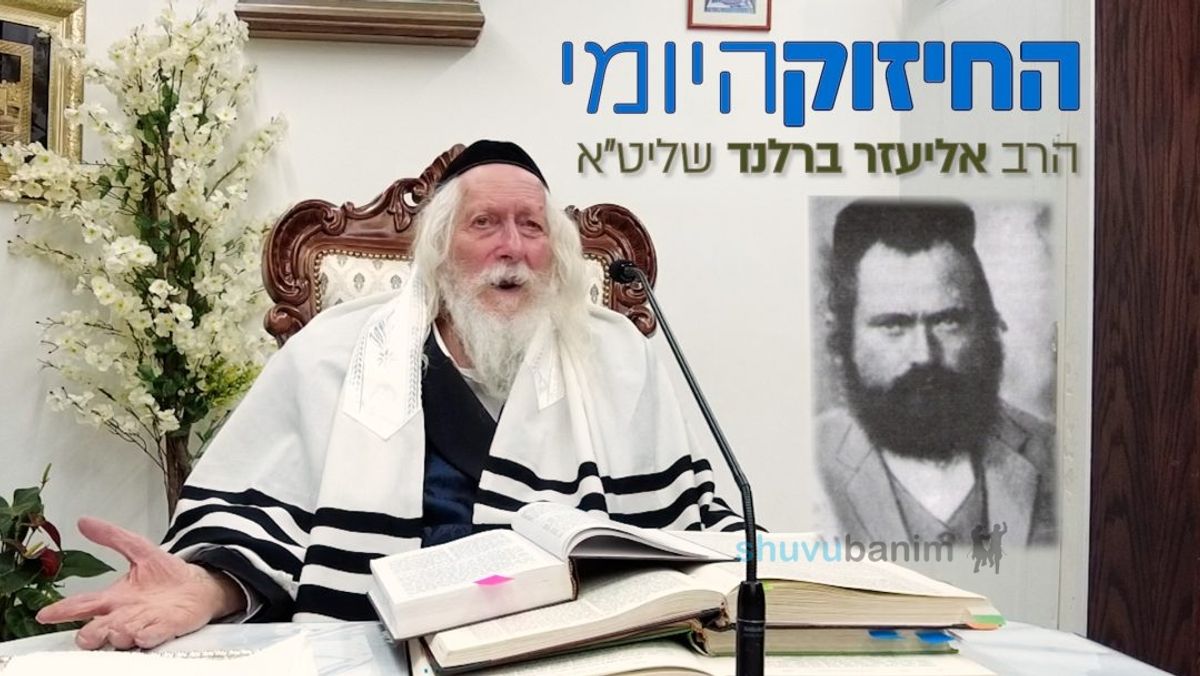
There are moments when heaven and earth touch one another – moments that seem simple, like a knock on the door. A Jew who merits to hear the voice of a poor person is actually hearing a gentle call from the Upper Worlds. The small act of giving, specifically when it is difficult or when one lacks, opens gates that are hidden from the eye. The following story reveals how thin the thread is that connects a simple act of kindness to entire destinies.
Sunday, 12th of Sivan 5785 – The Daily Chizuk (spiritual encouragement) from the Gaon and Tzaddik, Rabbi Eliezer Berland shlit"a (may he live long and good days):
A poor person knocks on your door – they are sending him a dorona miskena (a gift for the poor).
This was the story of Nachum Weisfish (Rabbi Nachum Weisfish zt"l, of blessed memory, a member of the Meah Shearim community and a farmer in Meir Shfeya, who worked to unite the hearts of the Old Yishuv with the members of the labor settlements and pioneers. He was murdered by Arab rioters in 1938, and his murder was a severe blow that left the agricultural settlement in Shfeya abandoned).
Nachum Weisfish
Nachum Weisfish, the father of all the Weisfishes, lived in the colony of Meir Shfeya near Zichron [Yaakov]. He originally lived in Jerusalem and moved to Shfeya, and from Shfeya he would send milk to Jerusalem; all the kosher milk came from him.
https://vimeo.com/1091521900?share=copy
All the cows back then belonged to gentiles, and they needed a Jew to do the milking, so he would supervise the milking. He lived in Shfeya (Meir Shfeya near Zichron Yaakov) which the Baron (Rothschild) built, and he was the only Haredi (ultra-Orthodox) Jew in the entire settlement. He would put the milk on the train that came from Zichron—the train is still in Zichron to this day. He would put the milk jugs on the train, travel to Jerusalem, and there they would unload it. This was all the milk for Jerusalem; every day he would put out new milk jugs. At night they would milk the cows, putting out 10 milk jugs for all of Haredi Jewry. 10 milk jugs were enough because every child received one cup of milk.
The incident occurred on a Thursday night. A poor man knocked on the door and asked Rabbi Nachum Weisfish for tzedakah (charity). Weisfish told him, "I only have a 50 bill," and asked the poor man, "Do you have change for fifty?"
A fifty bill was like 50,000 mil (currency during the British Mandate period); every Lira was a thousand mil, so fifty [Liras] was 50,000 mil. Now the poor man needed to bring change for 50,000 mil.
The poor man asked, "How can I bring change for 50,000 mil?"
Afterward, Nachum Weisfish regretted it and said, "It doesn't matter, let him return the change to me another time," but he could no longer find the poor man – on that same Motzaei Shabbat (Saturday night after the Sabbath) that he missed that poor man, he was murdered.
If someone knocks on a person's door (and asks for charity), they must immediately run with a shekel, 10 shekels, something. "Let not the oppressed return ashamed (the poor and needy shall praise Your name)" {Psalms 74:21}, at least give him one shekel.
For the "oppressed and ashamed," they send him a dorona miskena (a gift for the poor); they send him a poor person as a gift in order to sweeten the judgments (dinim) – if they send a poor person to a man who knocks on his door, it could be that there was a death sentence upon him today, or upon his child—his child crosses the road and a car runs him over, Heaven forbid.
Subscribe to Our Newsletter
Receive Torah articles and inspiration directly in your inbox