The Custom of Shooting Arrows on Lag BaOmer – Roots, Secrets, and the Explanation of the Bnei Yissaschar
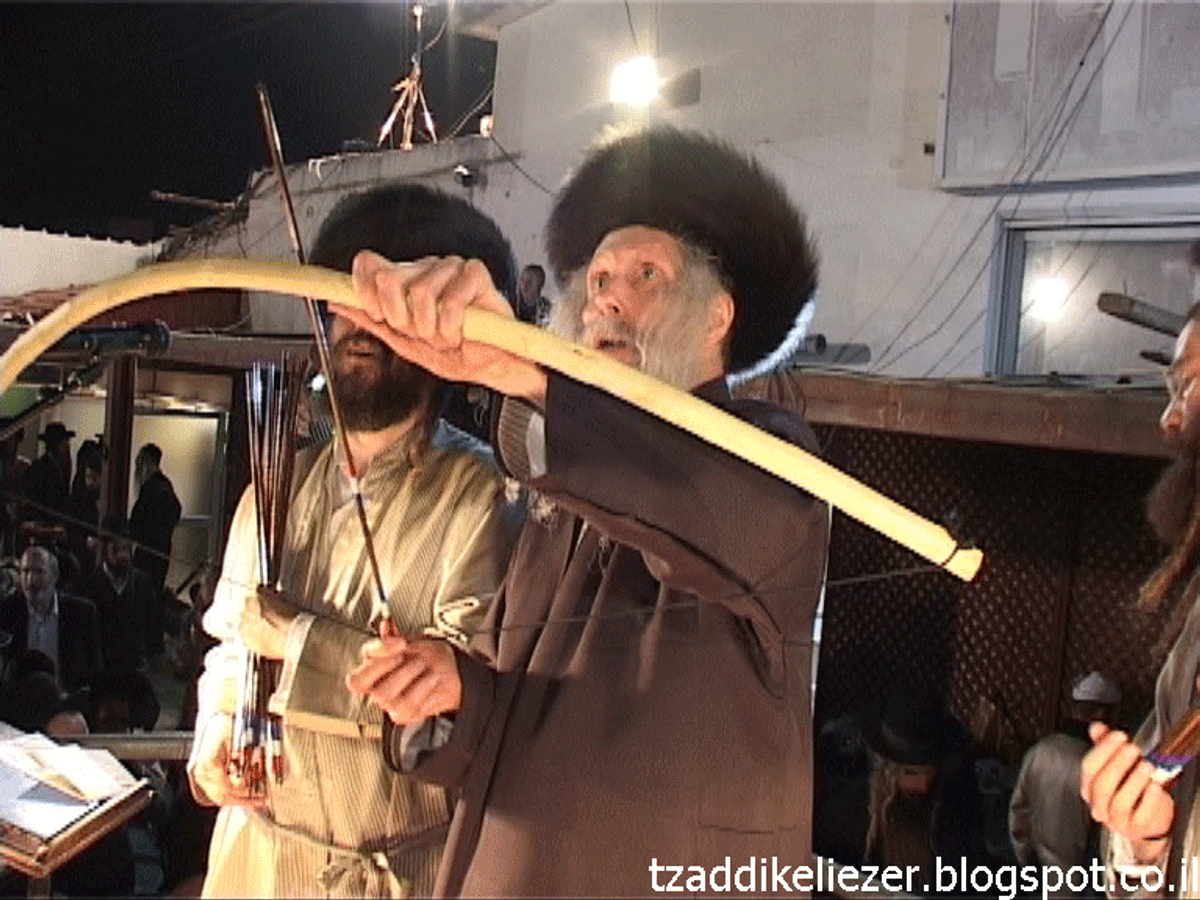
Anyone who observes the streets of a Charedi city or a Chassidic village on the day of Lag BaOmer sees a sight not seen on any other day of the year: small children, bundles of bows and arrows in their hands, shooting at targets between the courtyards. An ancient custom passed down from father to son, from grandfather to grandson, from generation to generation.
Where does this come from? What is the connection between the Rashbi and a bow? And why specifically children? In this article, we will trace the roots of the custom, read the words of the great Chassidic masters, and understand the depth hidden within an innocent children's game.
The Bow – A Sign for the World
The verse in Parashat Noach says: "And the bow shall be in the cloud; and I will look upon it, that I may remember the everlasting covenant" (Genesis 9:16). The rainbow in the cloud is a sign that Hashem will not destroy the world with water – even though the generation might be deserving of destruction.
The rainbow appears only when generations sin and there is already a reason to destroy the world, but the covenant with Noach prevents God from bringing another flood. Meaning: a rainbow in the cloud = a sign that the world deserves a flood.
"One Who Did Not See a Rainbow in the Days of the Tzaddik"
The Gemara in Tractate Ketubot (77b) says an awesome thing:
"Rabbi Shimon bar Yochai – the rainbow was not seen in his days"
– Meaning, throughout the entire lifetime of the Rashbi, a rainbow did not appear in the cloud. And why? Because his merit, the immense holiness of his Torah study, shielded the world to the point that there was no need for the sign of the covenant. The Rashbi himself, in his holiness, protected an entire generation.
And therefore, Rabbi Shimon bar Yochai himself truly says: "I can exempt the entire world from judgment." Because the power of this tzaddik is so immense, that he can nullify all harsh decrees.
The Bnei Yissaschar – Explanation of the Custom
The strongest source for the reason behind the custom of shooting arrows on Lag BaOmer is found in the book "Bnei Yissaschar" by Rabbi Tzvi Elimelech of Dinov, may his merit protect us (Month of Iyar, Maamar 3). He explains:
"And therefore, schoolchildren have the custom on the day of Lag BaOmer to shoot arrows with a bow as a remembrance of the fact that the rainbow was not seen in his days"
The children shoot with a bow to commemorate the fact that in the days of the Rashbi there was no need for a rainbow in the cloud. And this is a tremendous teaching: that when there is such a tzaddik in the world, even a small child can illustrate his immense merit.
And more than that – it is not just a memory. It is a connection to tradition. Every child who holds a bow in his hand on Lag BaOmer becomes part of the spiritual power of the Rashbi that protects the world.
The Bow and the Rashbi – Two Secrets
There is an additional secret in Kabbalah, that the bow is in the secret of Yesod d'Abba (according to the language of the Kabbalists), whose concept is the tzaddik who is the foundation of the world. The Rashbi is called the "supernal tzaddik" upon whose merit the entire existence of the world depends. And as it is written, "the tzaddik is the foundation of the world" – that tzaddik is the protecting bow.
Therefore, the shooting of arrows by the children is a spiritual act of connection – the children connect to that "tzaddik who is the foundation of the world," to that Rashbi, and receive from his merit.
Rabbi Pinchas of Koritz – The Custom of Protection
The Admor Rabbi Pinchas of Koritz, may his merit protect us, one of the greatest disciples of the Baal Shem Tov, explained the custom as a form of spiritual protection. He taught that every child who shoots an arrow on Lag BaOmer – this arrow literally "strikes" the external forces that try to harm the people of Israel. The arrow itself does not physically hit anyone, but it symbolizes the spiritual arrows that emerge from it, from that merit of the Rashbi, which nullify the harsh decrees.
Why Specifically Children?
The holy Arizal taught that children – in their innocence, without foreign thoughts, without calculations – are the strongest conduit for receiving supernal lights. And on Lag BaOmer especially, when great lights spread through the world in the merit of the Rashbi, the children are the most worthy to receive them.
And there is another layer: Rabbi Akiva, the teacher of the Rashbi, lost twenty-four thousand students during the days of the Omer counting. On Lag BaOmer, the death of his students ceased. The children of Israel shooting arrows symbolize the new generation of students that arose – the children who have not yet been harmed by the accusations of strict judgment, who are the continuing seed of the people of Israel.
"The Custom of Our Fathers is Torah"
The custom is ancient, cited in many books of customs, and to this day it is upheld in all Chassidic communities in Israel and around the world. Even in our days, every child who holds a bow in his hand and shoots an arrow into the air on Lag BaOmer – is part of a long chain of tradition, of faith, of connection to the holy Rashbi.
On the Night of Lag BaOmer in Meron
In Meron on the night of the hilula, you see hundreds of children with bows and arrows. They wander between their parents' legs while the parents pray at the tziun. They are there, in the holiness of the place, learning from a young age the beauty of Lag BaOmer.
This is the best education – to raise a generation that grows up with love for the Rashbi, with love for the secrets of Torah, with love for the Holy Land and for holy Meron.
To Be a Partner in the Holiness of the Day
Submitting names for prayer and for Chai Rotel in honor of the Rashbi on Lag BaOmer 5786 allows every Jew, even one who cannot arrive, to be a partner in the holiness of the great day.
➤ To submit names and donate Chai Rotel in honor of the Rashbi
May the merit of the Rashbi and the merit of the custom of shooting arrows protect you and your children, amen.
Read more
Subscribe to Our Newsletter
Receive Torah articles and inspiration directly in your inbox