
Special: Purim Kiddush from the mouth of the Gaon and Tzaddik Rabbi Eliezer
Berland shlit"a
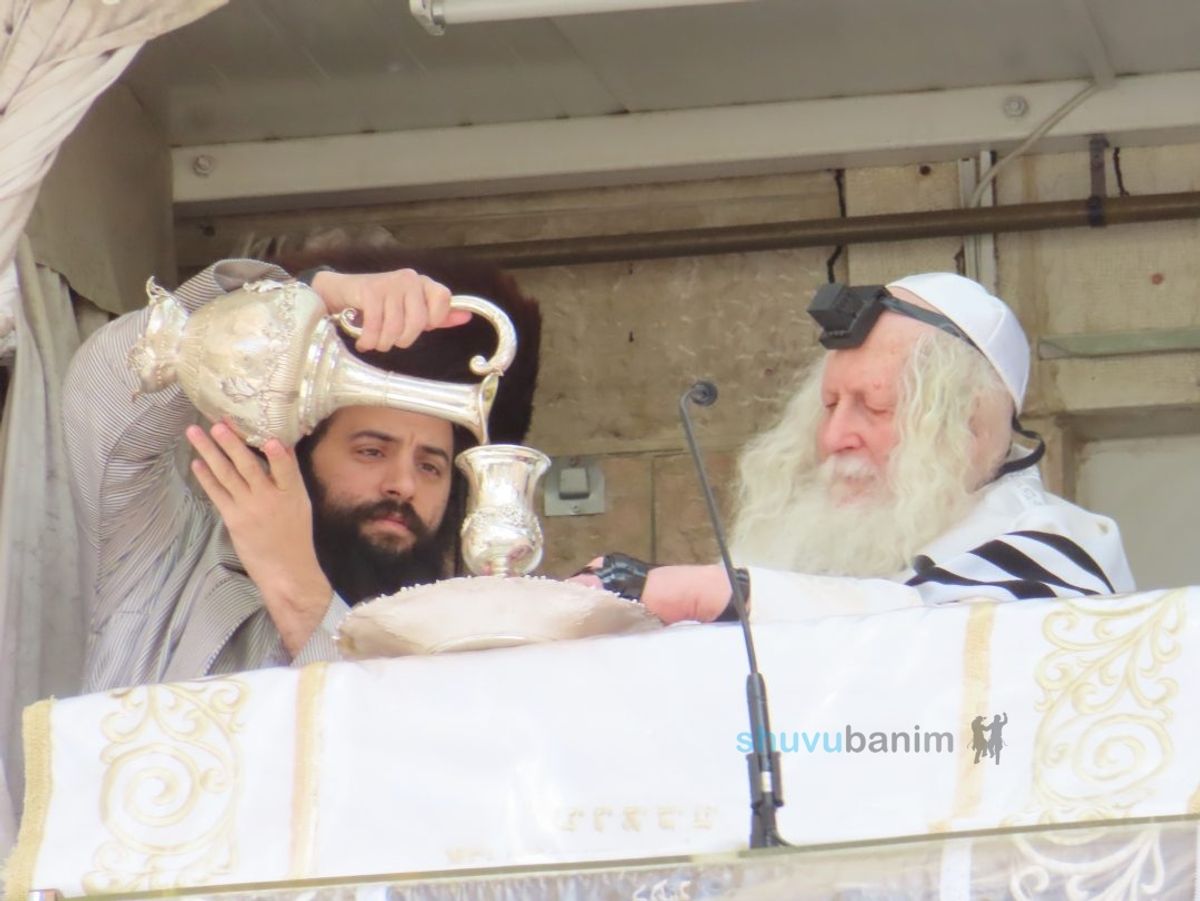
Last night, on the holiday of Purim of the Walled Cities (Shushan Purim), our teacher the Rav, Rabbi Eliezer Berland shlit"a, conducted the 'Purim Kiddush' after the conclusion of the Megillah (Scroll of Esther) reading and the Shacharis (morning) prayer, as he does every year. He began with a Purim joke (milta d'bidichusa) and continued into awesome and hidden secrets revealed on Purim. Before you is the full Kiddush and the lessons delivered afterward:
The Kiddush:
"And the heavens and the earth were finished and all their host, and on the seventh day G-d finished the work which He had done... and He hanged Vashti and Haman and his ten sons...". And he (Haman) had seventy sons who were all Roshei Yeshivos (heads of Torah academies), and they all returned in teshuvah (repentance). And they all went to Mordechai to ask for forgiveness; all of Haman's sons had to go ask forgiveness from Mordechai, to kiss the soles of his feet. And also Vashti—in this merit may there be the complete Geulah (Redemption) speedily in our days, Amen!
At the conclusion of these words, the Rav shlit"a recited the blessing over the vine (HaGafen) and drank according to the commandment of the day (grape juice). Afterward, he began delivering a lesson on the greatness of the day of Purim:
Purim is the Resurrection of the Dead; we rectify the sin of Adam HaRishon (the first man). For Hashem asked Adam HaRishon, "What do you want [which punishment for the sin?], stoning, burning, beheading, [or] strangulation? You brought death to the world; all the Holocausts are because of Adam HaRishon. Choose for yourself something for atonement—either stoning, burning, beheading, or strangulation." So Adam HaRishon said, "Hang me on the tree." "Is it from [Ha-min] the tree?" says the Da'as Zekenim of the Tosafists—"Is it from the tree"—Adam HaRishon said to Hashem, "Hang me on the tree; I ate from the Tree of Knowledge, hang me on the Tree of Knowledge." Hashem said to him, "Choose for yourself an atonement, find yourself an atonement." So he looked until the end of all generations, and he saw Haman the Wicked. He said: "Master of the World, Haman the Wicked is my atonement, he is my substitute, he is my replacement; let this Haman go to his death and we shall all enter into good life and peace, to the Resurrection of the Dead speedily in our days, Amen!"
Afterward, he recited the Kaddish Yehei Shlama and delivered another lesson, this time on awesome and hidden secrets through the path of Sod (Kabbalistic secrets) and Remez (allusions) hidden within the Megillah:
So, there are four times that the Name Havayah (the four-letter Name of G-d) appears in the Megillah. "All this is worth nothing to me" (Kol zeh einenu shoveh li) — this is [the final letters of] the Name Havayah. "[For] evil was determined against him" (Ki chaltah eilav hara'ah) — then he saw that this is the Name Havayah; though he was the chief of the ministers, within three days he descended to the depths of the lowest pit (Sheol Tachtiyos) and was hanged on the tree. [The additional place where the Name Havayah is alluded to is:] "Let the King and Haman come" (Yavo HaMelech VeHaman).
For Esther knew the Shem HaMeforash (the Explicit Name of G-d), because once, every woman knew the Shem HaMeforash. And therefore it is alluded to: "And the King's decree shall be heard... for it is great, and all the women shall give honor" (Hi ve-chol ha-nashim yitnu yekar) — so "she and all the women shall give honor" is another time the Name Havayah appears, for every woman is the Name Havayah. Every woman is essentially the Name Havayah. Therefore, the woman is responsible for everything; she is responsible for the Geulah (Redemption), and also through the merit of the women will be the complete Geulah speedily in our days, Amen!
Subscribe to Our Newsletter
Receive Torah articles and inspiration directly in your inbox