
"Specifically From the Mirrors They Built the Mishkan!" • Parshas Ki Tisa from
the Gaon and Tzaddik Rabbi Eliezer Berland shlit"a
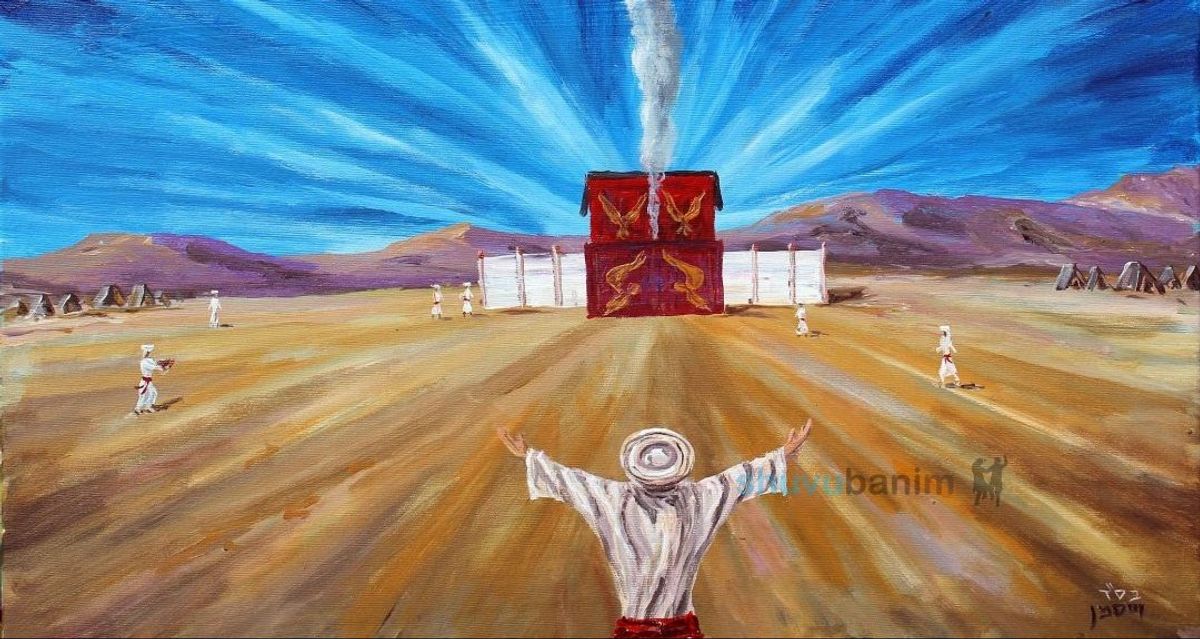
What happened when the women brought the mirrors to build the Mishkan (Tabernacle)? And why did Nadav and Avihu not want to wash their hands from the Kiyor (Basin)? And how did the Nesi'im (Princes) bring stones from Gan Eden (Paradise) if it must be "And they shall make a Mishkan"? Insights and pearls for the weekly Torah portion of Vayakhel from the Gaon and Tzaddik Rabbi Eliezer Berland shlit"a
"Mar'os HaTzov'os" (The mirrors of the legions):
"And the men came upon the women, everyone whose heart was generous" (Exodus 35:22). The men arrived at five or six in the morning; they said, "I wanted to arrive at Netz (sunrise)," but the women had already arrived at three. Therefore, it is called "Mar'os HaTzov'os" (the mirrors of the legions) (ibid 38:8). After Moshe said that everyone should bring their contribution for the construction of the Mishkan (Tabernacle), the women brought their mirrors, which were made of polished copper. Moshe said to take planks to break their legs—that every father should take planks and break the legs of his daughter and wife for bringing such an impure thing to build the Mishkan, which is intended for the indwelling of the Shechinah (Divine Presence). Then a Bas Kol (Heavenly Voice) went out and said to him, "Moshe, Moshe, you do not see, you do not understand; this is more precious to Me than everything!" As soon as Moshe heard the Bas Kol, he retracted his stance. From these mirrors, they made the Kiyor (Basin), as it is written: "And he made the Kiyor of copper and its base of copper from the mirrors of the legions" (ibid). But Nadav and Avihu, the sons of Aharon, who did not hear the Bas Kol, said, "What happened to our uncle—Moshe? Has he lost his mind? He is starting to bring mirrors?" They did not wash their hands from the Kiyor, Heaven forbid! For they believed it was made from something impure. Since Moshe had initially loathed them, Nadav and Avihu also loathed them. Hashem said to him: "Moshe, this is more precious to Me than everything," but Nadav and Avihu did not hear the Bas Kol. They thought they were wiser than Moshe Rabbeinu; they were certain they were greater than Moshe Rabbeinu. They did not hear the Bas Kol that Moshe heard in praise of those mirrors, as written at the end of Tanchuma Pekudei, which emerged after Moshe said to take planks to break the women's legs. There are things that are beyond human intellect.
And these are the portions of Vayakhel, Pekudei, Terumah, and Tetzaveh—the construction of the Mishkan is mentioned once in the portions of Terumah and Tetzaveh, Vayakhel is the second time, and after that in Pekudei, we have it three more times. Because the Mishkan is all Techeiles (blue wool), Argaman (purple wool), and Tola'as Shani (scarlet wool) to join the linen and the Shesh (fine linen). Every thread is six-fold, as we learn from the word "Shesh" (which means six). Shesh is both marble and linen, and it says in the Megillah, "A pavement of Bahat, and Shesh, and Dar, and Socheres" (Esther 1:6), because on Purim everyone receives a floor of diamonds, and "a pavement of Bahat, and Shesh, and Dar, and Socheres"—the entire floor shone like the sun.
If you see that the face is blurry, immediately go home and do Teshuvah (repentance)
Moshe built the Mishkan; everyone brought some nose ring, earring, or ring. All of the Jewish people, 600,000—one brought his wife's ring, another brought his wife's earring, her nose ring, a necklace. Until nothing was left, they brought all the jewelry, they brought all the gold, no gold remained. The women did not protest; the women continued to bring all the time, until no gold was left. Fine, they started bringing mirrors. They made the Kiyor from the "Mar'os HaTzov'os" (mirrors of the legions).
Mirrors are the most precious and the most despised thing, because it is forbidden to look in the mirror for more than two minutes. A woman needs to know that one does not look in the mirror for more than two minutes. Four hours in the mirror? In four hours, one can finish the entire book of Tehillim (Psalms) twice! So a woman asked, "How will I have time to say Tehillim?" Look less in the mirror, then you will have time—instead of four hours, three hours...
So the mirrors are the most despised thing, yet from them they built the Mishkan! Specifically from the mirrors!! So the women brought mirrors, and Moshe was alarmed—what, shall we build a Mishkan from mirrors?! A mirror is the most despised thing, the most disgraceful. Hashem said, "I want specifically from the mirrors!" From the mirrors they built the Kiyor, and anyone who brings a Korban (sacrifice) stands before the Kiyor. The Kiyor was made of mirrors; if one sees that the face is blurry, immediately go home and do Teshuvah (repentance), then come again. If the face is blurry, it is a sign that the Teshuvah was not accepted. A person comes to the world so that their Teshuvah will be accepted; without Teshuvah, Hashem does not accept the Korban! "To what purpose is the multitude of your sacrifices to Me? says Hashem" (Isaiah 1:11). Why are you bringing Me sacrifices? All day long sacrifices? Do Teshuvah! Do not commit sins! Conduct yourselves with Tzniyus (modesty), loathe sins, loathe this—it is a disgusting thing! The most disgusting thing is a sin! Loathe it! Hashem says, "You bring Me sacrifices? First do Teshuvah, stop committing sins."
A Holy Temple of Fire through the Zemiros (songs)
And in the Targum (Aramaic translation), it says that the Nesi'im (Princes) brought everything from Gan Eden (Paradise)—the incense spices, everything, everything. They went to the Pishon river and brought the twelve Shoham stones (Onyx), the stones of the Choshen (Breastplate), Tarshish, Shoham, and Yashfeh, and the incense. The Targum says they brought everything from Gan Eden. It is asked: everything needs to be the work of man's hands, yet they brought it all from Gan Eden? The Steipler (Rabbi Kanievsky) asks: if a Beis HaMikdash (Holy Temple) of fire descends, will it be possible to offer sacrifices? This is difficult, for it must be "And they shall make a Mishkan"—our work is "And they shall make a Mishkan," and if the Temple of fire descends, how will "And they shall make for Me a Sanctuary" be fulfilled? Rather, it is the Zemiros (Sabbath songs). The Rebbe (Rebbe Nachman) says that through the Zemiros we build the Mishkan; even though a Temple of fire will descend, it will descend in the merit of the Zemiros—through the Zemiros, it becomes "And they shall make a Mishkan"!
The lesson has undergone editing, and if any error has occurred, it should not be attributed, G-d forbid, to our teacher the Rav shlit"a, but rather to the writer, and "may our error remain with us."
Illustration courtesy of the artist R' Yehoshua Wiseman. To purchase: www.yehoshuawiseman.com
The Shuvu Banim website wishes all followers and readers a Shabbat Shalom and blessed!!
Subscribe to Our Newsletter
Receive Torah articles and inspiration directly in your inbox