
Strong: Why Must We Give Thanks Before Crying Out?
Rabbi Michael Gol shlit"a on 'Hitchadshut' - Watch
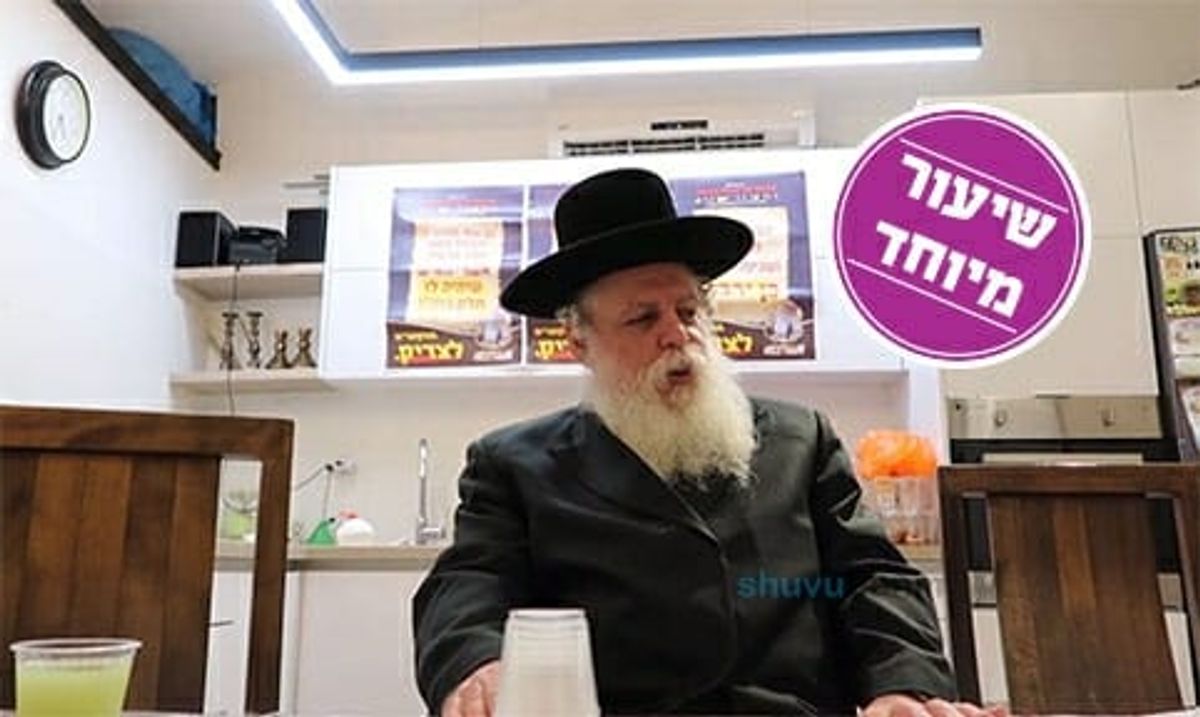
The esteemed Rav Michael Gol, Rosh Yeshiva of 'Maginei Eretz' and one of the veteran students of our teacher, the holy Rav Eliezer Berland shlit"a, shares a special and strengthening conversation with the staff of the Torah monthly 'Hitchadshut'. During his remarks, Rav Gol touches upon a point so vital in the life of every believing Jew: why we must thank Hashem for all the good He does for us, and why gratitude is a prerequisite for crying out and requesting from the depths of the heart.
Rav Gol reinforces the importance of disseminating the point of the true tzaddik of the generation as a condition for the Geulah, while addressing the importance of distributing the 'Hitchadshut' monthly.
"We must make an effort so that 'Hitchadshut' is always published"
"Are you familiar with the Rebbe's talk, that every book destined to be written is necessary? This is part of the concept of emunat chachamim (faith in the sages), that we rejoice in every article that is published, and everything that is written, of course, should be written with good taste. In 'Hitchadshut' there are special, unique things that we need and deserve, and we must make every effort for this booklet to be published. First of all, this booklet is more unique than most, because it deals with the subject of our teacher, Rav Berland shlit"a, and this is a very important point."
"We believe with complete faith that the entire Geulah and all the salvation of the Jewish people depends on the point of our teacher, Rav Berland; this is simple to us. In every generation, there is that tzaddik in whom everything is concentrated, according to the words of Reb Noson on Torah 228: that the tzaddik of the generation must undergo humiliation, for if he does not undergo it, it is impossible to bring people close."
"And Jacob dwelt in the land of his father's sojournings, in the land of Canaan" (Genesis 37:1). There are two Midrashim, and our Rebbe connects both Midrashim as one. Jacob sought to dwell in tranquility, but the agitation of Joseph sprang upon him. And another Midrash adjacent to it: 'In the land of his father's sojournings'—from the word 'giyur' (conversion)—that he was occupied with converting converts. And the Rebbe connects both Midrashim as one and says: When a person is occupied with converting converts, then controversy must arise against him; there is no other reality."
"Today, those who draw close to Rav Berland are only those who seek the truth"
"Our Rebbe brings the Gemara in Yevamot 24: 'We do not accept converts in the days of Mashiach,' just as they did not accept converts in the days of Solomon and David. The Rebbe also mentions the matter of David, that when the Jewish people are at the peak of the world (succeeding), it is not evident that a person is drawing close because he is seeking Hashem. Today, one sees clearly that whoever draws close to our teacher, Rav Berland, is only someone who is truly searching, someone for whom the truth is truly burning and who truly wants to draw close to Hashem; otherwise, they do not draw close."
"Today, to be 'Shuvu Banim' is not a great honor, and one does not receive prizes here; one only receives humiliation. A person must have a true desire to seek the truth. Reb Noson connects truth to faith; until a person has truth, he cannot reach faith. Even though faith seems like something abstract, no, says Reb Noson, whoever truly searches, even in the matter of emunat chachamim, if a person searches with the eye of truth, then he will certainly reach the greatness of our teacher, Rav Berland. He will reach emunat chachamim, that the entire tikkun depends on Rav Berland—these things are not simple; nothing proceeds simply."
Reaching the importance of the tzaddik through closeness to his students
"There is an immense virtue in 'Hitchadshut' because it speaks of our teacher, Rav Berland, and it is beautifully edited. Today, one also needs a magnificent venue. People want to see beautiful, colorful pages with bright pictures. The things are edited and styled with good taste, which one does not always see in other places. 'Hitchadshut' highlights many of the students of our teacher, Rav Berland, and this is very important."
"We know the story that Reb Moshe Breslver would come to speak with Reb Avraham Berenyo; they were good friends. One time, Reb Avraham Berenyo was not there, and Reb Moshe wanted to return, but the father-in-law, Reb Abba, one of our Rebbe's students, said to him: 'Why won't you speak with me?' He replied: 'You are students of the Rebbe, I mean, where are we and where are you...' He answered him: 'You know more from the Rebbe through Reb Noson than we know from the Rebbe. Your closeness to Reb Noson birthed something for you that we do not have.'"
"The tzaddik cannot illuminate himself in every matter. Reb Noson says it is like how Moses our teacher found the making of the Menorah difficult, and it was specifically Bezalel the student who could make the Menorah, because the Menorah is the light of the tzaddik; it is the student himself. The tzaddik cannot stand and insert [the light], and in general—here the tzaddik seeks humiliation for himself; one needs someone to strengthen us, to explain: 'Look, these are humiliations, and know that we are speaking of a tzaddik upon whom all the worlds depend, specifically through these humiliations.'"
"Once, someone spoke to me about the greatness of someone, and I told him: 'He is a great man, certainly, but if this is the tzaddik the Rebbe speaks of, then where is his humiliation? Where is the humiliation? What, was the Rebbe's Torah only for those generations?' Reb Noson says that what the Rebbe speaks of regarding humiliation applies to every single generation. He says: 'In the generation of the holy Ari, they argued with him, and in the generation of the Baal Shem Tov, most of those who argued with the Baal Shem Tov held by the holy Ari.'"
"We understand that holding by the tzaddikim of previous generations is not proof at all. The proof is in this time, in this generation, in this second, if I merit to hold on—and this is the virtue of this booklet."
"Why must we say thank you to Hashem at all?"
"There are two points, and one must combine them. Reb Noson in Hilchot Kilayim Behema 4 says a great foundation: today there is already awareness to say thank you; 'say thank you and you will see salvations.' Reb Noson does not disagree with this, but there is a great secret here related to Chanukah. We are now at the conclusion of Chanukah, and the light of the holiday continues, and Reb Noson explains a great foundation in gratitude."
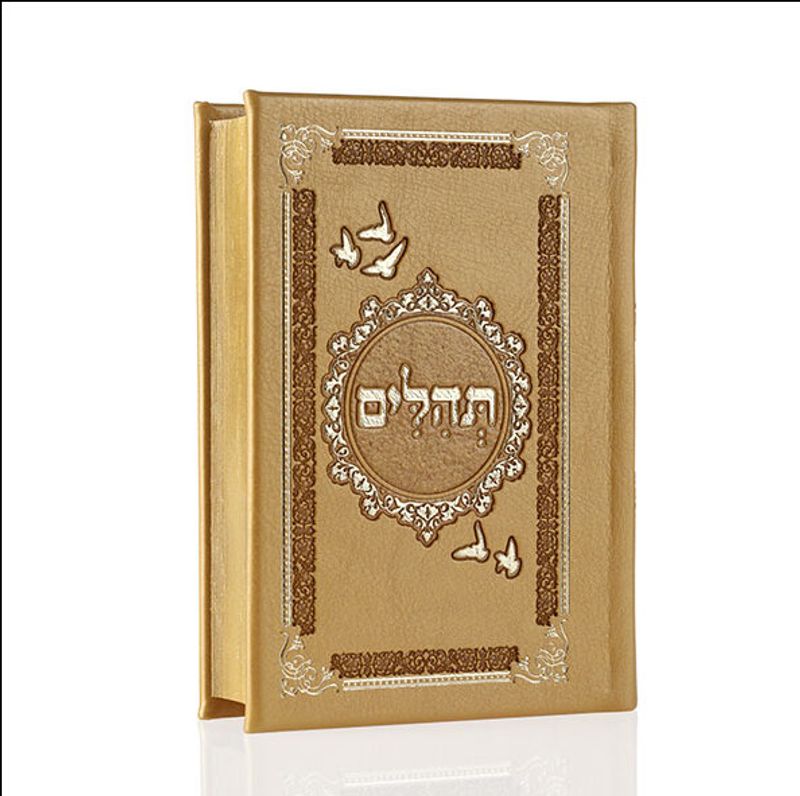
"One point: Why is the Book of Psalms called that? After all, Tehillim (Psalms) are praises to Hashem, and in practice, it should be called the Book of Cries and Shouts, not Tehillim. The essence of the book is a cry and a shout to Hashem; King David cries and shouts to Hashem in almost every psalm. Another wondrous point that Reb Noson relates to—I do not know if there is another book in the world that relates to it, but one can say this about hundreds and thousands of articles of Reb Noson—without the explanation of Reb Noson, the matter is not understood at all."
"Reb Noson brings the Gemara in Berachot page 7, the incident of David fleeing from Absalom, and the Gemara says: 'A Psalm of David when he fled from Absalom his son' (Psalms 3:1). 'A song (Mizmor) for David?'—a lament (Kinah) is what is needed! What kind of psalm? Someone whose son is chasing him says a lament, shouts 'Gevald,' a lament? No! King David saw this as a great miracle, thanks and gratitude to Hashem that my son is chasing me and not a slave chasing his master; the son will have mercy on his father."
"Through the scriptures, one can see that Absalom had a small hesitation, only that Ahithophel was the one who stood behind this entire malicious plan, but seemingly it is difficult in several ways. Every person prefers that troubles come from the outside and not from the inside. Chazal themselves say, 'A bad culture inside a person's house is harder than the war of Gog and Magog' (Berachot 7b)."
"Regarding the war of Gog and Magog, David says in Tehillim in the previous chapter: 'Why do the nations rage and the peoples plot in vain' (Psalms 2:1), and in this chapter he says: 'Many are my adversaries, many rise up against me.' We see that it is harder. So how did he suddenly find a place to give thanks to the Master of the World? It is 'fun' that it is the son and not a slave? Thank You, Master of the World. There is a Midrash in 'Shochen Tov' on this chapter, chapter 3."
"It says there that King David gave thanks, he said: 'Master of the World, I am indeed pursued, but the heroes are still around me. I am not alone, even Joab son of Zeruiah.' Chazal learn later that he hesitated in the rebellion of Absalom whether to join Absalom. It is written: 'For Joab inclined after Adonijah, and after Absalom he did not incline.' Chazal say, and Rashi brings it: 'He sought to incline, but did not incline.' He said, 'The remnant of David still exists.' That is to say, there was a great danger here; we understand that if Joab had inclined, it would have looked very different, Hashem, what it could have been."
"When Jacob our father sends the herds, it is written that he sends herd by herd alone; seemingly, what is the idea?"
"I once did a favor for someone and waited for a thank you; I didn't understand, 3 days passed and the person didn't react at all. I told myself that when I meet him, I will apologize that it was only a small help and he will understand the hint. After 3 days, he sent me a long sheet of thanks with rhymes."
"Chazal say that Jacob our father requested, not all at once, that after a period of time another trouble would come, just as one passes through the exiles where there was a period of time between exile and exile. Here too the question arises: why not finish everything together and not have it last thousands of years from exile to exile?"
"Reb Noson says: Beyond the fact that one must give thanks to Hashem literally for all the kindnesses, I cannot cry out if I do not say thank you beforehand. Our Rebbe says in Torah 195: 'In distress You have enlarged me' (Psalms 4:2); when a person is inside the trouble, he must see the expansion that Hashem has expanded for him, then he can give a cry. If not, for what will he give a cry? If I do not see how many miracles Hashem has done with me, then what am I going to cry out for?"
"He says: 'Maybe no one hears me at all, but if he says, I have already passed such a trouble and I cried out and was saved and saw how many kindnesses Hashem does with me—now he goes and receives more strength of crying out.' Reb Noson connects everything as one."
"Reb Noson says that if we had passed through exile after exile, it is like giving a person blow after blow; he is already so broken and bent that he has no ability to thank Hashem, but suddenly you are given an expansion. We can, Heaven forbid, despair of prayer; in order not to despair, one must precede it with thanks. Therefore, Jacob our father requested relief between trouble and trouble."
"Even the Jewish people needed a respite from troubles before the continuation of the exiles"
"And this is the secret of the Hasmonean war against the Greeks; it is a small relief inside a sea of troubles. From the Babylonian exile we went to the Median exile which also includes Persia, and from there to the Greek exile, from the Greek exile to Rome. When did we have a period of salvation? In the time of the Hasmoneans! The days of Chanukah are days of gratitude; we had a period of 103 years, we had a time of gratitude to Hashem, a time to lift our heads, and this gives me strength afterwards to give a cry to Hashem."
"And this is what King David says: 'I have sunk in deep mire where there is no standing' (Psalms 69:3). David does like Jacob, because he also sees the future exiles and asks Hashem for time. 'Give the Jewish people a period of salvation that we will take for generations.' This is Chanukah, in which we see that Hashem saved me, and thus it is possible afterwards to cry out."
"Reb Noson says that this is the secret of the Book of Tehillim which is composed of cries, but one must start first with gratitude, otherwise how will I cry out? Reb Noson says that the psalm is divided into two: 'Hashem, how many are my adversaries, many rise up against me' (Psalms 3:2). What a hard life I have, but thank you to Hashem. What kind of thanks is this?"
"David called it a psalm, but in reality, it is a lament; therefore, Reb Noson says that we divide this psalm into two. On one hand, 'In distress You have enlarged me,' David seeks the salvations—the main thing is our booklet from 'Hitchadshut' which is composed of thanks and crying out. Thanks to Hashem for the wonderful revelation in every article..."
"I do not give up on reading 'Hitchadshut'"
"I stand by the booklet and see that there is not one article here that one can skip, and do not be mistaken, I read the entire booklet. I haven't read the latest edition yet, because..., but I do not give up."
"Mishael and Nachman were guests in my home, and I showed them in the tiny bookcase of the 15 books that I study regularly, the 'Hitchadshut' booklet. Now that the new one has come out, it is replaced and the old one goes up. I said that I want to have 'Hitchadshut' always—to be renewed. First, one must praise Hashem, a psalm of thanksgiving that we have such a wonderful, interesting, fascinating booklet."
"The main point is the words about our teacher, Rav Berland, but today leaflets come out with jokes, and we understand that today one needs something that will catch the eye, and 'Hitchadshut' is intended for the outside, but is also intended for us. Certainly, on the outside, one must illuminate the light of our teacher, Rav Berland; today there is such darkness and concealment."
"This does not exempt us from saying that the Rav invited humiliation upon himself; our teacher, Rav Berland, invites darkness to the world, because this is the trial of the generation, because it is impossible to draw close today without this. But if we, the students, do not take action and do something, then many souls are lost. We do not know what brings people close—one word, one speech—only a picture of our teacher, Rav Berland."
"I can tell you about a lawyer who sat in my home and told me that he heard bad things about our teacher, Rav Berland. He looked at the corrupt device and saw slander that described evil that had not existed since the days of Hitler, may his name be blotted out, such a danger to humanity. He wanted to see what this danger was; he saw our teacher, Rav Berland, and said to himself, 'This does not fit; there is a special light on the face of this person, it cannot be what they are talking about.'"
"So he decided to check and opened the 'Shuvu Banim Int' website; two names popped up, Rav Ofer Erez and myself. He was completely enthusiastic about Rav Ofer and listened to him regularly, and to me a little. He told me that after he heard us, he said to himself that the image they painted of Rav Berland does not fit the stories, the students—it does not fit the stories—he returned in teshuvah."
"You wouldn't say that it is about a Litvak who became a Breslover—a completely secular person who doesn't know his right from his left returned in teshuvah. I cannot detail the things; modesty is beautiful for them, but it is unbelievable—it is not about one or two. Of course, this booklet needs and it is important that there be distribution, at least national if not global—there needs to be great distribution."
"Here we arrive at the second part; Reb Noson says that we start with thanks so that we can cry out. After all, we started with thanks for this booklet and we are crying out—friends, wake up, everyone must take it upon themselves."
"Yesterday I was at 'Nitzotzot,' they invited me and I arrived, because I respect Rav Stern very much. The 'Nitzotzot' booklet is excellent and does wonderful and important things, but 'Hitchadshut' is no less important—and for us, the students of Rav Berland, it should be more important, each according to his interest."
"'Nitzotzot' is excellent and deals with the greats of Breslov, wonderful articles, words of Torah from important members of Anash without exception, but in 'Hitchadshut' there is a uniqueness that is not in any booklet in the world—and for us, the claim is on this booklet."
"To subscribe to the 'Hitchadshut' monthly, click here"
Subscribe to Our Newsletter
Receive Torah articles and inspiration directly in your inbox