
The Constriction a Person Experiences is Only a Preparation for His Private
Parting of the Red Sea!! Seventh Day of Pesach from the Gaon and Tzaddik Rabbi Eliezer Berland shlit"a
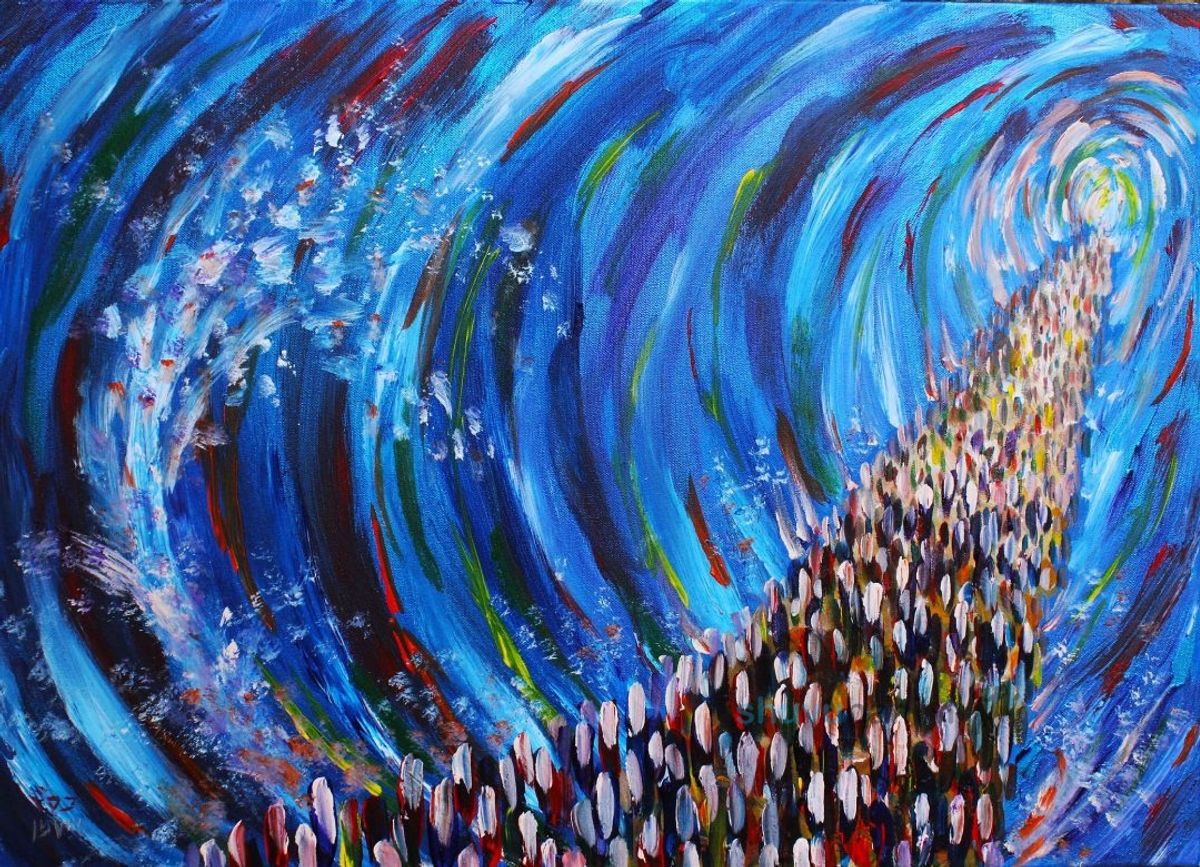
Why is it specifically on the eve of the Seventh Day of Pesach that we descend into a constriction of consciousness (Katnut HaMochin)? And what did the Jewish people say to Moshe Rabbeinu on the shores of the sea? And is it possible that the Parting of the Red Sea was actually supposed to happen on Isru Chag (the day after the festival) and not on the Seventh of Pesach? The secret of the Seventh of Pesach within the inner dimension of the days of Sefiras HaOmer (the Counting of the Omer) from the Gaon and Tzaddik Rabbi Eliezer Berland shlit"a.
The Order of the Counting in the Inner Dimension
Reb Noson brings here in Hilchos Pikadon, Law 4, the order of the Mochin (spiritual intellects), and this is also the rule for Sefiras HaOmer (the Counting of the Omer)... eight types of Mochin. If you divide them by four—four in Abba (the aspect of Wisdom) and four in Imma (the aspect of Understanding)—it goes like this: Katnut A (small constriction), Katnut B (large constriction), Gadlut A (small expansion), and Gadlut B (large expansion). We have four types of Mochin: two of Katnut and two of Gadlut. Katnut A and Katnut B each have four in Abba and four in Imma. Thus, the seventh day results in Gadlut A of Abba, and the second will be Gadlut B of Abba. Reb Noson says that this is the order of the counting every day; every week it repeats. Gadlut A of Abba descends—this is the seventh Moch (intellect), the greatest intellect, or almost the greatest. After that, on the second day, Gadlut A of Imma descends—this is called the third Moch. This descends on the second day—Gadlut A of Imma. After that, on the third day, the Katnut B levels descend. Katnut B is from the constriction, but it's also from the second Moch which is slightly larger. Two constrictions descend. B is called the second Moch. And the sixth Moch—so they descend from the second and sixth Moch of Abba and Imma. On the fourth day, the fourth Moch descends—this is Gadlut B of Imma. On the fifth day, the smallest Mochin descend; on the fifth day, one descends into such a state of Katnut (constriction).
The Jewish People Regretted Leaving Egypt Specifically Before the Parting of the Red Sea
It is written there in Parshas Beshalach, such Mochin deKatnut (constricted consciousness): they regretted leaving Egypt, they regretted everything. "Why did we leave Egypt?" This was the fifth day of the Omer—the eve of the Seventh of Pesach—when one falls into the smallest Mochin! Suddenly, a person is filled with questions; one reaches such states of Katnut that suddenly they don't know why they need these things. What is the point? What does it give? Is this why we came into the world? For these things...? Is this why we came into the world...? This is called Katnut A of Abba. Katnut A of Imma is called the first Moch and the fifth Moch. This is what happened here on the Seventh of Pesach—on the eve of the Seventh of Pesach, on the fifth day of the Omer. They fell into such constricted consciousness: "And the people said to Moshe: 'Is it because there are no graves in Egypt that you have taken us to die in the wilderness? What is this you have done to us, to bring us out of Egypt?'" Why did we leave? Why did we come here? Why did we listen to your voice? You are just dragging us to destruction! Just throwing us into nonsense! What was bad in Egypt? We ate fish there for free, there were cucumbers, watermelons. Why did you drag us? "Is this not the word that we spoke to you in Egypt, saying: 'Leave us alone, that we may serve the Egyptians'?" We already told you this; it's not new. We told you this would be the end! We warned you, right! We warned you and told you that in the end you would fail, and in the end you wouldn't succeed. You did a few lice, the frogs—that's what you're capable of; lice and frogs are what you can do. But to take a nation out of Egypt—what does one have to do with the other...! Look, "all the host of Pharaoh, six hundred chosen chariots"—see what a disaster you've brought us to! They will literally slaughter us all here!! And we warned you in Egypt, we warned you about this: "Is this not the word that we spoke to you in Egypt, saying: 'Leave us alone, that we may serve the Egyptians? For it is better for us to serve the Egyptians than that we should die in the wilderness.'" These are such Mochin deKatnut! He regrets everything; suddenly things turn bad for him, he faces distress, he faces despair; he regrets everything from A to Z. Why did I come here? I started on these paths with people, they told me that in the end you will despair, in the end you will break—they warned him. Why didn't I listen to them? And one falls into such constricted consciousness, and all this happens on the fifth day of the Omer, because one must pass through this too—one must pass through every type of consciousness in the world. So on the fifth day of the Omer, one falls into Katnut A—this is the smallest constriction of Imma; Katnut A of Abba is the fifth Moch, which is the fifth day of the Omer.
The Great Light Begins on the Seventh of Pesach!
And on the sixth day of the Omer, suddenly such a great light begins—the Seventh of Pesach, the Parting of the Red Sea! Such a great light begins to shine, such a wonderful light begins to be. And the main part, he said, would enter on Isru Chag (the day after the festival), entering as the seventh of the Omer. So why do we count? The Ari HaKadosh says that on the Seventh of Pesach... because the main thing is the Moch (intellect) that begins to enter, which was a Reshimu (spiritual trace); something of this Moch enters, and even that "something" already split the Red Sea, already split all the seas.
All the Ships in the World Sank for the Honor of the Jewish People
The Ba'al HaTurim says that all the ships in the world sank; there wasn't a ship in the world that didn't sink! All the nations, every single one of them, knew that the Jewish people were now leaving Egypt, so all the ships sank. It is written that when Abraham would pray, no ship would sink. Now it is exactly the opposite; the Ba'al HaTurim says they had to show the world that there is nothing besides the Jewish people. Know this: no one is needed—not your merchant ships, not your wine, nothing—you will all sink! They are walking there with the Clouds of Glory, Manna from heaven, the Well of Miriam; there is enough wine. Abraham Avinu needed the wine, but the Midrash says now we don't need it. We have the Well of Miriam, as much wine as we want for free; we don't need their ships. So the Ba'al HaTurim says, "And the waters were split"—all the springs in the world were split, every spring in the world was split. "And they were split"—a strong east wind came from the sea. The Ba'al HaTurim says, "An east wind shall break the ships of Tarshish," teaching that all the ships in the sea were broken, all the springs were split, all the seas were split, every place was split—the sea, all the ships of the entire world were broken and sunk. To show the world: no one needs ships, or wine, or trade, or for them to bring us things—we have everything! The Jewish people walk with the Clouds of Glory, seven Clouds of Glory, Manna from heaven, the Well of Miriam, the quail (slav) comes right into their hands. So they won't need anything, any help from anywhere in the world. Let them all sink, let them all perish—either they will convert or they will believe in the Jewish people. Or they will be lost from the world! So all the springs in the world were split, all the springs in the world were split!
The Parting of the Red Sea on Isru Chag?
Then such a light was revealed, such a light of Pesach was revealed—it was only the Reshimu (spiritual trace)! So Reb Noson says here, it is only the Reshimu of the Gadlut (expansion). He brings the Etz Chaim here; the Pri Etz Chaim explains that even though Isru Chag is even greater! The Pri Etz Chaim says that even though Isru Chag is much greater than the Seventh of Pesach, because the great eighth Moch, the great eighth Moch enters. [-] Now the Ari asks: how is it possible that the eighth Moch, which is the greatest and is actually on Isru Chag—so why do we celebrate the holiday on the Seventh of Pesach and not on Isru Chag? And why was the Parting of the Red Sea actually on the Seventh of Pesach? The Pri Etz Chaim brings this at the end of the Seventh of Pesach: that the eighth day, which is the greatest Moch, the Ari says it enters on Isru Chag. But he says that even though the essence of the eighth Moch enters on Isru Chag and not on the Yom Tov (holiday), the Ari says we follow the beginning of the Moch! The Reshimu! The "something" of the Moch, a drop of the Moch—the moment it just begins to sparkle, the Parting of the Red Sea already happens! All the ships in the sea already sank, all the Egyptians already perished! From a "something of a something" of the eighth Moch, such a great intellect!
The Secret of the Doe: Specifically When Reaching the Greatest Constriction, Everything Opens!
Therefore, the Ari says the smallest Moch (intellect) was exactly on the eve of the Seventh of Pesach; that is the smallest Moch, and then they fell into the height of despair, all hope was lost. They said, "It's a pity we listened to the voice of Moshe Rabbeinu." Moshe Rabbeinu, the dreamer... he thinks that if he can bring lice and frogs, he can also take the Jewish people out of Egypt. There is no connection between the two; we just got confused by him.
And this is the secret of the Doe (Ayala) that the Zohar says in Beshalach: that a doe cannot give birth, so a snake comes and bites her. This is the secret of every single person: the moment he reaches the Katnut of Katnut (the ultimate constriction), which everyone goes through—Chol HaMoed Pesach arrives, and we said if there are no true Kisufim (longings) during Bein HaZmanim (the intersession period), then we would be learning twenty hours now. But the sorrow is that even in Bein HaZmanim there aren't the right longings, so it doesn't burst forth as much as it should. Then one falls into despair, G-d forbid; suddenly they see they cannot learn, they cannot pray. All this, the Ari says, is called Katnut deKatnut (the constriction of constrictions). All this is a massive preparation for the Mochin of Gadlut deGadlut (the expansion of expansions)!! Because a person who fell into the Mochin of Katnut deKatnut—this is the fifth day of the Omer, the eve of the Seventh of Pesach—immediately after that, such great Mochin arrive! Such Gadlut deGadlut! From these Mochin, all the seas are split and all the enemies are drowned, and we shall merit the complete Geulah (Redemption) speedily in our days, Amen!
The lesson has been edited, and if any error has occurred, it should not be attributed, G-d forbid, to the Rav shlit"a, but rather to the writer, and "may our error remain with us."
The Shuvu Banim website system wishes you, the readers and followers,
a Kosher and Happy Pesach!!!
Subscribe to Our Newsletter
Receive Torah articles and inspiration directly in your inbox