
The Depth of Free Will on Purim and the Secret of Queen Esther's Banquet
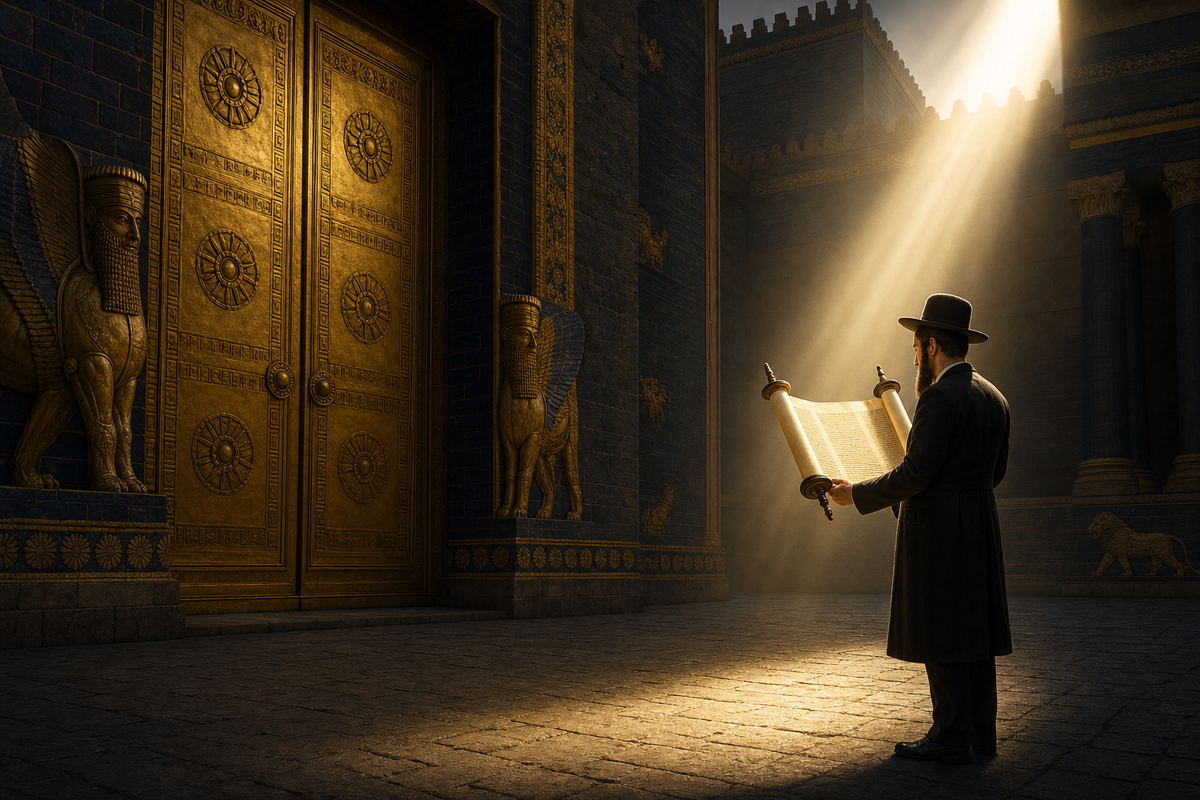
Class No. 180 | Motzaei Shabbos Kodesh Parashas Terumah, the eve of the 5th of Adar 5759 - 'Melaveh Malkah' seudah (festive meal) at the Yeshiva
The transition from the revealed miracles of the Exodus from Egypt to the concealment of the Babylonian exile reveals the secret of the Jewish people's free will. Through Queen Esther's hidden plan at the banquet, we discover the immense power of an 'ayin tovah' (good eye) and the danger of underestimating the enemy.
Regarding the verse in Shir HaShirim (Song of Songs), "While the King was at His table, my spikenard gave forth its fragrance," the Sages expound that the sin of the Golden Calf was transformed into merits and a pleasant fragrance, like spikenard and cinnamon. The question arises: How is it possible that such a terrible sin was transformed into a pleasant fragrance? The answer lies in understanding the concept of free will. In truth, until they committed the sin of the Golden Calf, the Jewish people had no free will whatsoever. Hashem took them out of slavery to freedom, everyone ran after Moshe Rabbeinu (Moses) in the desert, the Well of Miriam accompanied them, Manna fell from heaven, and every day they witnessed a new miracle. In such a state of absolute revelation of the Shechinah (Divine Presence), free will does not apply.
Suddenly, the wise men of the Erev Rav (mixed multitude), Yunus and Yambros, came and said to the Jewish people: "Who needs Moshe Rabbeinu? We can manage without him! Let us make a calf, and it will conquer the Land of Israel for us." They convinced the nation that Moshe was only confusing them with laws and statutes, and that it would be better to have a calf that would do their will.
Why do the nations of the world choose gods of wood and stone? Because this way, they can do whatever they want. They dictate to their gods what to do, rather than the gods dictating to them. This is the profound difference between the God of Israel and the gods of the nations of the world. For us, the goal is to nullify our own will: "Make His will like your will, so that He will make your will like His will." We are required to nullify the evil inclination and our desires in order to do the will of Hashem.
The Return of Free Will
For three months, the Jewish people followed Hashem and Moshe with their eyes closed, without a single doubt. But the moment Moshe disappeared and did not return on time, their true free will began. A person receives a reward only for their choices. A person will not receive a reward for running after Hashem or after a tzaddik with closed eyes due to the illumination of miracles. Only when the confusions and concealments arrive, and the person nevertheless chooses to run after the tzaddik—that is when their reward begins.
Hashem could have brought Moshe down from the mountain one day earlier and prevented the sin of the Golden Calf, but He wanted to see how the Jewish people would behave out of their own free will. When Moshe came down and cried out: "Whoever is for Hashem, come to me!", and everyone was required to demonstrate mesirus nefesh (self-sacrifice), that is where the true reward of the Jewish people began.
However, even this choice was still not entirely complete, as it was made under the immense impression of the Ten Plagues, the Splitting of the Red Sea, and the miracles in which they were carried "on eagles' wings." The truest and purest choice, where the Jewish people choose Hashem in all situations—even in exiles, even during decrees of annihilation, and even when people come to kill them—was only revealed later on.
The Secret of the Holiday of Purim
When the Holy Temple was destroyed and the Jewish people had already been in exile for seventy years, that is where the true choice began: Will we follow Hashem even amidst the destruction and concealment? This is the immense power of the holiday of Purim. In contrast to Pesach, Shavuos, and Sukkos, which were given through revealed miracles and wonders, Purim is a holiday of absolute concealment. On Purim, there is nothing but prayer.
Therefore, the Gemara in Tractate Yoma says that Purim is the "end of all miracles." Megillas Esther was written at a level almost equal to a Sefer Torah, "like the truth of the Torah," because it represents the pinnacle of free will and emunah (faith) from within the darkness.
The Hidden Plan at Esther's Banquet
The Gemara in Tractate Megillah asks:
"The Sages taught: What did Esther see that she invited Haman?"
What caused Esther to risk her life and enter the king's inner courtyard without an invitation? Achashverosh was a paranoid man who constantly suspected that people wanted to assassinate him, and therefore he secluded himself in the inner courtyard. When Esther arrives and invites him and Haman to a banquet, Achashverosh's suspicion only grows. He does not understand why she is inviting a stranger to an intimate gathering, and why she is risking her life for another cup of wine.
Rabbi Yehoshua ben Korcha explains that Esther went with the intention of dying. She wanted Achashverosh to suspect that she and Haman were conspiring against him, so that he would kill them both. Abaye and Rava reveal to us that the entire secret of the Megillah is hidden in a verse from the prophecy of Yirmiyahu (Jeremiah) regarding the downfall of Babylon:
"When they are heated, I will set their banquets, and I will make them drunk, that they may rejoice, and sleep a perpetual sleep, and not wake, says Hashem" (Yirmiyahu 51:39).
The Maharsha explains that the way of the nations is to get drunk at banquets and stab one another. The original plan of Esther—and of Divine Providence—was to bring Achashverosh and Haman to a state of drunkenness and rage, where they would kill each other. Hashem wanted to avenge the vengeance of the Jewish people to the very end: that Achashverosh would die at the banquet, Haman would be killed, and Mordechai would become king over all of Media and Persia.
Why Did Achashverosh Remain Alive?
If this was the plan, why didn't Achashverosh die in the end? The Yaaros Devash explains this based on a statement in the Gemara, that when Esther reached the chamber of idols, the Shechinah (Divine Presence) departed from her. Why did the Shechinah depart from her at that critical moment?
The Gemara explains that this happened because Esther prayed and recited the verse from Tehillim (Psalms):
"Rescue my soul from the sword, my only one from the grip of the dog."
She called Achashverosh a "dog." Seemingly, isn't this a fitting title for a man who gave his signet ring to destroy, kill, and annihilate all of the Jewish people in a single day? However, Hashem does not agree with this. The decree against the Jewish people did not come about because of Achashverosh or Haman, but rather, "because of our sins we were exiled from our land." Without the sins of the Jewish people, no nation would have been able to rule over them.
Here lies a tremendous spiritual secret: The moment a person calls his enemy a 'dog,' he sweetens all the judgments upon him. If the enemy is a person with intellect and free will, he deserves punishment for his evil deeds. But if you define him as a 'dog'—a dog has no intellect and no free will, and therefore does not deserve any punishment for biting!
The moment Esther called Achashverosh a 'dog,' she nullified the death sentence that was hovering over him. Only when she retracted and called him a 'lion' ("Save me from the lion's mouth"), did the Shechinah return to her, but the opportunity to kill Achashverosh and crown Mordechai over the entire empire was missed.
The Power of a Good Eye
From here we learn the deepest message of the days of Purim. The entire essence of Purim—sending portions of food to one another and giving gifts to the poor—is about acquiring a 'good eye' (a positive perspective).
True perfection is to fulfill the verse: "If your enemy is hungry, give him bread to eat... for you will be scooping coals onto his head." Your greatest enemy—give him to drink, feed him, and speak his praises. Only through a good eye and baseless love will Hashem subdue all the wicked, and only in this way will we merit the complete Geulah (Redemption) speedily in our days, Amen.
Lesson No. 180
Subscribe to Our Newsletter
Receive Torah articles and inspiration directly in your inbox