The Depth of the Fall of Yaravam ben Nevat and the Secret of the Hidden Books
Class No. 59 | Monday, Parshas Behar-Bechukosai, 18 Iyar, Lag BaOmer 5756
The discourse of Rabbi Berland shlit"a reveals the root of the historic fall of Yaravam ben Nevat (Jeroboam), which began with a public rebuke and arrogance. Through the words of Likutey Moharan, the secret of the hidden books is explained, along with the immense danger hidden within the wisdom of apikorsus (heresy), which could mislead even the greatest of tzaddikim.
King Solomon built the Millo. He took a plot of land that belonged to the pilgrims, a place where they used to pitch tents and camp, and closed the breach that his father King David had made in the City of David. At one of the gates, he built a palace for the daughter of Pharaoh. Furthermore, he took the pilgrims who passed through there and subjected them to angaria (forced labor)—conscripting them for forced labor as plumbers, carpenters, and glaziers, in order to repair everything that was broken in the palace. He even collected special taxes from them to maintain the palace of Pharaoh's daughter.
King David had made many breaches in the wall so that the Jewish people could ascend for the pilgrimage festivals from all directions without overcrowding, until they reached the Jaffa Gate, Zion Gate, or Damascus Gate. King Solomon, however, fenced them in to collect taxes and enslave the pilgrims. Because of this, Yaravam ben Nevat came and rebuked King Solomon in public.
But Yaravam made a grave mistake—he rebuked King Solomon in public. When a person rebukes his friend in public, it is ineffective. He should have rebuked him in private, and then he either would have influenced him or fulfilled his obligation to rebuke. Because he rebuked the King of Israel in public, Hashem said to him: "Now I will test you with such a thing that you will fail infinitely more. You will build walls around Jerusalem and decree that no one may ascend to Jerusalem anymore."
The Root of the Fall: Arrogance
The Gemara says regarding the verse:
"And this is the matter that he lifted up his hand against the king" (Kings I 11:27).
Rav Nachman said: He removed his tefillin in front of him. Removing tefillin in front of one's Rav is considered a tremendous disgrace, and he did this intentionally to humiliate King Solomon.
The holy Rebbe, Rebbe Nachman of Breslov, explains that everything stemmed from arrogance. Everything that happens to a person, the falls and the mistakes, all stem from arrogance and infinite pride. Yaravam thought he knew everything, that there was no one wiser than him, that he was the greatest halachic authority. A person can be the greatest of the generation, and even the greatest of several generations, like Yaravam who taught novel Torah insights that no ear had ever heard, and nevertheless make a grave mistake that any small child can clearly see.
If a person does not uproot pride from within himself, he can make the most terrible mistakes in the world that will completely forsake the entire Jewish people. The arrogance that was in Yaravam is what drove him from the world.
The Heretical Wisdom of Yaravam
Yaravam made a political and personal calculation. He said in his heart:
"Now the kingdom will return to the House of David. If this people goes up to offer sacrifices in the House of Hashem in Jerusalem, then the heart of this people will turn back to their lord, to Rechavam king of Judah, and they will kill me" (Kings I 12:26-27).
He knew the halacha that no one is permitted to sit in the Azarah (Temple Courtyard) except for the kings of the House of David. He understood that when the people would see Rechavam sitting and him standing, they would say, "This one is a king and this one is a slave," and they would kill him as a rebel against the monarchy. Immediately, he took counsel and made two golden calves in Beis El and in Dan.
The question arises: How does one make golden calves in a single day? How do you convince an entire nation that just yesterday went to the Holy Temple, to suddenly go and worship calves in Beis El and Dan with self-sacrifice? Is it conceivable that he misled a great multitude with such foolishness?
The holy Rebbe Nachman explains in Likutey Moharan that Yaravam certainly possessed very great wisdom of apikorsus (heresy). If, Heaven forbid, even one page from these books of Yaravam ben Nevat had remained today, people would be driven very far from Hashem, blessed be He, and it would be impossible to draw close to Him at all. He had such persuasive arguments that even we would have bowed down to idol worship and would not be able to serve Hashem.
The Secret of the Hidden Books
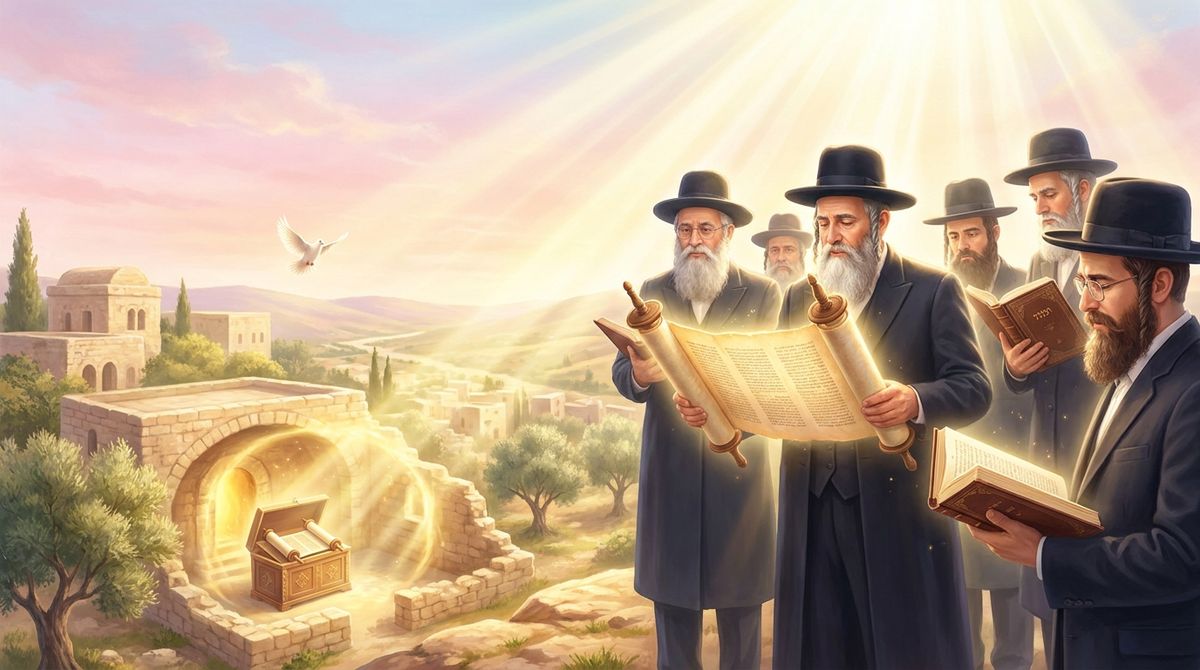
From here we learn a tremendous foundation regarding books and Torah teachings that have disappeared from the world. There are hidden tzaddikim who know deep facets of the Torah, but they must conceal their teachings. The main thing is the spiritual effect that the Torah accomplishes through its very concealment. There are teachings that are completely forbidden to exist in the atmosphere of the world, because they arouse harsh judgment.
It is a great favor to the world that there are books that have disappeared and been burned, because through this, the books of heretics and apikorsim are also burned. Avraham Avinu wrote 400 tractates on idol worship to explain all the idolatries in the world, and we have no trace of them. The Tannaim and Amoraim wrote many books that were lost. If they had not been lost, the books of the wicked or of the great leaders of the generation who made mistakes would also have remained, and the entire world would have followed that mistake.
How were the tzaddikim deceived?
How did Yerovam actually succeed in deceiving everyone? The Gemara relates that he seated one hundred men: fifty tzaddikim and fifty wicked men. He arranged them so that for every tzaddik, two wicked men sat beside him, one on his right and one on his left. He said to the tzaddikim, "Sign whatever I ask." They agreed, for after all, he was a righteous king.
When he told them that he wanted them to worship idols, the tzaddikim cried out in protest. But the wicked men sitting beside them calmed them down and said: "Salka datach d'gavra k'Yerovam ben Nevat palach la'avodat kochavim? Ela l'minsinhu hu d'ka ba'ei" – Does it enter your mind that a great man like Yerovam would worship idols? He only wants to test you.
This is how he managed to get even Achiya HaShiloni, the prophet of Hashem, to sign. With this seal of Achiya HaShiloni, they went from city to city and from village to village. When the people saw a kosher certification from the prophet, everyone followed after the golden calves. Even Yehu, who eradicated all the prophets of the Baal and the Asherah with mesirus nefesh (self-sacrifice), stumbled with the calves. Why? Because they showed him the seal of Achiya HaShiloni. He saw the seal of Achiya HaShiloni, he saw it and erred.
Part 3 of 4 — Lesson No. 59
Subscribe to Our Newsletter
Receive Torah articles and inspiration directly in your inbox