
The Entire Essence of the Seder Night is to Restore the Infinite Light •
Passover Holiday from the Gaon and Tzaddik Rabbi Eliezer Berland shlit"a
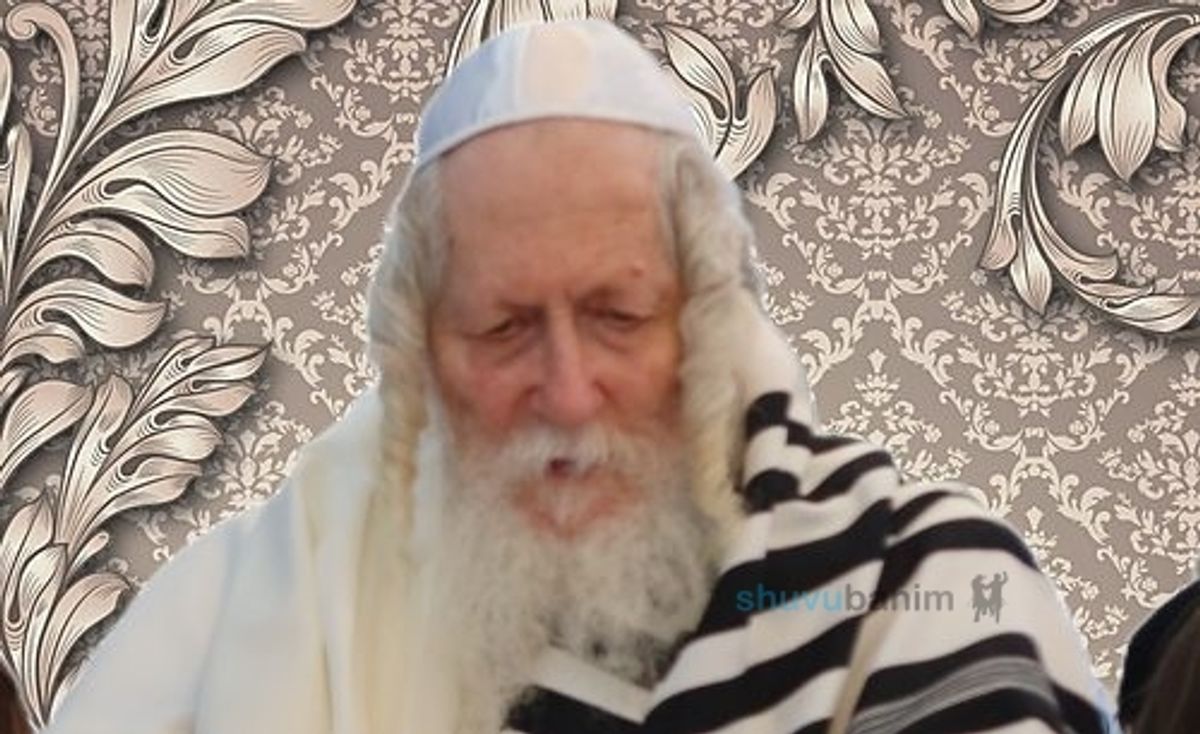
Before you is a collection of lessons, insights, and pearls for the holiday of Passover from the Gaon and Tzaddik Rabbi Eliezer Berland shlit"a (may he live long and good days):
Abraham Established Shacharit
Abraham our forefather established Shacharit (the morning prayer). Shacharit is an acronym for Ch'acham (wise), R'asha (wicked), T'am (simple), and Sh'eino y'odea lish'ol (one who does not know how to ask). This is because Abraham our forefather already saw everything that would happen until the end of all generations, and therefore it is written, "a great dark dread fell upon him." At the Covenant Between the Parts, he saw everything that would be; all the Holocausts, the terrible Holocaust that occurred 65 or 70 years ago—everything. There was nothing that Hashem did not reveal to Abraham our forefather. Therefore, he returned to Charan—as written in the holy books—in order to sweeten the terrible decree. For anyone who recites the Parshas HaAkeidah (the portion of the Binding of Isaac) with intention is saved from all the decrees mentioned in the Siddur Tefillat Kol Peh in the small lines (in the name of the Zohar) before the Akeidah. For one who says the Akeidah with intention, a Heavenly Voice goes out and says: "Do not stretch out your hand against the lad," "By Myself I have sworn, says Hashem, because you have done this thing and have not withheld your son, your only one, from Me"—every time a person says the portion of the Akeidah with intention. Abraham our forefather, through the Akeidah, already fulfilled the obligation for everyone regarding all the "bindings" (sacrifices) in the world. And Abraham is Rebbe Nachman, he is Joseph the Tzaddik. For it is written in the Megaleh Amukos that Moses our teacher is the sixth. Because Adam was the first, then Abraham, Isaac, and Jacob—that is four. Joseph received the letter "He" because he is the fifth. After that came Moses, he is the sixth. Moses is the sixth, and after that will be Mashiach (the Messiah). This is the soul of Rebbe Nachman, which will already be the seventh. Abraham saw everything that would happen until the end of all generations. He returned to Charan for another five years to sweeten the terrible decrees, since he saw "a great dark dread fell upon him." and this corresponds to the Wise, Wicked, Simple, and the one who does not know how to ask.
Afikoman
For to the Wise son we say: "One does not conclude after the Paschal lamb with an Afikoman (the final matzah eaten at the Seder)." According to the Jerusalem Talmud in Pesachim, we give this answer to the Simple son—that one does not conclude after the Paschal lamb with an Afikoman. What is the Afikoman? Rebbe Nosson explains that the Afikoman is the Or Ein Sof (Infinite Light).
The Seder Night – The Infinite Light
For the entire essence of the Seder night is to restore the Or Ein Sof (Infinite Light). To restore the Infinite Light that was taken from us due to the Chet Etz HaDa'as (Sin of the Tree of Knowledge). For Chava (Eve) had 370 myriads of lights, because Chava was included [in Arich Anpin, the level of Divine Will], even though she was only a rib. But "My heart exults (alatz) in Hashem," Chana (Hannah) says, "Alatz (exults) my heart in Hashem," because Chana merited to rectify the Sin of the Tree of Knowledge, so she could say "Alatz (370) my heart in Hashem."
And as it is written regarding Chana: "And her face was no longer [downcast]." What does "her face was no longer" mean? The holy Arizal says that she merited that the 370 lights returned to her. "You change his countenance and send him away." For regarding Adam it is written, "You change his countenance and send him away," meaning he lost the 370 myriads of lights and the 150 lights. Therefore, King David says, "My soul longs, indeed it faints, for the courts of Hashem; my heart and my flesh sing for joy to the living G-d."
The Seder Night – The Holy of Holies
For now, we were all in the Kodesh Kodashim (Holy of Holies) on the Seder night; we were all in the Holy of Holies. "Restore the service to the Dvir (Sanctuary) of Your House." Dvir has the numerical value of Aryeh (Lion), 216. The Lion of the Chariot—we merited that the Lion should come and consume. A person merits that the Lion descends and consumes all the rectifications of the Seder night. "Restore to the Dvir of Your House" is the numerical value of Aryeh, which is what Rebbe Nachman says in Torah 50: that the whole matter is that a person who does not blemish the Covenant [merits that the Lion receives his prayer] through the Seder night. The entire Seder night comes to rectify the Pegam HaBris (blemish of the covenant/sexual purity). It is written that in the future, at the dedication of the Third Temple, it will last seven days. There will be a seven-day dedication of the House to purify from all the sins of all the exiles, from the sin of Adam, from all the exiles and all the sins. They will need to decontaminate the Altar, to purify the Altar. For seven days they will offer sacrifices just to atone for everything we sinned during all the years of exile, all the Mohin deKatnus (constricted consciousness) where we failed to see Hashem even in states of constriction.
The Levels of the Days of the Sefirah
Rebbe Nosson explains that today, on the second day of the Sefirah (Counting of the Omer), we are already in Gevurah shebe'Chesed (Strength within Kindness). But truly, our saying Chesed shebe'Chesed, Gevurah shebe'Chesed, is a very simple division. The true division is written on page 128, section 8, deposit 4: the true division is that the first week is the week of Chochmah (Wisdom), and therefore it is entirely a festival. The second week is the week of Binah (Understanding). The third week is the Kindnesses within Da'as (Knowledge). The fourth week is the Strengths within Da'as. The fifth week is Kindnesses. After that, the sixth week is Hod (Splendor). This week is Gevurah, these are Strengths, and after that, the final week is from Tiferet (Beauty) to Malchut (Kingship). This is the division according to weeks; this is the true division. And after that, there is a division of days. Rebbe Nosson explains the division of days is such that every first day of all seven weeks is always the first Gadlus (expanded state) of Abba (Father/Wisdom). For there is a first Gadlus and a second Gadlus. The first Gadlus is the smaller one, the second Gadlus is the larger one. So there is first Gadlus and second Gadlus. And after the Gadlus of Abba, there is the first and second Gadlus of Imma (Mother/Understanding). And there is Katnus (constricted state) A and Katnus B. The number B is always higher. Katnus B of Abba and Imma is even greater than the first Gadlus of Abba and Imma.
To Illuminate for the 'Wicked Son'
We will now go according to the order. Rebbe Nosson will now explain to us all the Mohin (spiritual intellects) we received on the Seder night, which is the meaning of "Abraham established Shacharit." For Abraham our forefather drew down all the Mohin. This corresponds to the Wicked son and the Wise son. The Wicked son is placed next to the Wise son because the Wicked son should have been at the end, but the main [work of] the Wise son is to illuminate the Wicked son—that is the essence of the Wise son's wisdom. And this is: "One does not conclude after the Paschal lamb with an Afikoman." The Or Ein Sof (Infinite Light) that is in the Afikoman. Therefore, even if the Afikoman is lost, we want to distribute it to everyone. The main thing is to take some crumb from the Afikoman, and after that, one can add more matzah. To restore the lights from Adam, because this crumb is literally the Infinite Light. For the entire Seder night is to restore the lights, as King David says, "My soul longs, indeed it faints, for the courts of Hashem; my heart and my flesh sing for joy to the living G-d." That even my heart and my flesh—even the flesh. For the flesh of Adam used to shine from one end of the world to the other, and the apple of his heel would dim the light of the sun. Whereas Moses merited later, when he descended from the mountain the third time, that the skin of his face radiated, but that was only a partial fraction, a trillionth of the light that Adam had. But Moses merited, by being on the mountain three times without eating or drinking, that all the 370 myriads of lights taken by the Sin of the Tree of Knowledge returned to him, as well as the 150 myriads of lights taken from Adam, which are 370 myriads and 150 myriads.
And this is the matter of King Hezekiah on the Seder night, who merited to subdue all the 260,000 myriads minus one of Sennacherib's entire army, and there were 185,000 generals, heads of legions... because the 370 lights are found within.
The Virtue of Charity
The rectifications of Passover begin with Parshas Shekalim (the portion of the half-shekel), when we say, "Lift the light of Your countenance upon us, O Master, and I shall lift a shekel in a firm and exalted house." Through the shekel, we merit to restore the 370 myriads of lights. Every time a person gives charity—a person must not leave money from one day to the next—and when a person gives charity, he restores the 370 myriads of lights that were taken from him. This is what Rebbe Nachman explains in Torah 67, that the main thing is to cut the leg of the letter 'Koph,' and through charity, we cut the leg of the 'Koph,' for Haman was hanged on Passover, not on Purim.
When was Haman Hanged?
Haman was hanged on the Seder night, and the Ya'aros Devash says it was on the 16th [of Nissan]. The Ya'aros Devash introduces an insight, all according to the Pirkei DeRabbi Eliezer, that the fast already began on the 13th, on the day of the decree. For Rashi says the fast began on the 14th, the day after the decree, and ended on the 16th at sunset, at the emergence of the stars. But truly, the Pirkei DeRabbi Eliezer says that they fasted on the 13th, the 14th was the second day, the 15th was the third day of the fast, and he says Heaven forbid that they desecrated Passover. For we always learn "And Mordechai passed (vaya'avor)" meaning they bypassed/desecrated the Passover, that they did not drink the four cups of wine and did not eat the matzahs. But the Ya'aros Devash says: in that year, they intercalated the year (added an extra month). The Sanhedrin was already in the Land of Israel. This was two and a half years before the building of the Second Temple; the Sanhedrin was already in the Land of Israel, and that year the Sanhedrin added another day, but in Persia they did not know. The messengers did not manage to reach Shushan the capital to inform them that another day had been added. And in this, Mordechai the Jew told them to fast for three days, and told Esther they must fast for three days, even if they would not eat matzahs on Passover or drink the four cups on Passover, because it was Pikuach Nefesh (saving a life) for the Jewish people. For the Midrash Rabbah says that immediately upon the issuance of the decree, they already began killing Jews in the streets. They grabbed Jews and strangled them, saying: "Tomorrow I will already behead you and take your apartment." Therefore it is written: "And Mordechai knew all that had been done." The simple meaning of "done" is what was done in Shushan the capital, what was done everywhere—that the letters had already arrived saying it was permitted to kill Jews, so no one would wait 11 months. Esther thought they could wait 11 months, but truly they could not wait because they had already started killing Jews. Just as when Hitler rose to power, they already started killing Jews everywhere; by the time the war broke out, they had already started killing Jews everywhere. They didn't even wait for Hitler to arrive.
Do Not Despair of the Redemption
The Chatam Sofer says that the fish in Egypt only rose up in the pitchers of the women. When the men would go out to fish or draw water, no fish entered the pitcher. Only the women, in the merit of their self-sacrifice (mesirus nefesh), were redeemed. For the men had already despaired of the Geulah (Redemption). It is written "Yoash and Saraph"—who are Yoash and Saraph? They are Machlon and Chilyon. If a person despairs of Redemption, he is liable to burning (shreifah)! A person who has a thought of despair is liable to burning! For truly, there is no despair at all! The Ra'avad says in 'HaGozeil' that there is no such thing as despair. A person never despairs. Abaye says: "Unconscious despair (ye'ush shelo m'daas) is not considered despair." This is the view of Abaye, and the law follows Abaye in the cases of Ya'al Kagam. Because Abaye was from the House of Eli, and since he engaged in Torah and acts of loving-kindness, he lived 60 years. Rava, who only engaged in Torah, lived only 40 years. Therefore, it is Ya'al Kagam—Ya'al hints to Eli, and Ya'el, because Ya'el drew down the soul of Abaye.
To Merit Humility
For Abaye was an orphan from his father and an orphan from his mother. This is hinted at in the acronym of Abaye: A'sher B'cha Y'rucham Y'atom ("For in You the orphan finds mercy"). The name Abaye was given to him by Rabbah bar Nachmani. Rabbah bar Nachmani was his uncle and raised him, and he gave him the name Abaye. Therefore, he is also called Nachmani after his father, for his father was named Nachmani. Abaye, out of the great shiflus (humility) he possessed—he was always at the peak of humility—merited that at the very least in the cases of Ya'al Kagam, the law follows him. And even where the law does not follow him, it is like Rabbi Eliezer, where a Heavenly Voice went out saying the law follows him everywhere, but we cannot rule accordingly because we rule according to the rules of the majority and other principles. But sometimes, when the entire subject follows Abaye, we rule like Abaye as well.
The lesson has undergone editing, and if an error has occurred, it should not be attributed, G-d forbid, to our teacher the Rav shlit"a, but rather to the writer, "and with us let our error lodge."
The Shuvu Banim website system wishes you, the readers and followers,
A Kosher and Happy Passover!!!
Subscribe to Our Newsletter
Receive Torah articles and inspiration directly in your inbox