The Heart is Sealed, There is No True Feeling of Sorrow for the Destruction and
Exile - Shabbat Chazon Rabbi Menachem Azulai shlit"a
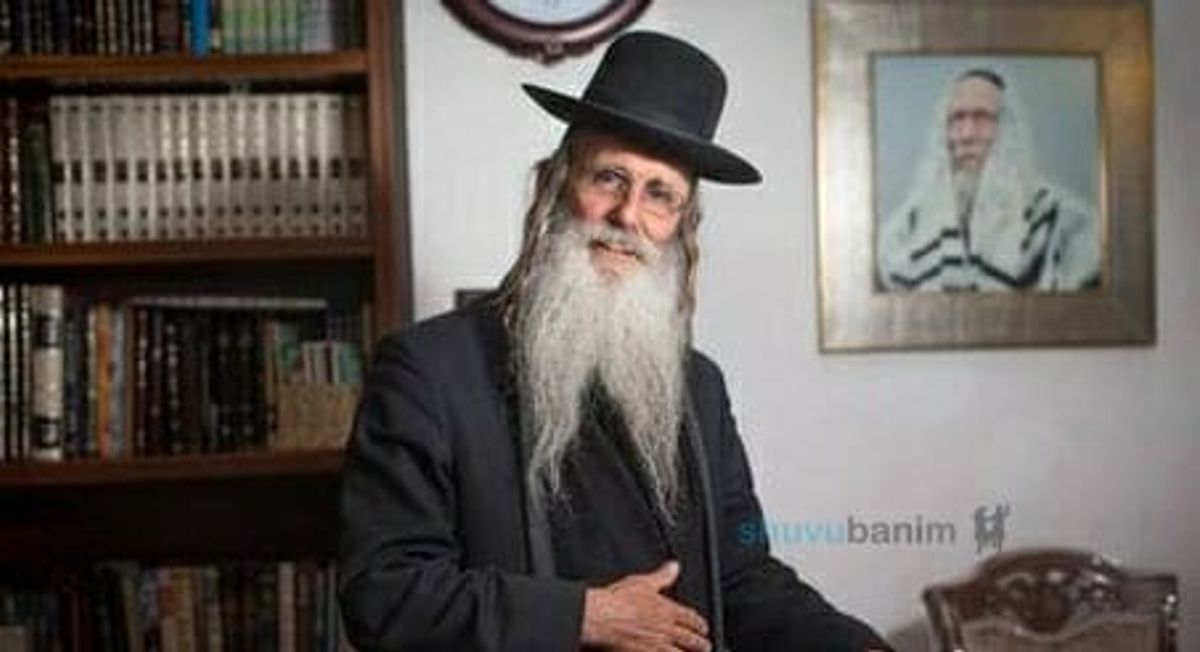
Holy words from Rav Menachem Azulay shlit"a - Parshat Devarim, always before Tisha B'Av, within the "Three Weeks of Straits".
"These are the words that Moses spoke to all of Israel" (1:1). What words? Words of rebuke, but all in allusion, all with the benefit of the doubt. For the places themselves caused them to sin. "The place causes." You are fine, you are wonderful; only the places you passed through caused you to sin, for they passed through the desert, a place of snakes, fiery serpents, and scorpions, and that is what caused them to fail (based on Likutey Halachot, Orlah 4:16). "Eicha" (How) - the cry of Eicha is not a protest, it is a search; it is that eternal cry of a Jew who wants the closeness of Hashem so that this sweetness of Hashem's closeness will give him the strength to overcome all the other things that pull him and distance him from Hashem. Our entire purpose in life is to maintain the connection with Hashem. Only this will fill my soul, only this will truly make me happy. Materiality never succeeds in filling us. If it does, it is only for a moment, and then it disappears and is gone, leaving us with a taste of missed opportunity. The Yetzer Hara is not life.
A person might feel some pleasure, he might feel that he is enjoying himself, but somewhere, in the end, he will feel bad, he will feel emptiness. Everything a person does that is not connected to Hashem hides the light of Hashem from him; it distances him from Hashem. Parshat Devarim is always before Tisha B'Av, within the "Three Weeks of Straits." The Divine soul has a tremendous desire to exit the straits of the body, the straits of materiality. The animal soul wants to sleep, to rest, to eat, and to drink. But in truth, this does not do us good. The Divine soul wants completely different things. It wants to yield, it wants to overcome, it wants to strengthen itself in another matter of holiness. We are constantly between the straits. All kinds of straits. And the hardest straits are routine. We do things without enthusiasm, without excitement, without truly feeling Hashem.
The heart is sealed, there is no feeling of true sorrow for the destruction and the exile. It is hard to feel sorry for a friend who has gone off the path, G-d forbid, so to mourn and cry for three weeks over the destruction and the exile? What does hurt us? Our distance from Hashem. Distance from the Source of Life. There is no Jew for whom this does not hurt. The weeping we cry on Tisha B'Av is a weeping of longing; we cry to Hashem that He should be with us, that finally, we will be connected to Him, because if not, we are connected to other things. We cry because it is hard for us to cry, hard to feel, hard to pray, hard to be happy. We cry for our soul, which has fallen to such low places, a soul hewn from the Throne of Glory and imprisoned within a body with desires, with such low cravings. As long as a person lives, he is in a war. The war of the Yetzer.
Master of the World, help me in this war because alone I cannot. Because without You, I have no chance. A person—the bad thoughts, the bad desires—do not leave him for a moment. Until it seems to him that perhaps he truly has no chance in this war. Perhaps it is really not for him. Our whole life is a struggle. Every single moment. One moment we feel Hashem, and a moment later the body overcomes. Just like what happened to the people of Israel, who after the spiritual elevation of the Giving of the Torah, fell to the Golden Calf to permit themselves immorality. If a person does not work to nullify the Yetzer Hara, it will not leave him. A person knows he has a Yetzer Hara—to be angry, to eat with gluttony, to neglect Torah, to speak lashon hara—what he must do is pray. About every matter of holiness. About every thing that distances and separates me from Hashem. And more than anything, about guarding the eyes, because here is the greatest Yetzer Hara. Prayers from the depths of the heart. With all the intensity. Like a person fighting for his life.
Everything is possible. It is possible to merit good eyes that rejoice in the success of another; it is possible to defeat anger; it is possible to overcome the desire for food, the desire for sleep; it is even possible to guard the eyes. Everything is possible if you walk hand in hand with Hashem. If you do not stop praying and asking. A person must remember: you are not alone. You have someone to turn to. You have a path, a direction; you know that with prayers you can win the war of life. Remember: just as a Jew wants Hashem, so Hashem wants the Jew. Just as a Jew loves Hashem, so Hashem loves the Jew. Even more. This war is filled with difficult trials. But only this way do we merit to rise in spiritual levels and draw close to Hashem, only when we truly break ourselves to do the will of Hashem.
In this difficulty of the trial, a person builds himself. He brings out from potential into action the hidden powers that are within him. Tremendous powers that cannot come to light when everything is going normally and everything is wonderful, but when a trial is presented to him and he stands in it, then he becomes happier, he feels better, he discovers himself as a greater person than he was before. There are many straits in life. Problems with bank accounts, housing problems, many problems of child-rearing, many problems of domestic peace, and many very difficult things; in every Jewish home it is like this. Every minute we have a strait, every minute we have a trial, every moment we have some suffering, but what do we say? "All her pursuers overtook her between the straits"—there are also attainments, there are not only straits. All the straits are vessels for attainments of Divinity. Every single strait is a wonderful vessel to draw close to Hashem. Suddenly, the person feels that Hashem is so close to him; he feels that Hashem is holding his hand, not leaving him. "It is so hard for me, but Hashem loves me within this difficulty, Hashem is with me, walking with me from place to place, He is with me all the time." Why? Because I am between the straits. Within the troubles, within the constraints, within our straits, we discover the mercies of Hashem. We discover the kindness within the judgment.
If there were only kindness here, we would treat it as something taken for granted, something we deserve, there is nothing else. But when everything is hard, when every moment is another trial, then there is no choice but to flee to Hashem, to increase in prayers, and an abundance of prayer is already attachment to Hashem. Tisha B'Av is a day that drains into it all the sorrow and pain that the Jewish people have experienced in the thousands of years of their existence. It is not mourning of grief, of despair, of bitterness and disappointment, G-d forbid; it is a cry of hope, of faith, of yearning and longing. This crying is something wonderful, like all the wonderful ways of Hashem. We cry for the Holy Temple that is no more, because when it existed, a Jew would enter there and immediately receive wonderful knowledge, offer a sacrifice, and immediately feel so close to Hashem; for this we cry. We cry for the fact that even the light of the tzaddik is also gone, it too is hidden from us: "For when one desires his own honor, then he cannot draw close and benefit at all from the light of the tzaddik, and sometimes he even becomes an opponent, especially now, in these generations, where the point of truth is very despised" (Otzar HaYirah, Bein HaMetzarim 2).
"Eicha" (How) is a cry of yearning and searching for a Beloved who has distanced Himself. The pain within it stems from the depth of love. Even if the separation is so long, the longing has not weakened; it continues to grow stronger. A Jewish soul yearns to be released from the straits of the body, from the boundaries of materiality. It wants completely different things; it wants the Infinite. How do we attain the Infinite? The Holy Torah in Parshat Devarim gives us the answer: unconditional love.
There are Jews whose love for every single Jew knows no bounds. They always know how to judge a person favorably. The patience they have for everyone, the honor they show every person, is a true sanctification of Hashem. They live with this knowledge that everyone is a child of Hashem, that every Jew is a part of G-d above, and to know that Hashem is also found in one's fellow is a very high level. Moses our Teacher lists in Parshat Devarim all the places where Israel angered their Father in Heaven, but this is not a piercing rebuke; it is a rebuke said with caution and gentleness. Everything in allusions, so as not to hurt them. For example, a place called "Di Zahav" comes to allude to the sin of the Golden Calf and so on. "He obscured the words and mentioned them in allusion, for the sake of the honor of Israel" (Rashi). Judaism in its beauty. The main thing is not to shame a person. The main thing is to guard his honor.
The days of the "Three Weeks of Straits" are days in which one must strengthen oneself in the commandments between man and his fellow, for the Second Holy Temple was destroyed because of the sin of baseless hatred, and what will bring us the Geulah is baseless love. Ahavat Yisrael (love of Israel) is first and foremost to draw people close to Hashem. Life must be a journey of drawing hearts close to the Father in Heaven. No one is exempt from this mission. Each in his own way. "For these I weep," for so many Jews who are far from the light of Hashem, from the light of the Torah, from the light of faith. "These are the words that Moses spoke to all of Israel." Moses our Teacher speaks to all of Israel. He knows the truth, that there is no such thing as a Jew who does not want Hashem, that it is possible to reach every single Jew. The Holy Torah demands of us much internal work. You cannot love the Father and so easily dismiss His children. You must begin to look with good eyes at every single child of the Holy One, Blessed be He, and find his special beauty, the thing that only he can do for the honor of his Creator and no one else can do in his place.
We have so much to do with our own private house-cleaning, so why are we constantly busy seeing unseemly things in others?! This is what the holy Baal Shem Tov said: "A person sees all blemishes except for his own blemishes." A person only forgets that if he saw an unseemly thing in another, surely he also has some of that same kind. With the Holy One, Blessed be He, it is all one. "It does not interest Me. With Me, you are together. It does not matter to Me who you are. You are the greatest man of the generation or you are a woodchopper or a water-drawer. With Me, you are all equal, I am the Father of all, I have no preference for the second even if he is more talented and more successful and more of a tzaddik."
The Holy One, Blessed be He, created the world out of His mercy. He wants a world where we will feel His mercy. And how will we feel mercy in the world if we do not begin to have mercy on one another? If we do not learn to step out of ourselves a little and begin to look around, to see where we are needed. We need to help everyone, to love everyone; this is such a minimal, simple, and existential thing; one does not even need to say words of Torah about it. There is nothing that draws us closer to Hashem than love of one's fellow. You say a good word to another, you do a kindness with him, the Shechinah immediately jumps, it is found between you. Between man and his fellow and between man and his Creator, it goes together. You reveal the Creator in the "good morning" that you say to another, in "blessed be you," in an encouraging smile, in a pat on the back, in every manifestation of love, of honor, of consideration for the other.
Whoever wants Hashem to dwell in his heart cannot ignore his brothers. Because giving is joy, and joy is the Holy Shechinah; the Shechinah does not dwell except through joy. With the relationship between man and his fellow, one receives a heart. We build a sanctuary inside the heart. We love You, Father, we love holiness, we love the Torah, we love to live within a community of those who fear Your Name, we love these wonderful moments that we feel You, suddenly we want to cry, we want to pour ourselves out before You within the holy words of prayer, within our own private words, suddenly we see a miracle, suddenly we feel You within all our troubles, suddenly we feel You within the heart. On the day that is next week, the great day of the 15th of Av, a day about which it is said: "There were no better days for Israel than the 15th of Av and Yom Kippur" (Masechet Taanit). Our teacher the Rav: ["If a person believes in what the Sages say, then now, the 15th of Av, is truly Kol Nidre."
Only instead of fasting and saying Selichot, they gave us juice and cake so that we would have a happy Yom Kippur. The gates of heaven are open. Every person can receive today holy eyes, a holy mind; everyone can from today merit everything that is possible to merit on Yom Kippur. Just keep your head. Remember that it is Yom Kippur. Although they do not close the stores and cars are driving in the street, a person must remember that he is now with the Holy One, Blessed be He. Today they are distributing minds, distributing hearts; a person regrets, does teshuvah, cries out to Hashem: "I am tired of forbidden desires, I am tired of forbidden thoughts," then Hashem will give him a new heart, a new mind. Today it is possible to exit all the falls, all the failures, all the nonsense, all the imaginations.
A day in which they give a person tremendous powers, they bring down for him a new soul, a new mind, new eyes, a day of forgiveness of sins through songs and dances, we increase in joy and dances and sins are forgiven"] (up to here, our teacher the Rav). Shabbat Chazon is not just the Shabbat before Tisha B'Av. Shabbat Chazon opens our eyes. Chazon (vision) is a term for prophecy. We see the Geulah from up close. Within the exile is the Geulah. "Raze it, raze it to the foundation." Although they destroyed the Temple, it was only to the foundation. To the foundation they did not reach. The bricks can be destroyed, not the souls. The people of Israel and every Jew personally has a covenant with the Creator of the world. It is an eternal bond that cannot be nullified. All this we see on Shabbat Chazon. A Shabbat that is the closest to the Geulah. The general and the personal.
Subscribe to Our Newsletter
Receive Torah articles and inspiration directly in your inbox