
The Main Thing is to Connect Oneself to the Tzaddik of the Generation
Rabbi Avraham Chanania shlit"a
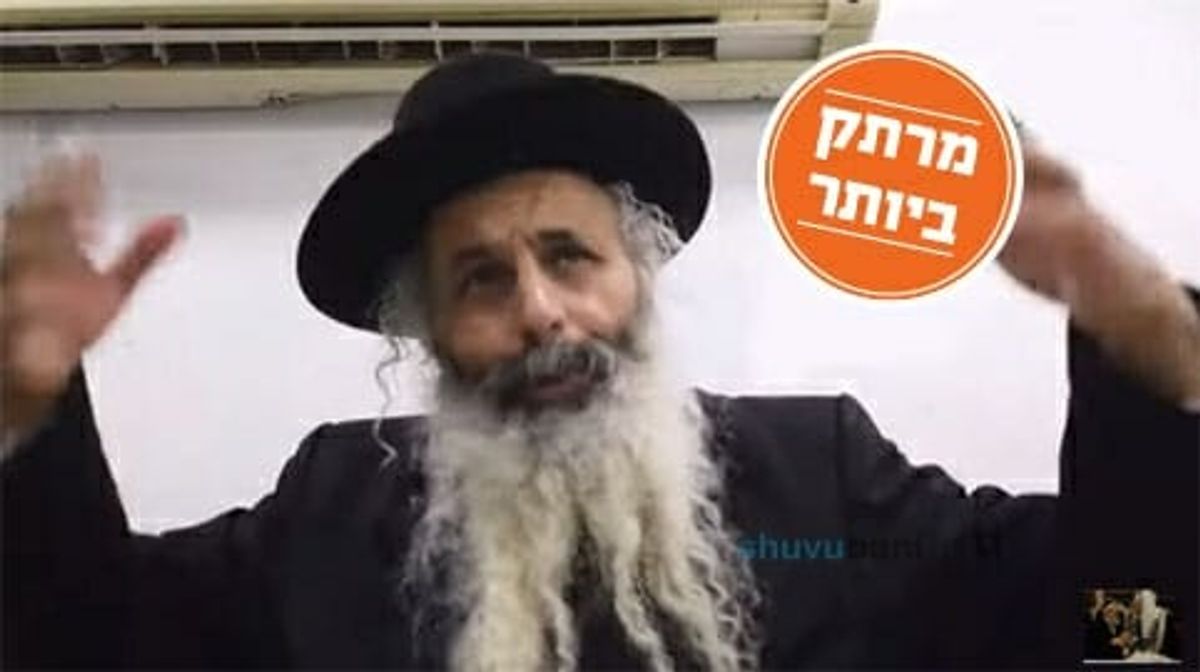
Rabbi Avraham Chananya shlit"a, one of the veteran students of our teacher, the holy Rav Eliezer Berland shlit"a, arrived at the Netzach Netzachim Yeshiva in Jerusalem and delivered holy words regarding the importance of drawing close to the tzaddik.
Strengthening pearls from his words:
"Rebbe Nachman says (Torah 123, Likutey Moharan - To connect oneself to the tzaddik of the generation), 'The main thing and the foundation upon which everything depends is to connect oneself to the tzaddik of the generation and to accept his words regarding everything he says, whether it is a small matter or a great matter, and not to deviate, Heaven forbid, from his words to the right or to the left.' A person truly wants to emerge from their desires; they understand that the truth is in Judaism and search for an opening for salvation, but the evil inclination fights against the person. And Rebbe Nachman says (in the aforementioned Torah) that to emerge from desires is possible only through a true connection to the tzaddikim - because only through the power of one who has emerged from this can he extract us."
"'And they believed in Hashem and in Moshe His servant' (Exodus 14:31). Reb Noson says that it is possible to believe in Hashem only if one believes in Moshe His servant. And likewise, it is written in the Zohar that the 'extension of Moshe' exists in every generation (Tikkuney Zohar 69); the soul of Moshe Rabbeinu is drawn down and extends into every generation until he rectifies us all, with Hashem's help."
"Reb Noson writes (Likutey Halachot, Berkat HaRei'ach, Halacha 4) that 'a commandment is a lamp and the Torah is light,' meaning that the Torah and the commandment are the light and the lamp that allow us to discover this tzaddik who can and must draw us close to Hashem. For regarding the search and revelation of Hashem, it is written, 'For he who finds Me finds life' (Proverbs 8:35). But in truth, Hashem is the Infinite One, blessed be He, as Reb Noson says (ibid., Halachot Pesach 6), that Hashem is exalted and elevated far above our intellect, and it is impossible to attain faith except through the tzaddik. Just as an infant cannot understand a complex reality, we too need the tzaddik to condense the concepts of Divinity for us. The tzaddik reveals to us and implants within us that Hashem is close to us and that He hears us."
"The tzaddik merited closeness to Hashem after he cut himself through toil and self-sacrifice in the service of Hashem, and he refined his body like tanned leather that has no scent of this world. Therefore, he can instill faith in the entire world, not just in the people of Israel. As Rebbe Nachman writes (Likutey Moharan 188), the tzaddik first finds his own lost objects until he eventually finds the lost objects of the whole world. He knows the work of everyone in the world, what their incarnations are, and what they came to rectify in the world; therefore, when one comes to the tzaddik, they receive their lost objects."
"I once asked our teacher, Rav Berland, about what Rebbe Nachman says in this Torah, that the tzaddik does not return a person's lost objects to them until he verifies that they are not a liar or a cheat. And I asked, 'But these are the person's own lost objects!' Rav Berland answered: 'If a person always works on having a good eye, through this, one receives all the lost objects from the tzaddik.' For to be a student of Avraham Avinu, of the tzaddik, one must pray and ask to merit a good eye. And the Rav said that Elijah the Prophet merited what he did because he prayed for every Jew to have all the good in the world."
"Rabbi Tzanani told me that one also receives the good eye from the tzaddik, as Reb Noson says that the main thing is that a person should not be a fool, that he should continue to ask Hashem for a good eye."
"In order to enter the gates of teshuvah (repentance), one must pass through many transitions, ascending and descending. Our teacher, Rav Berland shlit"a, said that the main test is not to leave him. Rebbe Nachman said this in Sefer HaMiddot, that we are all before the tzaddik like a pen in the hand of the scribe; he raises and lowers - the main thing is not to fall in our minds and not to leave the tzaddik."
"The tzaddik literally enters within us; this is called emerging from the 'serpent,' to feel that I truly do not do anything. He prays from within you, he lifts you up; we only need to remember that it is not we who are acting, to emerge from the serpent, from pride. Our teacher, Rav Berland, taught this 30 years ago in Likutey Halachot (Re'iyah 4), that the tzaddik lowers a person like a diver into the depths of the sea, and when he raises him, many stones and precious pearls rise with him that could only be brought up by that person."
"The tzaddik lowers the person intentionally in order to extract him from pride and from the illusion of 'my strength and the power of my hand.' And when the person finally ascends, he merits humility and knows that it is not he who is acting."
Subscribe to Our Newsletter
Receive Torah articles and inspiration directly in your inbox