
The Power of Prayer and Supplication
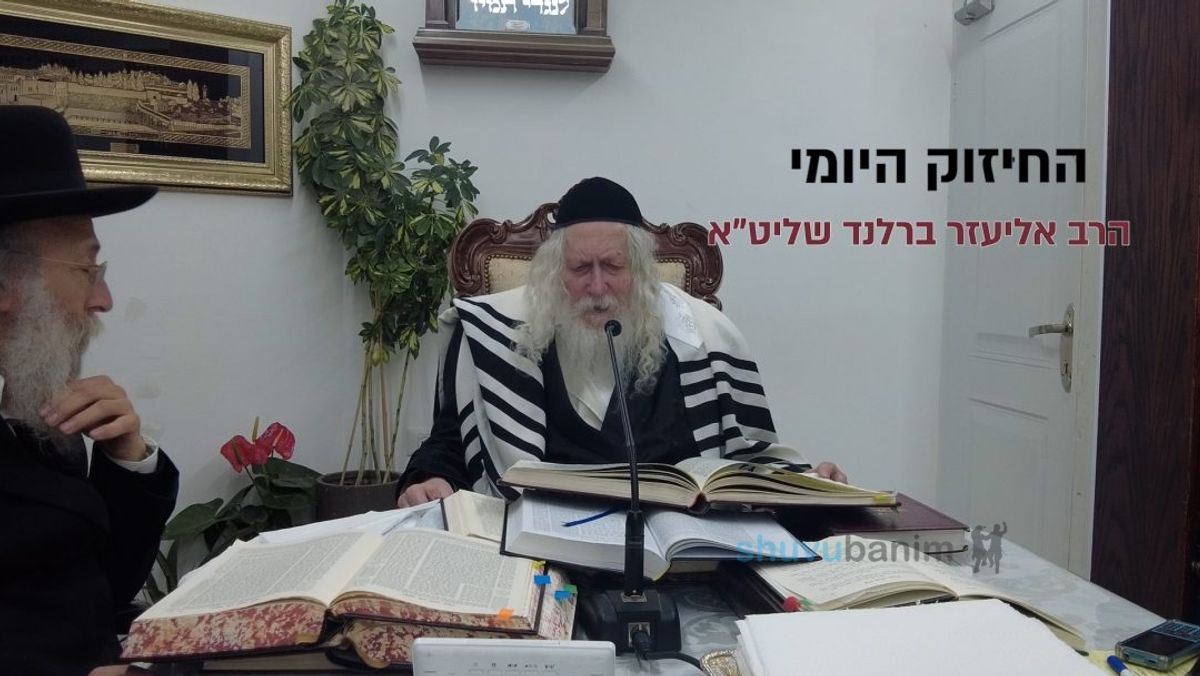
The Daily Strengthening from the Gaon and Tzaddik, Rabbi Eliezer Berland shlit"a
It is brought in the Midrash Kohelet (Kohelet Rabbah, Parsha 9, Section 7) regarding a simple Jew named Abba Tachna Chassida, who arrived at his home on Erev Pesach (the eve of Passover) carrying a package for his family.
In the past, there weren't shoes like there are today; people would walk barefoot all winter in the snow—after all, it snows in Jerusalem. Everyone was barefoot, and he brought shoes for the children in honor of Pesach (Passover), in honor of the Seder night.
The Daily Strengthening from the Gaon and Tzaddik, our teacher Rabbi Eliezer Berland shlit"a (may he live long and good days) – Tuesday, 19th of Sivan, 5784
Five minutes before he reached the city, at a distance of 5 minutes from the city, he saw a dying man. The man said to him, "I am going to die; bring me into the city, bring me into some house, I am lying here at the crossroads."
Abba Tachna Chassida said to him, "If I bring you into the city, the sun will already set and I won't be able to bring the shoes and clothes to my children, and then they will be barefoot all winter."
https://vimeo.com/967359735?share=copy
The man said to him, "Either you bring me into the city or you don't; I am already in the final minute of my life."
Well, Abba Tachna said, "Fine." He threw the package with all the shoes among the bushes, placed the man on his shoulder, ran with him into the city, and brought him into the first house.
Meanwhile, it had already become dark. It wasn't like today; there was no light at all. Darkness then meant the "Darkness of Egypt." “And the darkness was felt” (Exodus 10:21)—one could actually feel the darkness.
Abba Tachna saw it was already dark and said, "I must bring the package home." He thought, "It doesn't matter [what people think], my children are hungry, barefoot, and it's the Seder night." He ran between the bushes and retrieved the package. All around was total darkness, the Darkness of Egypt, and he ran with the package.
Suddenly, the public saw Rabbi Abba Tachna Chassida running with a package. The man considered the most pious was running with a package on Shabbat (Sabbath) inside the city; he was running and it was already dark, stars were already visible.
Abba Tachna ran and ran, and everyone was shouting: "Abba Tachna desecrated Shabbat! Abba Tachna desecrated Shabbat!" And not only that, he himself felt this way. He arrived home and burst into tears, saying, "I should have just left my package among the bushes."
At that very moment, Hashem performed miracles for him—while he was crying inside, "I desecrated Shabbat, I desecrated the holiday, I desecrated Pesach," at that same hour, the Holy One, Blessed be He, caused the sun to shine... as it is written (Malachi 3:20): "But for you who fear My name, the sun of righteousness shall shine."
And the question is asked: For such a person, who overall only knew how to say Techinos (supplicatory prayers)—he was "just" Abba Tachna, not a great scholar (Lamdan), not a great genius (Gaon), he only said Techinos—for him, Hashem caused the sun to shine anew?
That for the simplest Jew [such a miracle would occur]? It is written: "Hillel the Elder had eighty students (Sukkah 28a), thirty of whom were worthy that the sun should stand still for them." Those thirty who were like Moshe (Moses) could certainly move the sun, for Moshe moved the sun five times: during the war with Amalek, with Sichon, and with Og (that makes three), at the Giving of the Torah (Matan Torah), and on the day of his passing (histalkus).
On the day of his passing (histalkus), Moshe wrote 13 Torah scrolls: 12 Torah scrolls for each of the tribes, and one more Torah scroll for the Holy of Holies (Kodesh HaKodashim).
Subscribe to Our Newsletter
Receive Torah articles and inspiration directly in your inbox