
"The Red Heifer - In Every Prayer a Person Turns to Ash" • The Daily Lesson from
the Gaon and Tzaddik Rabbi Eliezer Berland shlit"a
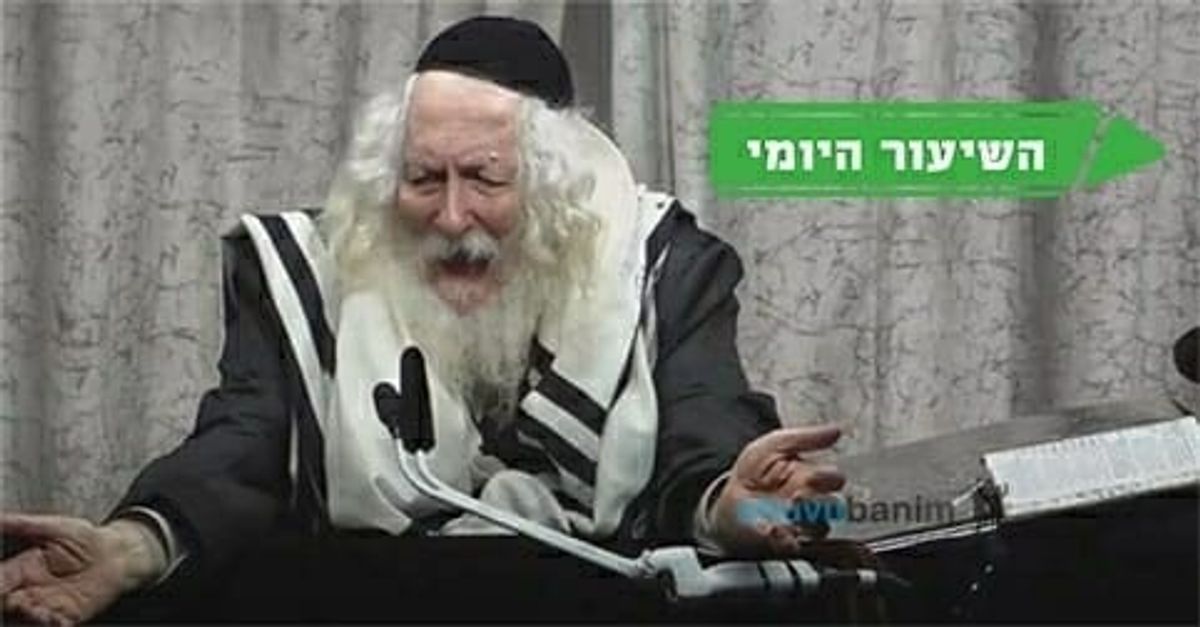
Before you is the full daily lesson as delivered by our teacher, the Rav, Rabbi Eliezer Berland shlit"a - yesterday after the Maariv (evening) prayer, Wednesday, Parshas Tzav, the night of the 18th of Adar II:
"So now we are in [the week of] Parshas Parah Adumah (the Red Heifer); in two days we will read about the Red Heifer. On Purim, we become the Red Heifer. Rebbe Nachman says in Torah 55 that the 'Parah' (cow) refers to the cow turning into ash, meaning that in every prayer a person turns to ash. Every prayer where a person disconnects from all foreign thoughts—from the Xiaomi, from the smartphone—he turns to ash; he feels that he is nothing. Like Rabbi Zira who was 'slaughtered' in honor of Purim (a Talmudic reference to the intense spiritual experience of the Purim feast). Rabbi Levi Yitzchak [Bender] said he wanted to be buried immediately, because the deceased cannot bear it when everyone else is dancing and singing while he lies there like a corpse. This cannot be; he is fed up with being dead. He says, 'Why am I dead? I am lying like a corpse, I can't dance, I can't do anything.' He wants to be buried immediately, so why does it say 'the next day'? Why is he buried the next day? Because this is Shuvu Banim (Return, O children)... Shuvu Banim buried him the next day, that's what he did the next day. But it is forbidden to bury the next day; one must bury on the same day. So why is it written 'the next day'? In Megillah 7b—I don't know what is written in your [tractate] Megillah—is it written there that he buried him the next day? In Shmuel Isaac's version, it says he buried him the next day. In yours, I don't know, maybe they buried him on the same day. So why the next day? Why the next day?
[Rather] he knew that on Shushan Purim it is possible to revive the dead. Therefore, he studied the laws of libun (purifying vessels with white-hot heat) with him, for thirty days before Pesach (Passover) we study the laws of libun. We need to purify all the vessels, and therefore he studied with him about a white-hot knife. Thirty days before Pesach—that is why he left him until the next day. He said, 'Tomorrow is Shushan Purim, it is possible to revive the dead.' Because on Pesach we read about the Resurrection of the Dead. Now, during the thirty days between Purim and Pesach, it is possible to revive all the dead.
For Yael could revive the dead, and Deborah could revive the dead. Once, every daughter [of Israel] knew how to revive the dead; they would all fly in the air—from Tzipori they flew in the air, from Kfar Shamai they flew in the air, from Beis Hillel they flew in the air, from Shlomi they flew in the air. Out of their intense desire to pray, they did not give up on any prayer; every prayer they would fly in the air, out of the intense desire to pray at the Kotel (Western Wall), to pray in the Beis HaMikdash (Holy Temple). They would fly in the air, because a daughter [of Israel] is always flying in the air. Like Deborah the Prophetess who was—Mount Tabor was forty parsas (an ancient measurement of distance), so the height was ten parsas, which is forty kilometers high. So she would fly in the air; who can climb forty [kilometers]? So Deborah flew in the air, and Yael flew in the air. Therefore, when Sisera arrived, he said, 'If they ask you, "Is there a man (Ish) here?" say "Ayin" (none/nothingness),' because she was 'Ayin'—the woman turns into 'Ayin' (nothingness). The woman, in the merit of being a woman, turns into 'Ayin.' She has to work twenty-four hours a day, to be a caregiver, to get up at night, to give a pacifier to the child, to search for the pacifier under the bed when there is no light—Avigdor Liberman doesn't give a budget for electricity, we don't know what to do—so how can she search for the pacifier in the dark? They tie the pacifier but it doesn't help, so she cannot sleep at night or during the day, she has no time to eat. So the woman goes through the seven chambers of Gehenna (hellish suffering); she becomes 'Ayin'—this was Yael, she was 'Ayin.'
Therefore, Yael is the Gematria (numerical value) of Sarah, Rivka, Rachel, and Leah. And the Gematria of 'Blessed among women is Yael' is also—'Blessed shall she be above women in the tent'—this is also David; David was 'impregnated' (spiritually) in Yael. For every woman merits that David is 'impregnated' in her. Every woman [has the power] to pierce Sisera, for the Geulah (Redemption) will only be in the merit of the righteous women who refused to divorce. And even if they did divorce, they did not agree to it. Then Miriam the Prophetess entered the Beis Din (Rabbinical Court) of the Sanhedrin and said: 'Everyone here is divorcing, this cannot be! We are miserable children, a woman and orphans, who will take us? Will the gentiles take us?'. Immediately they canceled the decree; immediately Amram returned to Yocheved, and at that moment all the women returned [to their husbands]. But the sons had already received the death penalty, because they also sinned with the Golden Calf and the Spies; the women did not. It is written, 'And among these there was not a man (Ish)'—all the women continued to live until they entered the Land, up to the age of two hundred.
Yocheved lived until the age of two hundred and fifty. It is written in Chapter 46, Verse 15, that she lived until two hundred and fifty. We just brought the Ramban who asks, 'Is it not enough that it is written she lived until one hundred and thirty, yet you add another two hundred and fifty to her?'. But these are the liturgical poems of Simchas Torah, that Moses came to comfort his mother; his mother lost three children [in the same year]. It is not simple! Three righteous children: Miriam passed away on the 10th of Nissan, and after that Aaron on the 1st of Av. The first thing is to travel to Aaron the Priest; one must travel to Aaron the Priest on the 1st of Av. Today it is past Beersheba, past Yeruham, past Mitzpe Ramon—there is Hor HaHar (Mount Hor), there is a mountain on top of a mountain. Everyone must travel to Aaron the Priest, because Rebbe Nosson says that Aaron did not pass away, Moses did not pass away, and Miriam is alive and well.
And Miriam's Well rotates through all the wells; every Motzaei Shabbos (Saturday night) one should drink a drop of water from the tap, from Miriam's Well, because Miriam is alive and well. 'And I sent before you Moses, Aaron, and Miriam,' for Hashem sent Miriam, because only Miriam brought the water. The water is in the merit of Miriam; until the end of all generations, even when there will be the Resurrection of the Dead, all the water is in the merit of Miriam, because water comes in the merit of the woman. Therefore, in the merit of the woman, the complete Geulah (Redemption) will be soon in our days, Amen!"
Subscribe to Our Newsletter
Receive Torah articles and inspiration directly in your inbox