The Secret of Building the Worlds in the Month of Tishrei and the Mystery of Taking the Lulav
Lesson No. 268 | Tuesday, Parashas Bereishis, Eve of 26 Tishrei 5761
An in-depth discourse on the order of the spiritual work of the month of Tishrei, from Rosh Hashanah until Simchas Torah. The Rav explains the kavanos (spiritual intentions) of the holy Arizal regarding the building of the spiritual stature, the secret of nullifying harsh decrees through the Hakafos Shniyos (Second Hakafos), and the hint hidden specifically in the blessing over the lulav, which is connected to the Resurrection of the Dead.
Our spiritual work during these days is to build the entire spiritual stature. The holy Arizal explains that all the spiritual ascents, beginning from the eve of Rosh Hashanah, are accomplished in the aspect of Rachel. This is the order of the tikkun (rectification): while on the holiday of Pesach we rectify the right arm of the upper worlds, on Rosh Hashanah we rectify the left arm.
All the work from Rosh Chodesh Elul until the first of Tishrei is intended so that we may merit to reach the night after Simchas Torah with a complete spiritual Partzuf (Divine persona), which includes Chasadim (kindnesses) and Gevuros (severities). Rosh Hashanah is the aspect of the right and left arms, Sukkos is the middle column, on Purim we build the left leg, and on Chanukah the right leg.
The Building of the Spiritual Stature from Rosh Hashanah to Yom Kippur
We begin to build the spiritual stature from the head downwards. On the first day of Rosh Hashanah, we performed the nesirah (spiritual separation) of the Kesser (Crown); on the second day, we separated the Chochmah (Wisdom); and on the third day, we separated the Binah (Understanding), which is the aspect of judgments. We continue in this manner day after day throughout the Ten Days of Repentance: the fourth of Tishrei is Daas (Knowledge), the fifth of Tishrei is Chesed (Kindness), the sixth of Tishrei is Gevurah (Severity), and the seventh of Tishrei is Tiferes (Beauty).
When we reach Yom Kippur, we are left to rectify the lower Sefiros (Divine emanations) all at once: Netzach (Victory), Hod (Splendor), Yesod (Foundation), and Malchus (Kingship). On Yom Kippur, the entire stature from Kesser to Malchus is already completed, in order to subdue the eleven chieftains of Esav and to extract all the holy sparks.
Afterward, we begin to build the vessels of the five Gevuros (severities). We build these vessels through the five prayers of Yom Kippur, starting from the night of Kol Nidrei. On Yom Kippur, there are five aspects of affliction (the prohibitions against eating, drinking, etc.), and all these spiritual ascents take place in the aspect of Rachel. Because a man and a woman are a single unit, it is impossible for the wife to fast while the husband does not, and therefore everyone fasts together in order to complete the tikkun (rectification).
The Secret of the Second Hakafos and the Nullification of Decrees
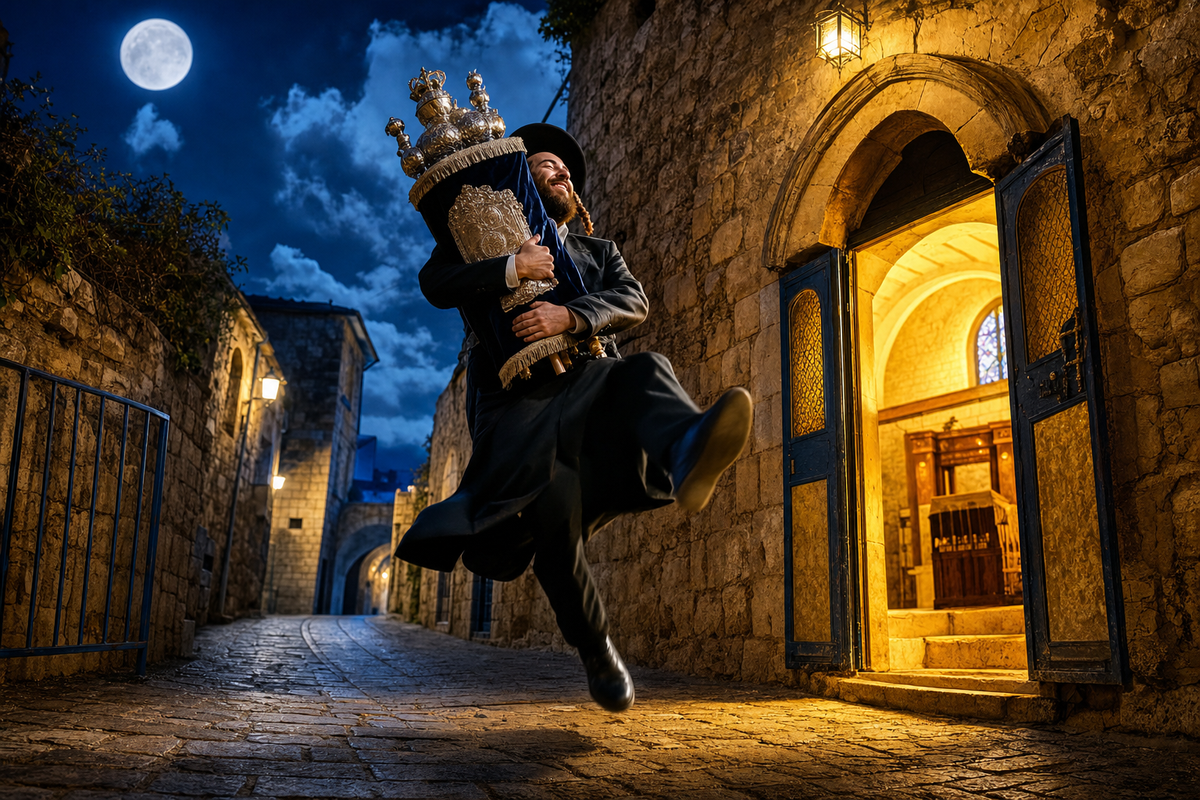
On the day of Simchas Torah, it is customary to take the Torah scrolls out of the Ark and circle the bimah (reading table) with them. The holy Arizal teaches that the Hakafos Shniyos (Second Hakafos) on the night after the holiday are also a true and deeply rooted custom, and not merely a superficial addition. Their purpose is to continue and sweeten the judgments.
Why is this so important? Because on Hoshana Rabbah the decrees are sealed, and on Simchas Torah they begin to hand them over to the "runners"—those angels appointed to execute the unfavorable decrees, God forbid. Therefore, we must constantly dance and make our feet jump in order to nullify the runners on the night after Simchas Torah. We dance until the morning and do not let them depart, because the dancing feet nullify the power of the runners.
The holy Arizal was very meticulous to perform seven complete Hakafos on the night after the holiday. In his time, there was no electricity like today that allows people to dance in one place until the morning, so he would walk from synagogue to synagogue in Tzfas. Wherever he arrived and found them still engaged in the Hakafos, he would enter, circle, and dance with them, in order to increase the sweetening of the judgments.
Surrounding Lights and the Embrace of the Right
The Ten Days of Repentance, from Rosh Hashanah until Yom Kippur, are in the aspect of "His left hand is under my head"—the rectification of the left column. But when the night after Yom Kippur arrives, the love of "and His right hand embraces me" begins to awaken. On each day of the holiday of Sukkos, a different Chesed (kindness) shines: the eleventh of Tishrei is Chesed within Chesed, the twelfth of Tishrei is Chesed within Gevurah, and so on.
When we reach Simchas Torah, the dances are in the aspect of the embrace of the right—"and His right hand embraces me." All the inner and surrounding lights enter into the Yesod (Foundation) and Malchus (Kingship), and this is the secret of the Water Libation and the other mitzvos of the holiday.
The Secret of the Lulav and the Resurrection of the Dead
Here a profound question arises regarding the mitzvah of the Four Species. The Midrash Pli'ah asks: From where do we derive the Resurrection of the Dead from the Torah? And it answers from the verse:
"And you shall take for yourselves on the first day the fruit of a beautiful tree, branches of palm trees, the bough of a leafy tree, and willows of the brook."
What is the connection between the Four Species and the Resurrection of the Dead? Furthermore, there is a tremendous difficulty here: Why do we recite the blessing, "Who has sanctified us with His commandments and commanded us concerning the taking of the lulav"? After all, the esrog is the fruit, it is the "fruit of a beautiful tree," whereas the lulav is merely branches that cannot be eaten at all! It would have been more fitting to bless "concerning the taking of the esrog" or "concerning the taking of the Four Species."
Rather, the Midrash explains, from here is the hint to the Resurrection of the Dead. We now recite the blessing over the lulav and believe that in the future to come, it will be as it is written, 'And the earth brought forth a fruit tree yielding fruit.' In the future to come, even barren trees and branches like the lulav will produce fruit. The blessing over the lulav is our declaration and faith in the Resurrection of the Dead and in the complete tikkun (rectification) of the future to come, for if we had fulfilled the mitzvos properly, with songs, melodies, and dances, we would have merited to see this immediately.
Class No. 268
Subscribe to Our Newsletter
Receive Torah articles and inspiration directly in your inbox